
Monitoring of local elections in Ukraine 2020

From challenge to solution
On 25 October 2020, local elections were held in Ukraine under a new system with so-called ‘open party lists’:
- first, voters select the party they want to vote for on the ballot paper. The list of parties varies from region to region;
- then voters also select a specific candidate from that party.
Rating Group conducted six waves of monitoring of the election results. At the same time, we not only determined the results of the parties in each region, but also compiled (aggregated) statistics: the total percentage of votes received by parties throughout Ukraine.
It should be noted that the elections took place during the COVID-19 pandemic, so it was difficult to conduct offline surveys. But the team found a solution: telephone surveys instead of face-to-face ones.
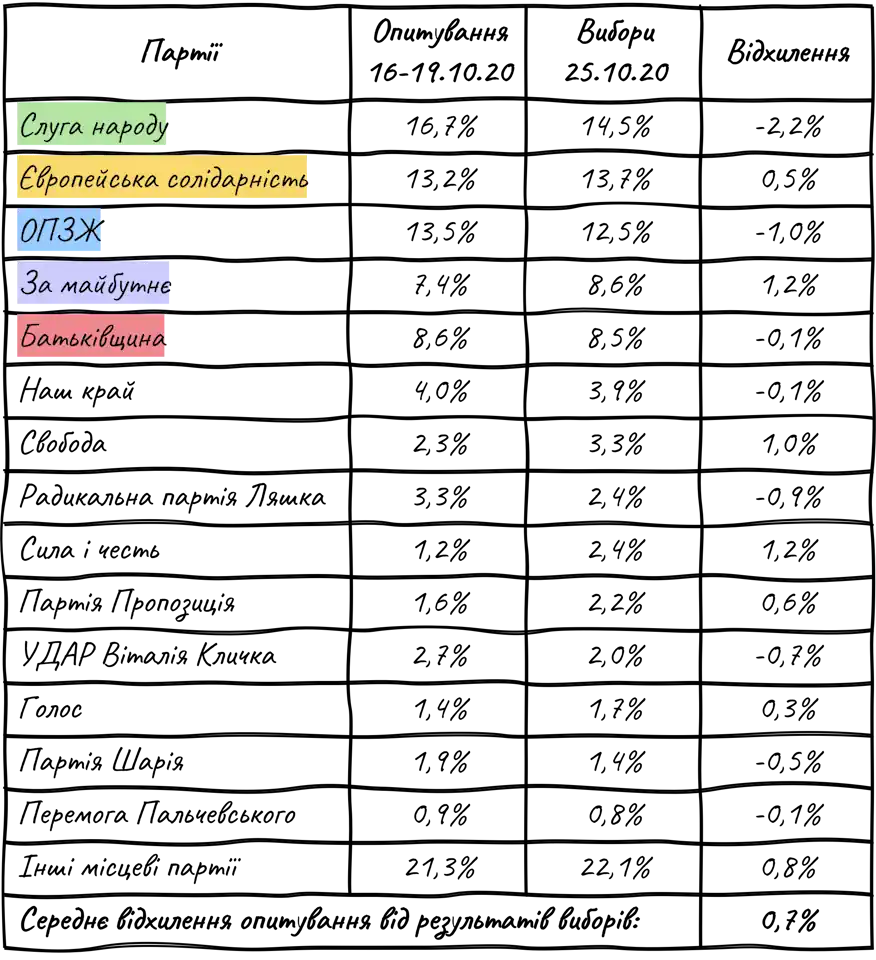
In late October/early November 2020, the Central Election Commission counted the election results. Rating Group predicted the parties' results with an average accuracy of 0.7%.
Methodology
Rating Group conducted six waves of monitoring surveys from mid-September to mid-October 2020. The last wave took place on 16-19 October (elections – 25 October).
We calculated the aggregate rankings of parties in local elections, i.e. the sum of the results of parties in elections to regional councils (in Kyiv – to the city council, in Donetsk and Luhansk regions – to district councils).
The team developed a special election questionnaire for each region. The list of parties in the questionnaire reflected the actual list in the elections in that region according to official data from the Central Election Commission.
In the final wave, for example, we surveyed 5,000 Ukrainians in all regions of Ukraine, except for the temporarily occupied territories of Donbas and Crimea.
The survey method was CATI (telephone survey) using special Rating Group technology. This is a good option for accuracy. It is also relevant for compliance with epidemiological standards in the context of COVID-19.
Elections forecast and monitoring
Effect
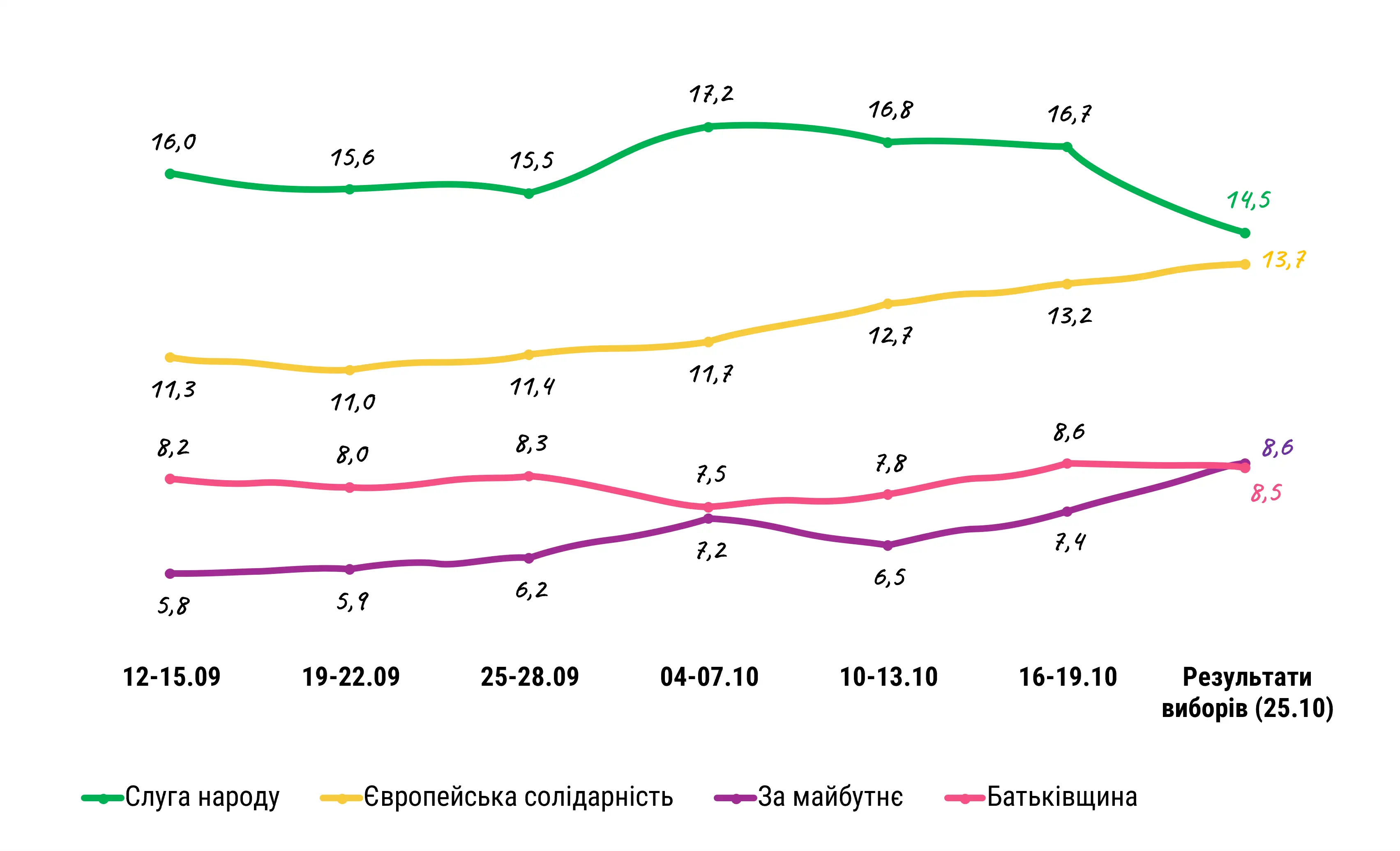
In these elections, it was important to evaluate and contrast national and local party brands as a certain effect of the decentralization reform. And also to answer the question: is the subjectivity of local politicians increasing? We showed this in percentages.
Application of innovative science-based approaches for trend analysis and forecasting.
Reliable regional and national ratings for analysts and experts.
Download full report
Contact form
Let's discuss your research idea
Fill in the form below and we will contact you shortly