04.03.2021
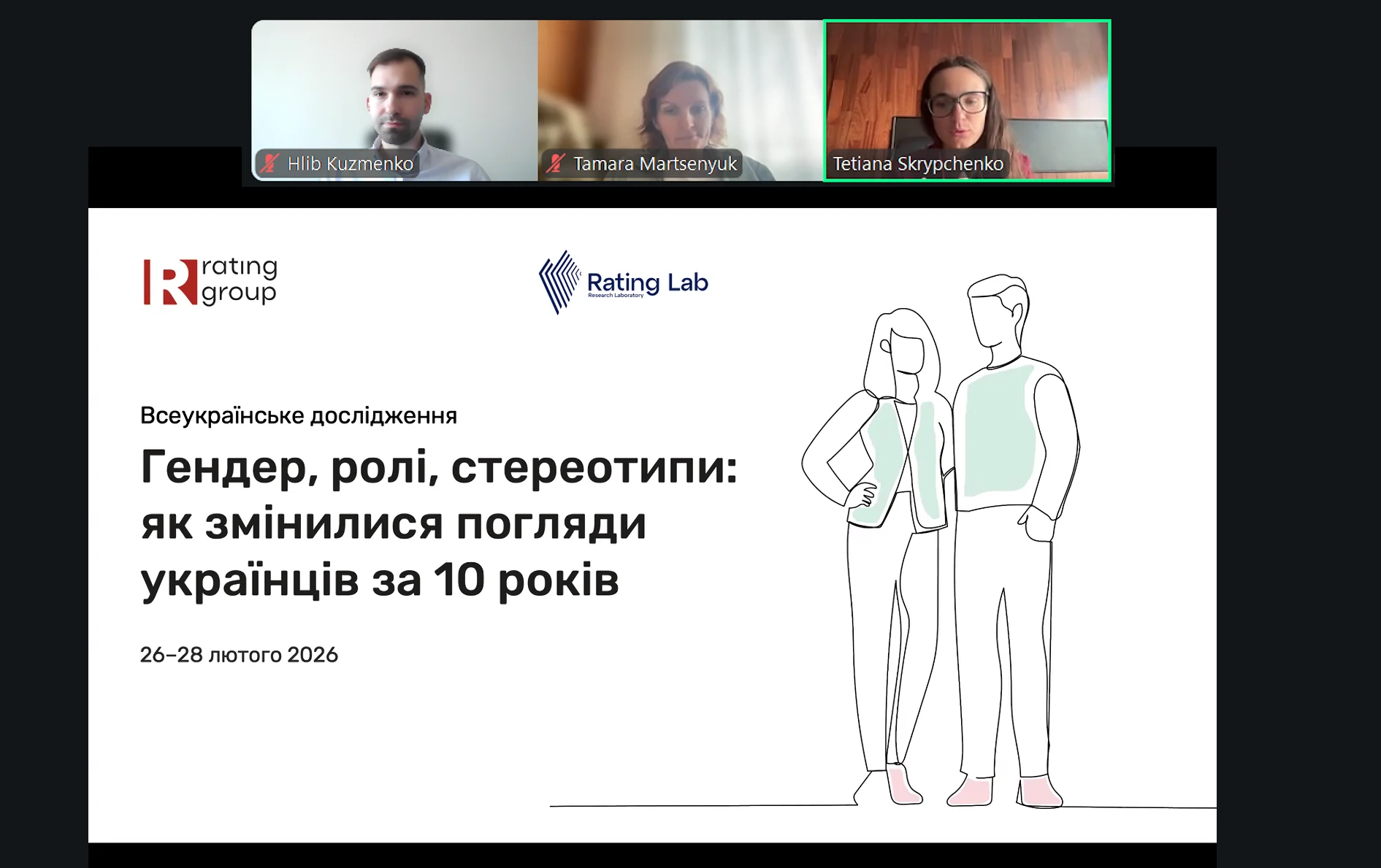
Gender roles and stereotypes
- According to a Rating Group survey conducted in late February 2021, 56% of respondents believed that inequalities between women and men in Ukraine were a rare phenomenon, while 35% were convinced that they were quite common. The latter view was more frequently expressed by women than by men. Over the past five years, there has been a slight increase in the share of those who consider gender inequalities widespread.
- When asked about career advancement opportunities in Ukraine, roughly half of respondents believed they were equal for both men and women. However, one-third were convinced that men had advantages in this regard, whereas only 12% believed women did. Regarding pay opportunities, 45% said men had more possibilities, 43% believed both genders had equal opportunities, and only 7% indicated women had an advantage. In politics, a majority of 54% believed men had better opportunities, 37% saw equal chances, and just 6% pointed to women. Notably, men were more likely than women to claim that opportunities were equal, while women were more likely to say men had advantages. Older respondents were also more likely to believe that men had greater opportunities. Professional, political, and social spheres have long remained male-dominated, so men tend to notice inequality less because it affects them less directly.
- In assessing family life and partnerships, respondents more frequently considered cooking (64%) and household chores (56%) to be “women’s” responsibilities. Between 30–40% said these tasks were shared by both partners, while only 3% believed they were mainly men’s duties. Regarding childcare, half of respondents said both partners shared the responsibility, while 41% claimed it was more often done by women. Thus, traditional role division remains more stable in the family sphere than in the professional one.
- Around half of respondents said that budget management and planning leisure activities were shared responsibilities. At the same time, about one-third stated that women more often took the lead in both financial and leisure-related decisions. Since women typically devote more attention to the household — which is considered their “work” — they are also more likely to manage family resources. The stereotype that “a man manages work, a woman manages the home” remains partially intact.
- Sixty-three percent said their relationship did not have a clearly defined “head of the household,” and decisions were made jointly. Twenty-one percent identified the man as the head of the family, while 14% said the woman was.
- In sexual relationships, respondents most often believed that both partners initiated sex equally (49%). Still, 40% said men initiated more frequently, and only 6% said women did. This reflects broader stereotypes of male activity and female passivity, not only in sexuality but in social roles more generally.
- Two-thirds believed men were the primary earners in a couple. Twenty percent said both partners earned equally, and 13% claimed the woman earned more. Professional achievement is still viewed chiefly as a male obligation and aspiration, giving men more space to earn and face less competition from women.
- Over the past five years, the share of people saying that women more often cook and care for children has gradually decreased. At the same time, more respondents now say leadership in the family is shared by both partners. However, compared to 2015, the share of those claiming that men earn more has risen, reversing the previous trend. As household tasks become easier due to technology and services, they require less time, and new norms of masculinity increasingly include a father’s involvement in child-rearing rather than solely financial provision.
- In matters of cooking, cleaning, and childcare, men often said these were “women’s” responsibilities or shared duties. Women, on the other hand, more frequently stated these tasks fell on them. As women’s employment and professional ambitions expand, they increasingly want to shift part of the domestic workload onto men. Meanwhile, men still often feel their masculinity is threatened by taking on stereotypically “female” tasks, which are routine, unpaid, and undervalued.
- Even though similar shares of men and women stated that budget management, leisure planning, and family leadership were shared, competition in these areas was common. Women were more likely than men to say they managed the money (42% compared to 20% of men). Regarding leisure planning, 39% of women and 30% of men said it was more often their responsibility. In terms of “leadership,” 21% of women and 29% of men said the role belonged to them. Thus, the “struggle” over who is in charge persists and may become even more complex as gender roles continue to blur.
- Although responsibility for intimate relationships was often described as shared, a relative majority assigned the leading role to men — and women said this slightly more often than men did. Earnings responsibility was also viewed as male-dominated, although 18% of women reported earning more than their partner.
- The presence of children influenced role distribution. Respondents with children were more likely to say that cooking was the woman’s responsibility and earning money was the man’s. This traditional model reflects the shift in a mother’s attention toward childcare and a father’s role in financial provision as family expenses grow.
- The COVID-19 pandemic significantly increased the time families with children spent on childcare and cooking. Women especially reported this: 42% said they spent more time on childcare and 34% on cooking. With children at home and often studying online, domestic duties expanded — and because these tasks remain coded as “female,” women’s workload increased as work and home responsibilities merged, contributing to rising stress.
- In “first date” scenarios, respondents more often gave the initiative to men. Fifty-six percent said a man should invite a woman on a date, while 43% said it depended on circumstances. Seventy-nine percent said the man should pay at the restaurant, and 18% considered payment a shared responsibility. This reflects persistent stereotypes that men should be active, financially responsible, and in charge.
- Only 5% accepted sex after a first date, while 44% said it depended on circumstances, and 50% considered it unacceptable. Social desirability likely influences responses, meaning some respondents in the “depends” category may actually be open to it.
- Men and women did not differ much on who should initiate the date, but men were more likely to take on financial responsibility for the restaurant payment, even though 25% of women accepted splitting the bill. Respondents almost never considered the possibility that only the woman would pay. Regarding sex after a first date, two-thirds of women considered it unacceptable, while nearly the same share of men said it depended on the situation. The absence of female initiative reflects social norms around sexual competence: women are rewarded for restraint, while men are expected to be eager and ready for sex, with their masculinity questioned if they do not initiate.
- More than two-thirds of respondents agreed that a man should fully provide for his family, that women’s workplaces involve more conflict, that a woman’s main calling is motherhood, that career success is more important for men, and that women are better at raising children.
- Around half agreed that sex is more important for men and that male friendships are stronger than female ones. Meanwhile, claims that men are better leaders or that women hold more responsibility for unwanted pregnancies received more disagreement, though still supported by 35–40%.
- Respondents were most likely to disagree with statements that a woman must obey her husband, that being a homemaker is full self-realization for a woman, and that men are generally smarter than women. These stereotypes are viewed as archaic and are gradually disappearing as roles transform.
- Over the past five years, support has declined for statements claiming that career success is more important for men, that sex is more important to men, that women are more responsible for unwanted pregnancy, and that women should obey men. Interestingly, respondents from western Ukraine were more conservative regarding gender roles and expectations. These views were also more common among older and poorer respondents. In the gender-age split, significant differences appeared among younger adults (18–35): young men were far more likely to support “patriarchal” views than young women.
- Sixty-eight percent said they would celebrate International Women’s Day on 8 March, while 29% would not. Over the past nine years, the share of celebrants has gradually decreased. The holiday remains most significant for residents of the South and East and for those who are married. In Western Ukraine, nearly 40% said they would not celebrate. Among divorced or unmarried respondents, 35–36% said the same.
Methodology
- Audience: Ukrainian citizens aged 18 and older in all regions except the temporarily occupied territories of Crimea and Donbas. The sample is representative in terms of age, gender and type of settlement.
- Sample size: 1,500 respondents.
- Survey method: CATI (Computer Assisted Telephone Interviews). Based on a random sample of mobile phone numbers.
- The margin of error for the study with a confidence level of 0.95 is no more than 2.5%.
- Fieldwork dates: 27-28 February 2021.
Contact form
Let's discuss your research idea
Fill in the form below, and we will contact you as soon as possible