16.04.2026
Breastfeeding: practices, support, barriers, stereotypes. Survey of mothers, women, doctors in Ukraine

Rating Group (Sociological Group “Rating”) conducted a unique cross-audit study on breastfeeding. We wanted to know how Ukrainian mothers, women, doctors relate to breastfeeding and what experience they have.
To do this, we interviewed three audiences:
- 970 mothers of children aged 0 to 2 years (in particular, 450 — mothers of children aged 0-6 months and 520 — mothers of children aged 6 months to 2 years)
- 792 other women (including women with older children, grandmothers of babies, women without children)
- 220 pediatricians and family doctors who work with children from birth
The authors of the study: Tetiana Skrypchenko, Deputy Director of Rating Group (mother of Solomiia, 1 year old); Marianna Tkalych, CEO of Rating Lab, Doctor of Psychological Sciences (mother of Masha, 17 years old); Anna Makhnitska, breastfeeding and infant sleep consultant, USCARA member, mother of 6 children.
The study was funded by Rating Group.
Important: the study is prepared in order to reflect the views, assessments, opinions, experiences of citizens of Ukraine. The results of the study are not medical advice.
How common is breastfeeding?
Almost 60% of babies from 0 to 6 months are breastfed. Instead, 28% — have artificial feeding (formula), another 14% — on mixed (both formula and breastfeeding at the same time).
Note: the method of primary feeding of the child was studied, additional exclusive feeding (without supplementation or complementary feeding) was not studied.
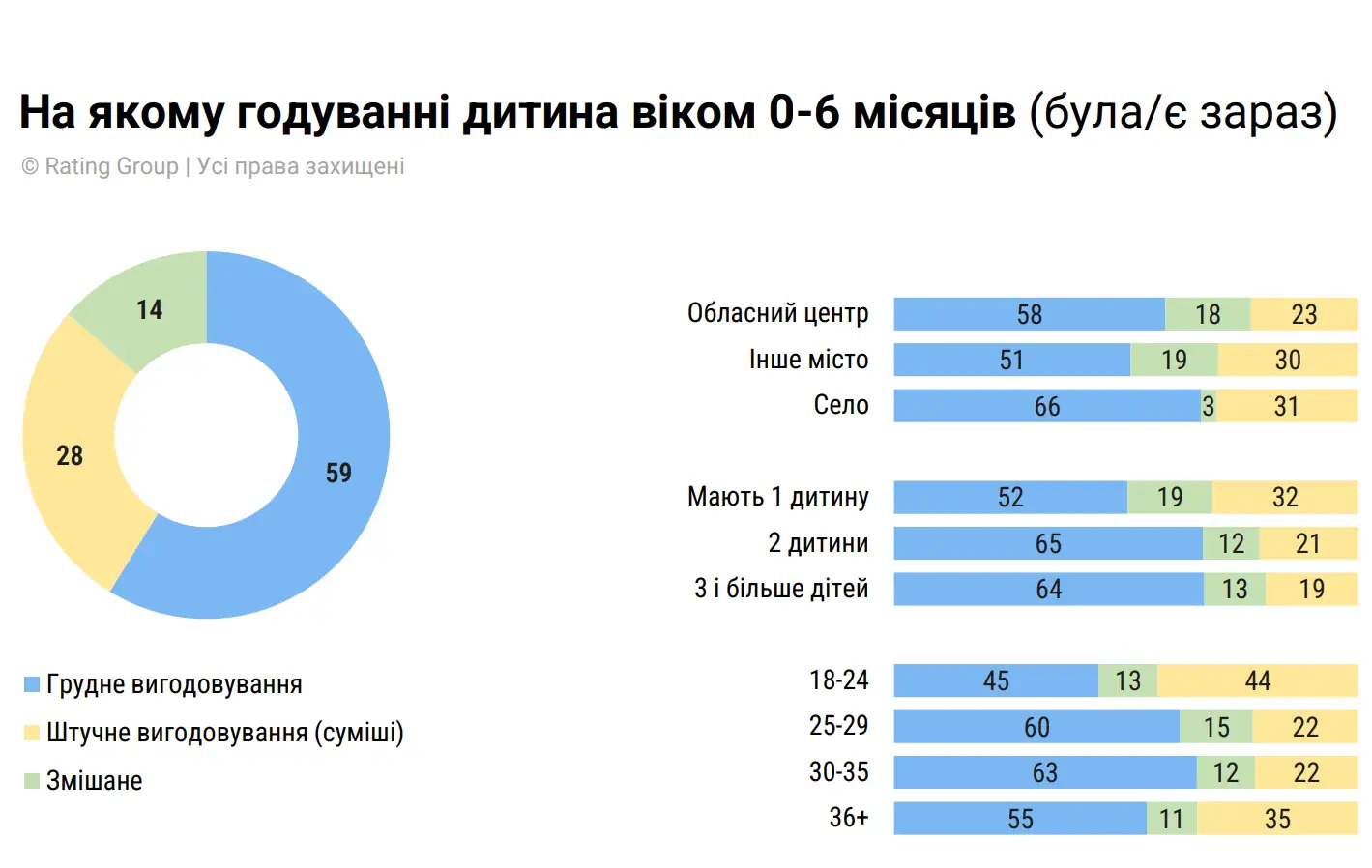
- The lowest percentage of BF — among young mothers aged 18-24 (45%) and women who are first-time mothers (52%). AF is also more common in villages (66%) and regional centers (58%) than in small towns (51%). The financial situation of the family has no connection with the level of BF.
- Most children who were on mixed feeding up to 6 months, after half a year completely switch to artificial feeding.
- 91% of mothers on BF feed their baby on demand. Among those who are mixed, on demand, 71% feed, those who are fully on mixtures - 59% (others feed on schedule).
- Mixed-fed babies are significantly more likely to use the dummy (45% — constantly use) than those on mixed (18% use constantly) or exclusively on BF (11% constantly use).
Feeding ideas
We asked respondents to rate which feeding — breastfed or artificial — was better according to various criteria.
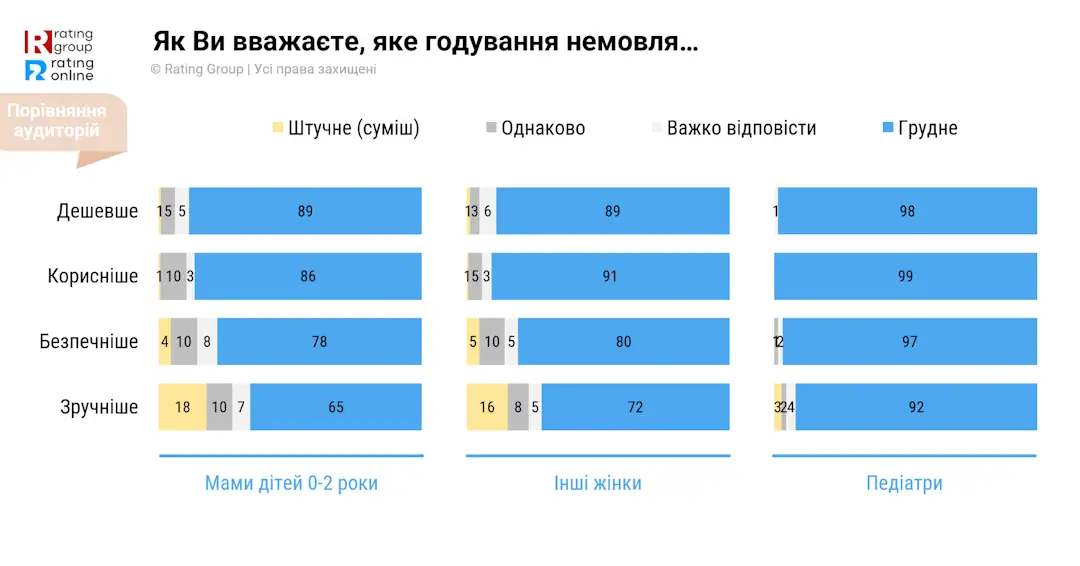
Among all audiences, the idea prevails, that breastfeeding is a cheaper, healthier and safer feeding option than a mixture.
At the same time, opinions are divided on convenience. In particular, for mothers on suture mixtures seem more convenient than breastfeeding.
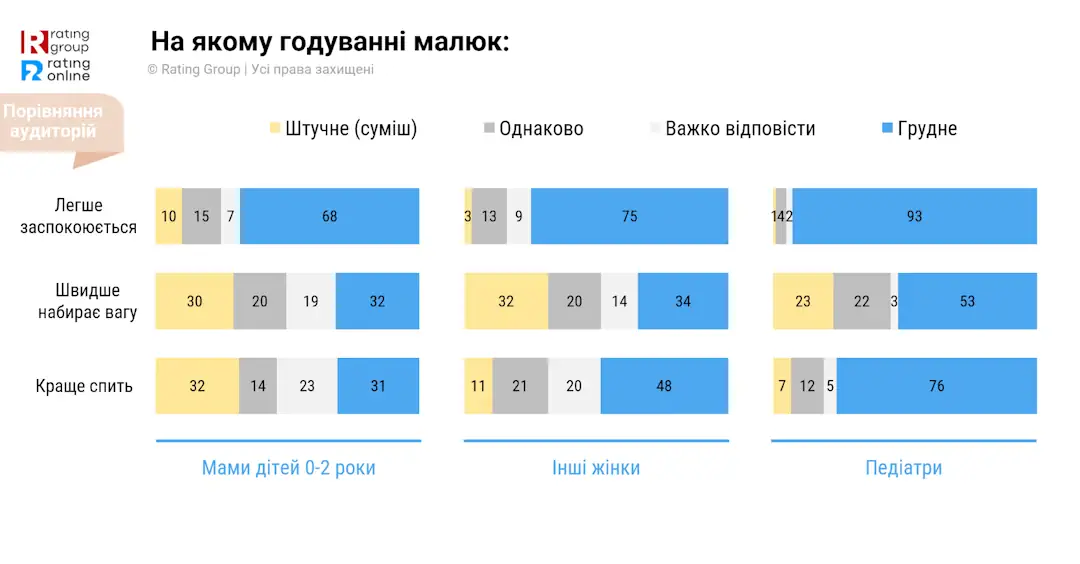
- On what feeding the baby calms down more easily: most believe that on BF (68%). The exception is mothers on AF, who in this matter often do not see the differences between AF and BF.
- On what feeding the baby gains weight faster: here half of the other women, and even almost half of the doctors answered that the child can gain faster on mixtures or that there is no difference between the mixture and BF in terms of weight gain. In part, even the mothers on BF also agreed with this.
- When the child sleeps better? Among mothers who are on AF or mixed feeding, half answered that they sleep better on the mixture, the rest opted for the option that it is the same or that they do not know. Even mothers with BF doubt this question: at least a quarter of them believe that the baby can sleep better on the mixture, most of them also could not answer.
- If compare expressed breast milk and formula, the majority of respondents clearly prefer breast milk from both mothers (77%) and other women (76%) and doctors (99%). At the same time, for mothers whose baby is on formula, the advantage of expressed milk is not obvious, almost half of them believe that the mixture is the best option (46%).
- Against this background, an option milk from a can of breast milk looks less familiar and understandable to respondents. In this comparison, the mixture is perceived as more familiar. For mothers on BF, milk from a can of breast milk is still better than a mixture, but for mothers on mixed - 50 to 50. And according to moms on the mix, the mixture is definitely the best alternative to milk from a can of breast milk.
Stereotypes, myths, public pressure regarding breastfeeding
Stereotyping support
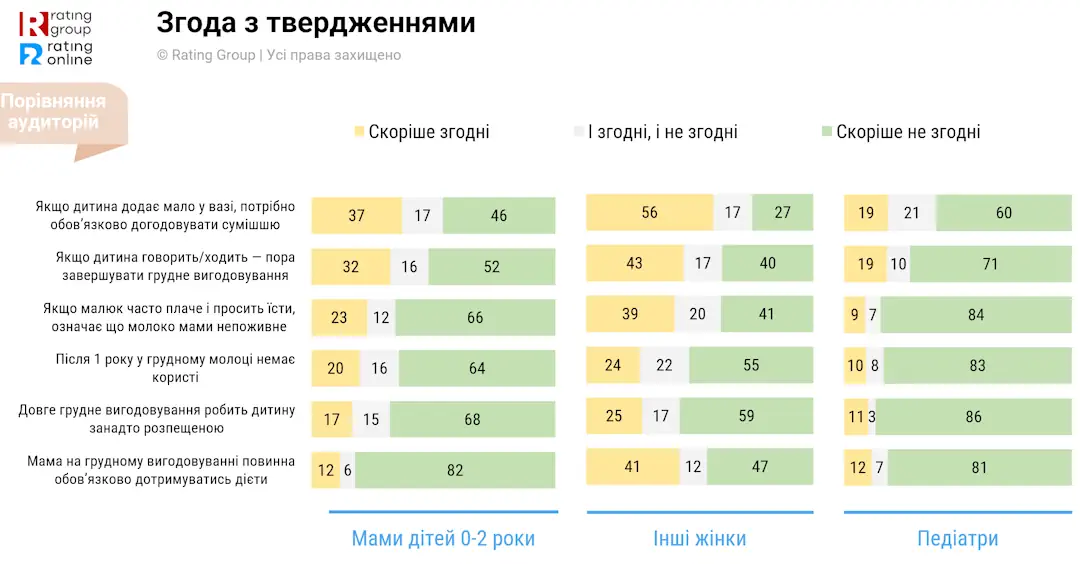
A block of statements about breastfeeding shows that anti-BF myths are not dominant, but noticeably present. Doctors mostly disagreed with all the statements, however, among other women, many myths are partly widespread.
“If the child gains little weight, you need necessarilytop up with a mixture”
This thesis received the most agreement: about 40% among mothers, almost 60% among other women and about 20% among doctors.
“If the baby talks/walks, it's time to complete breastfeeding”
A third of mothers, almost half of other women and about 20% of doctors agreed.
“If the baby often cries and asks to eat, it means that the mother's milk is not nutritious”
This is what 23% of mothers and almost 40% of other women believe.
“After 1 year, there is no benefit in breast milk”
20% of mothers and 25% of other women agreed.
“Long breastfeeding makes the baby too spoiled”
17% of mothers and 25% of other women agree.
“A breastfeeding mother should definitely follow a diet”
This is the statement where we see the greatest gap between the responses of mothers and other women. Among mothers, this is the least popular myth, but among other women, almost half are sure of it.
Differences by groups:
- Moms who are on BF, for the most part did not agree with any statement. In contrast, women on mixed or mixtures were significantly more likely to share such views.
- For example, with the statement “if the child gains little weight, it is necessary to supplement with a mixture” 60% of mothers on a mixture or mixed agree, while among mothers on BF - only 28%.
- “If the baby often cries and asks to eat, it means that the mother's milk is not nutritious” - also half of the mothers on the formula and a third of the mothers on the mixed one are convinced of this, while the mothers on the BF did not agree with this.
- Regarding other audiences of women: in general, all stereotypes are more common among grandmothers who have young grandchildren and may be trying to transmit these ideas to their children. Also, stereotypes are more common among women who do not have children at all.
- For example, if mothers do not agree that it is necessary to follow a diet on BF, then among grandmothers almost 50% are sure that a diet must be. The same proportion agreed with the statement among women without children. In general, among these two categories, there is also the most negative attitude towards long-term breastfeeding.
BF in 1-2 years: supported or condemned?
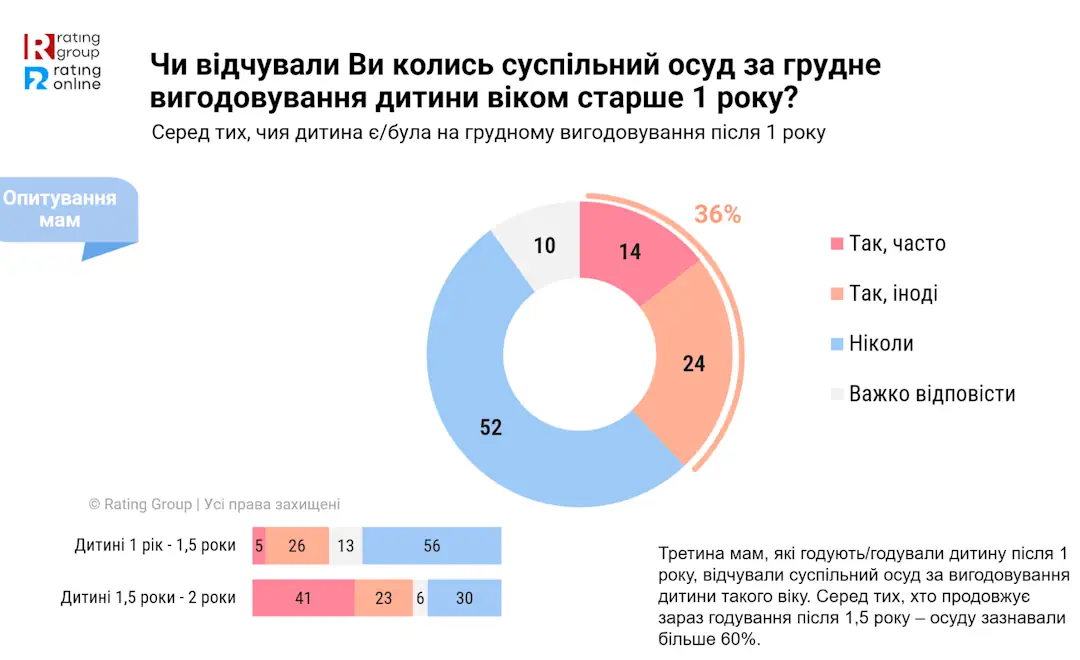
- Among mothers whose child was or is breastfed after 1 year, 36% felt public condemnation for it. And the longer they continue, the more condemnation they feel: for example, among those who continue feeding after 1.5 years, more than 60% have already experienced condemnation.
- Among the residents villages every fourth mother who breastfeeds after a year often faces condemnation for prolonged BF.
- The assessment of the normality of breastfeeding of a child aged 2 years, differs significantly between audiences .For mothers who are on BF, this is rather normal, especially among those who continue it on their own, but for mothers on mixed and mixed — it is rather not normal.
- Grandmothers of babies and women without children are the worst at breastfeeding at 2 years old.
- Among doctors, breastfeeding of a child aged 2 years is considered normal by almost 80%. A more positive attitude is among doctors who are guided by international recommendations or have passed a certification course on BF.
Attitude to breastfeeding in public places
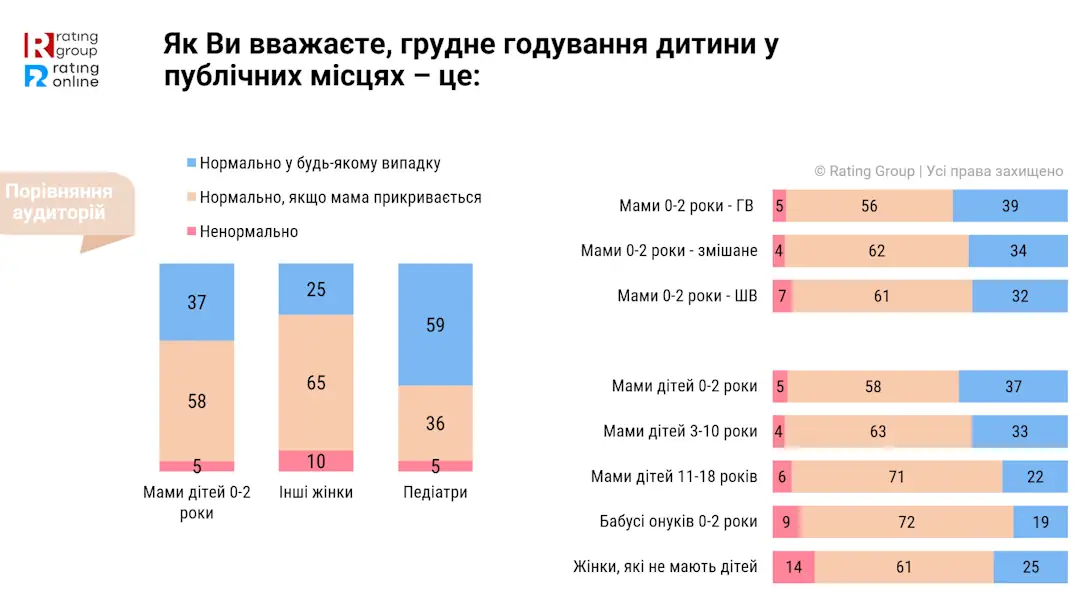
The attitude towards breastfeeding in public places is generally more acceptable, but with many “buts” — conditional, “if I don't see it”.
- Other women, including mothers, believe that breastfeeding in public places is normal, provided that the mother “covers up”. Moms who are themselves on BF are somewhat more loyal to this, but the difference is small.
- Grandmothers and women without children are most critical of this.
These trends are confirmed by our experiment. We told the respondents an imaginary situation about a mother who needs to feed her child in a public place. Then the respondents were asked to evaluate what the mother should do in this situation:
a) feed the baby here
whether b) look for another place to feed/return home?
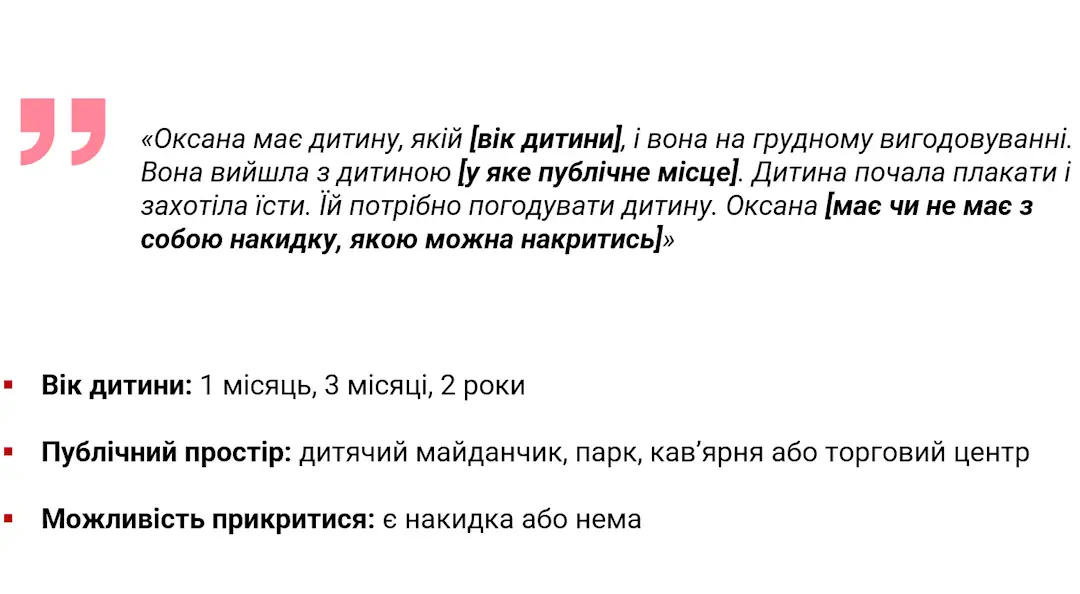
Factors that varied in situations: age of the child; place (playground, coffee shop, park, shopping center); presence or absence of a cape.
According to the results of the experiment:
- The factor of having a cape with which you can “cover up” is very influential: in its absence, among mothers, 24% advise the imaginary mother to go home, if there is a cloak - only 9%. Among other women, in the absence of mention of a cape, 42% are advised to go home, while if there is a cape, twice as much (23%).
- Among mothers there are no significant differences in location, but for other women it matters: most often they do not want to see a nursing mother in a coffee shop, restaurant. Also, mothers of older children do not really want to see a nursing mother on the playground. Relatively better attitude — if it is a park or shopping center. At the same time, if there is a cape, the impact of the feeding site is significantly reduced.
- The age of the child also matters for other women: for example About 40% of one- to two-year-old children believe that their mother should feed at home, while with a baby of several months it is less likely to be “sent home” (about 20%).
- In general, in the eyes of society, the most “comfortable” situation for feeding is when the baby is still small (3 months), there is a cape and this is, for example, a park.
- And the most stigmatized situation is if the mother is in a coffee shop and without a cape. In general, even here, most mothers themselves are ready to support breastfeeding, but not the rest of the population.
- Of course, mothers with their own experience of long-term HB (especially those who now continue to breastfeed) are the least critical of HB in public places in any situation.
Therefore, normalizing BF in public places is very important, including the attitude that “this is normal regardless of location”, “the cape may be an option but not a requirement”, and “even older children can be breastfed outside the home without shame”.
Combining BF with an active life
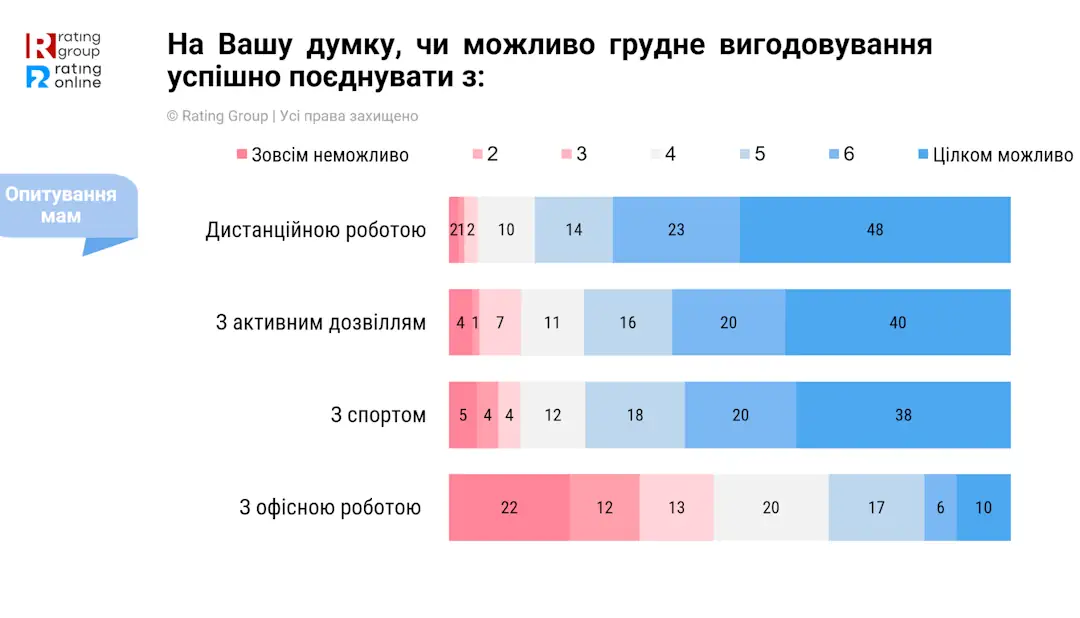
Moms mostly agree that breastfeeding can be successfully combined with leisure, sports and remote work, although mothers with BF have much more confidence in this.
- About 40% of breastfeeding mothers believe that feeding can even be combined with office work, while among mothers who use formula this share is twice as low. Breastfeeding mothers who already have part-time or hybrid work are the most confident that this is possible.
- Overall, the employment rate of mothers does not depend on the type of feeding their child receives: around 45% of surveyed mothers with children aged 0–2 are currently working full-time or part-time, and this показатель is almost the same across different feeding types. Mothers who practice mixed feeding are relatively more likely to have office-based jobs.
- Among women with office or semi-office work formats, about half report having the opportunity to breastfeed at work (availability of a mother-and-child room or a flexible schedule). However, among formula-feeding mothers working in offices, the majority indicate that they do not have such an opportunity.
Feeding experience
Help with feeding
- 65% received assistance from maternity staff in setting up BF, 27% - did not receive.
- 42% received advice on breastfeeding outside the maternity hospital: among them 40% — from a private consultant (more often in large cities); 35% from a family doctor; 34% — consulted with relatives (more often in villages); 18% - a public nurse.
- 72% felt support from loved ones, relatives in the process of establishing breastfeeding. The most important thing for them was the support of the husband— 55%, already in second place — parents (23%), sisters (7%). 18% did not feel support from relatives.
Having support is very important to establish breastfeeding
Breastfeeding rate depending on the availability of support:
- Among those who had skin-to-skin contact within the first hour after birth, the breastfeeding rate is 65% (vs. 49% among those who did not).
- Among those who received help from maternity staff, the breastfeeding rate is 66% (vs. 54% among those who did not receive help).
- Among those who felt support from relatives: 67% (vs. 48% among those without such support).
- Among those primarily supported by partners: 69% (vs. 56% among those supported by parents).
Feeding difficulties
- In general, the main challenges related to breastfeeding were experienced both by mothers who switched to formula and those who continued breastfeeding. These include physical pain, improper latch, emotional fatigue, and overall physical exhaustion.
- Mothers who switched to formula after the first month more often report emotional exhaustion, stress, and inability to constantly stay with the child.
- Regarding personal comfort, breastfeeding mothers were most concerned about milk leakage (37%), inconvenience of feeding outside the home (31%), and the need to constantly be with the child (26%).
- Around 20% were also concerned about milk let-down (sweating), inconvenience of night feedings, the need for special clothing, and the baby scratching during feeding.
- Diet, body changes, or breast sensitivity were less significant concerns for breastfeeding mothers. However, among those who switched to formula by personal choice, concerns about diet and body shape were more prominent.
Completion of feeding
- Nearly 60% stop breastfeeding before the child reaches 1.5 years (among those who breastfed). About a quarter stop between 1.5 and 1 year 11 months. Only 17% continue until age 2 or later.
- Mothers who stopped breastfeeding before 1.5 years often mention night feedings and sleep deprivation as the biggest difficulties. They also more frequently report emotional fatigue.
- Overall, reasons for stopping before age 2 include personal choice, discomfort, and exhaustion. Less frequently mentioned are the child refusing or being “old enough” (usually referring to children older than 1.5 years).
- Among those who stopped before one year, key reasons also include personal discomfort and the desire for the child to be more independent.
Switching to formula
- 42% started using formula from the first days in the maternity hospital, and another 40% did so within the first three months.
- 79% described the decision to switch to formula as forced, while 14% said it was their personal choice. However, 53% made the decision independently, while only 36% did so on the advice of a pediatrician (12% on advice from others). Those who followed medical advice more often mention concerns about the child’s weight.
- The main reasons for switching to formula were the feeling that the child is hungry (40%) and insufficient milk supply (40%). Secondary reasons include latch problems, concerns about weight gain, emotional exhaustion, and stress. Medical contraindications are rarely cited.
- At the same time, pediatricians note that, alongside lack of milk, a common reason is also the mother’s personal choice.
- For working mothers, in addition to insufficient lactation, returning to work and inability to stay constantly with the child is also a reason.
- Mothers who switched by personal choice cite personal discomfort, emotional exhaustion, and physical pain during feeding. Difficulties feeding outside the home are among the main limitations. They are also more concerned about milk leakage, attachment to the child, and dietary restrictions.
Doctors’ survey – breastfeeding practices
- 43% of doctors (family doctors and pediatricians working with newborns) frequently encounter cases where infants switch to formula within the first 6 months. This is reported more often by doctors in public practice.
- 21% of doctors rely on national guidelines for introducing formula, 34% on international recommendations, and 41% make decisions individually. Younger doctors and those in private practice are more likely to follow international recommendations.
- 24% of doctors have completed certification courses on lactation, 51% attended short trainings, and 52% studied independently. Full certification is more common among doctors in regional centers, younger doctors, and pediatricians.
- One in ten doctors considers breastfeeding a two-year-old child abnormal. 57% say it is completely normal, 21% rather normal, 11% undecided, and 12% rather abnormal.
- The more knowledgeable doctors are about breastfeeding, the more positively they assess feeding up to two years (73% “completely normal” among those with certification vs. 47% among those self-taught). Doctors who follow international guidelines are also more likely to consider it normal (65% vs. 44% among those using national protocols).
- 52% of doctors recommend breastfeeding for at least 2 years (40% up to 2 years, 12% up to 3 years). 42% recommend shorter durations. Doctors with lactation training more often recommend breastfeeding for at least 2 years.
- When parents consider switching to formula, about half of doctors insist on maintaining breastfeeding, while the other half suggest continuing but also provide guidance on formula. Older and more experienced doctors are more likely to insist on maintaining breastfeeding.
- Doctors generally recommend switching to formula in cases of medical contraindications or insufficient weight gain (around 60%). Secondary reasons (around 40%) include insufficient milk supply or inability of the mother to stay constantly with the child. Less frequently (10–15%) they recommend switching due to latch problems or breast pain.
When the mother complains of insufficient milk:
- most doctors (80-90%) observe the weight gain of the child, ask about attachment and feeding regimen, attachment technique;
- 75% also observe the further behavior of the child and the frequency of feedings;
- 58% examine the mother at the reception;
- 19% refer their mother to a lactation consultation.
Doctors with lactation training are more likely to examine mothers and refer them to specialists. More experienced doctors also tend to conduct such examinations more often.
About Family 360° technology
The Rating Group team launched the technology Family 360° for family surveys, where the child and his environment are in the center, a survey is conducted by parents, family members, in some cases - teachers, doctors, psychologists, etc. In this study, the focus was on interviewing mothers of babies, as well as their environment, including pediatricians.
The Rating Group is one of the largest research institutions in Ukraine, which has been on the market since 2008. The company is registered in Ukraine and has significant experience in conducting sociological surveys in Ukraine and abroad. The group includes: Sociological Group Rating, Research Lab Rating Lab, Rating Online platform and Rating Call Center.
Methodology
- Fieldwork period: November–December 2025
- Survey method: CAWI (Computer-Assisted Web Interview) – online survey
- Sample:
- 970 mothers of children aged 0–2 years (including 450 mothers of children aged 0–6 months and 520 mothers of children aged 6 months to 2 years)
- 792 other women (including mothers of older children, grandmothers, and women without children)
- 220 pediatricians and family doctors working with children from birth (who had seen such a child in the past few months; conducted using the Helsi.me platform)
Note: in some charts, percentages may not sum to exactly 100% due to rounding (including of small values).
Contact form
Let's discuss your research idea
Fill in the form below, and we will contact you as soon as possible