
09.05.2026
What does "being a mother" mean? Survey of mothers in Ukraine for Mother's Day 2026

For Mother's Day 2026 (May 10), the team of the Sociological Group Rating (Rating Group) asked Ukrainian mothers what it means for them to be a mother, what challenges they face, whether they have time for themselves, and if anyone helps them.
Being a mother means...
We asked the respondents to describe in their own words what being a mother personally means to them.
For mothers, motherhood is primarily love, care, tenderness, warmth, and a feeling of happiness. Many also mention that it means being a support and a friend to their child.

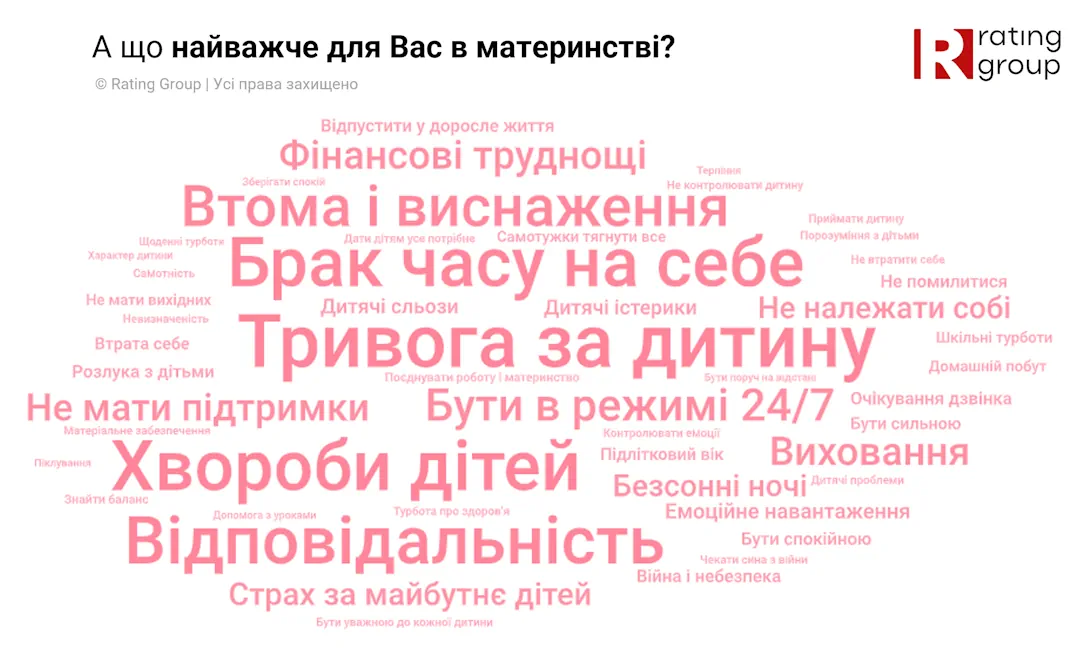
And what is the hardest part of motherhood?
Mothers say the hardest part is worrying about their child and their health, responsibility, lack of time for themselves, and the fatigue and exhaustion from being a 24/7 mom. And sometimes – a lack of support.
What do mothers feel?
We asked the respondents to assess their emotional state over the past month.
The most common feeling among Ukrainian mothers is anxiety (43%). Another 8% report fear.
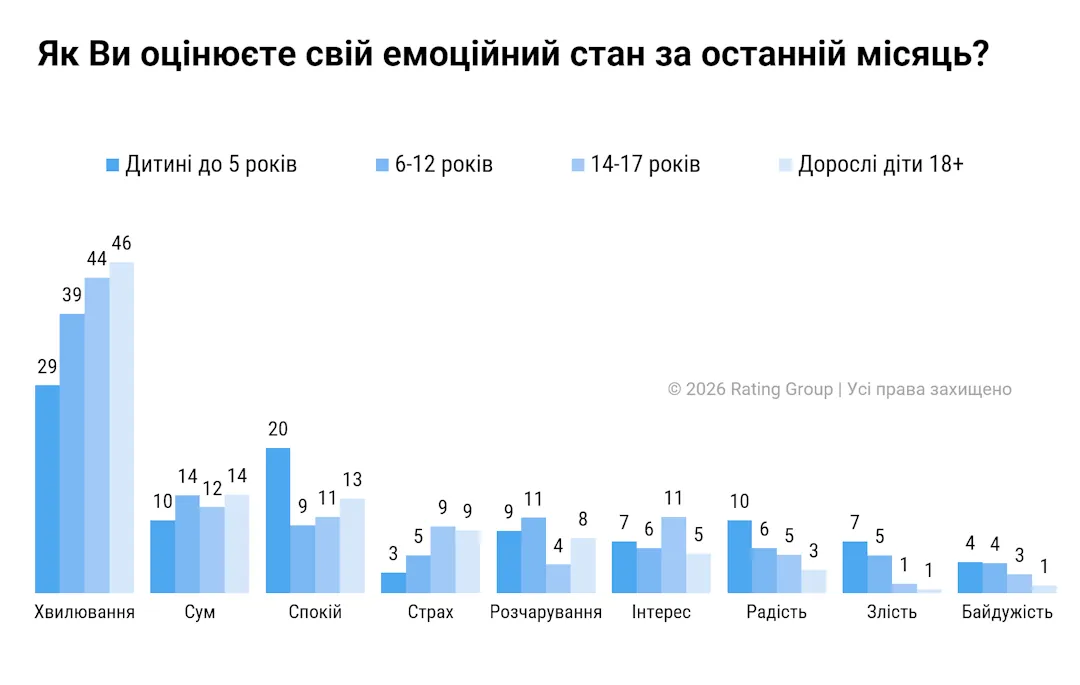
- In general, the older the child, the more often mothers feel anxious: 46% among mothers with adult children, compared to 29% among mothers of the youngest children (under 5 years old).
- Sadness is felt by 13% of mothers, while joy as a primary emotion is felt by only 5%. Mothers of children under 5 years old report joy relatively more often (10%).
- Calmness is felt by 13% of mothers. Mothers of children under 5 years old feel calm relatively more often: 20% (compared to 9-13% among mothers of children of other ages).
Time for themselves: what mothers (don't) manage to do?
Most mothers of children under 5 years old are unable to eat properly, rest, and do daily chores throughout the day:
- Approximately 65% of them cannot have breakfast and lunch every day. 57% cannot have a peaceful dinner.
- 64% of them cannot always take a shower/wash their hair when needed.
- 44% cannot even go to the toilet peacefully when needed.
What about time for rest?
- Approximately 35% of mothers of young children, 54-60% of mothers of school-aged children, and 72% of mothers whose children are adults have a relatively stable opportunity for rest. The rest do not have such an opportunity.
- Among mothers of preschoolers, one in four never or almost never has the opportunity to rest during the day (read a book, watch a movie, drink coffee, or just lie down). Only 7% of them have the opportunity to rest every day.
- Mothers of three or more children also rarely manage to rest.
At what age do mothers start getting enough sleep?
- Only about 10-15% of mothers of children under 18 get enough sleep every day or almost every day, whereas among mothers of adult children, this figure is already 30%.
- It is important to note that among mothers of preschoolers, almost 28% do not get enough sleep almost every day, and most of them sleep no more than 2-3-4 hours consecutively.
- Among mothers of school-aged children, about 40% also sleep poorly; however, a comparatively larger percentage among them get longer sleep of about 5-8 hours without waking up.
Help with the child
- Every second mother receives no help with her child/children, neither during the day nor in the evening. Every third mother receives no help even on weekends.
- In general, mothers receive support somewhat more often on weekends than on weekdays: primarily from their partner/husband (50%).
- The younger the child, the more support mothers receive from their partner and their parents. However, even among mothers of children under 5, one-third receive no help even in the evening.
- It is important that mothers of young children who receive no help with their children are significantly less likely to eat properly and do daily chores, especially regarding simple things like taking a shower or going to the toilet.
- Also, mothers who receive no help more often than others feel anxiety, sadness, indifference, and at the same time feel less joy.
Recovery
- It is important that the problem also includes the difficult process of postpartum recovery: almost every second mother needed more than 1-2 years to recover physically.
- Moral recovery is somewhat faster (from one month to six months), but not for everyone; at least one-third also needed a year or more to recover morally and psychologically.
- At the same time, with each subsequent child (for mothers having their second or third birth), recovery is a little faster, at least psychologically.
Rating Group is one of the largest research institutions in Ukraine, operating since 2008. The company is registered in Ukraine and has significant experience in conducting sociological surveys both in Ukraine and abroad. The group includes: Sociological Group Rating, Rating Lab research laboratory, Rating Online platform, and Rating Call Center.
Methodology
- Dates of conduct: May 7-8, 2026
- Survey method: CAWI (Computer-Assisted Web Interview) – online survey
- Sample size: 464
- Sample format: women with children (of various ages) who have a smartphone and internet access at the time of the survey (in all regions of Ukraine, except temporarily occupied territories)
Note: sometimes the sums of percentages in some charts may not arithmetically equal 100% due to rounding of numbers (including decimals).
Contact form
Let's discuss your research idea
Fill in the form below, and we will contact you as soon as possible