
22.05.2026
Common Contours #5. What worries Ukrainians most about the country's future? Comparison with opinions in the EU
"Rating" Sociological Group presents the fifth issue of its special research project "Common Contours". This time, we investigated which social issues concerning the country's future most concern Ukrainians during the full-scale war, and compared these sentiments with data from EU countries.
"Common Contours" is a survey about Ukraine in a European context, where we reflect questions and compare data from our own surveys of Ukrainians with data from other surveys in EU countries, candidate countries, and other European countries. In this issue, we compare our own research data with Eurobarometer data – a series of official EU surveys from the European Commission and the European Parliament. Eurobarometer data belongs directly to the EU, and we thank them for open access to it.
Note: This study examined a specific list of social issues from the Eurobarometer survey, which was researched in EU countries. This is not an exhaustive list of issues that may concern Ukrainians, especially during the full-scale war. The research results should be interpreted as relative indicators of priorities and differences in perception between Ukrainians and other European countries.
General Findings
Amidst the war, Ukrainians are particularly concerned that children will grow up in poverty
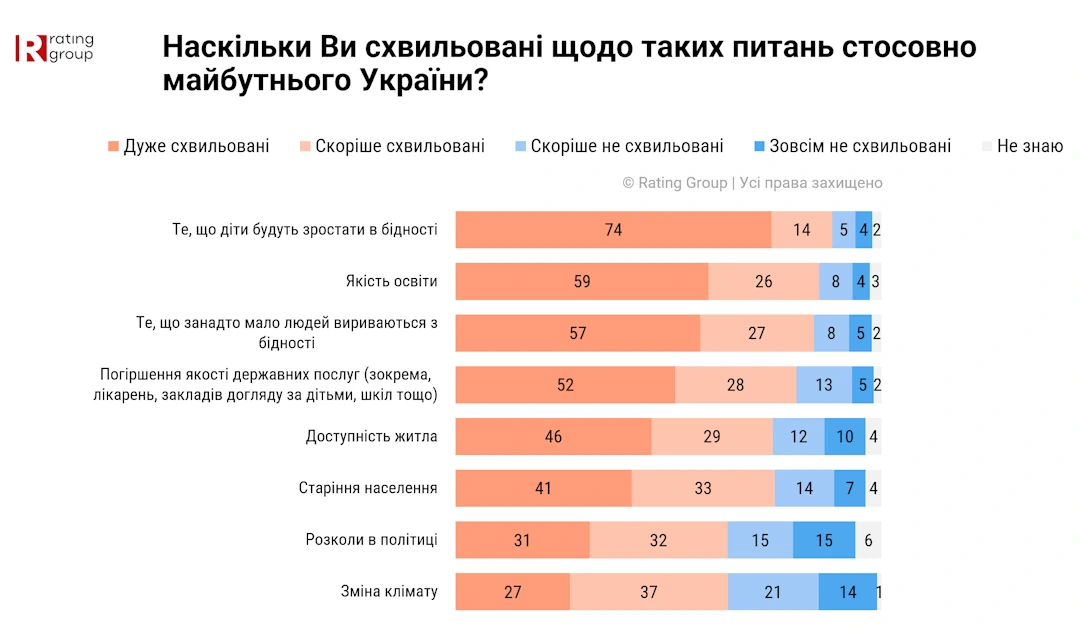
All topics examined in the study concern the majority of Ukrainians to some extent. However, the level of concern varies significantly.
- Amidst the war, Ukrainians are most acutely aware of issues related to the future of children and their risk of growing up in poverty (88% are concerned, including 74% who are very concerned),
- The top three concerns also include the quality of education (85% overall and 59% very concerned) and poverty (84% overall and 57% very concerned).
- Climate and political divisions also significantly concern Ukrainians, but amidst the war, they are relatively less pressing than socio-economic and humanitarian issues.
- At a general level, the responses of Ukrainians are quite similar to the average indicators in EU countries. In some cases, the differences lie not so much in the overall percentage of people concerned about a particular issue, but in the intensity of this concern.
- Ukrainians are significantly more concerned about poverty, the quality of education, and population aging than the average EU citizen.
- In contrast, Ukrainians are somewhat less concerned about political divisions and climate change than the average in the EU.
Below, we will look at several topics in more detail.
The future of children is Ukrainians' most pressing concern regarding the country's future.
- 74% of Ukrainians are very concerned that children might grow up in poverty; overall, 88% are concerned.
- This is the highest concern level among all topics in the release.
- In Ukraine, this issue is significantly more acute than the EU average: 40% there are very concerned (compared to 74% in Ukraine).
Education is one of the key concerns in the context of the country's future.
- 59% of Ukrainians are very concerned about the quality of education; overall, 85% are concerned.
- This is the second most pressing issue after the risk of children growing up in poverty.
- The overall percentage of concern is close to the EU figure (85% in Ukraine, 81% on average in the EU), but again, there is a significant difference in the proportion of those who are very concerned: 59% in Ukraine and 39% in the EU.
Population aging: Amid war, migration, and human capital loss, concerns about the demographic situation are even more acute.
- 41% of Ukrainians are very concerned about population aging; overall, 74% are concerned.
- This topic concerns younger people relatively less than older citizens. While about two-thirds of young men and women express concern, 81% of men aged 51+ are concerned about population aging, and 87% of older women are concerned.
- Given the war, migration, human capital loss, and other challenges, concerns about population aging are significantly stronger in Ukraine than in the EU. While 26% in the EU are very concerned, this figure is 41% in Ukraine.
Ukrainians are often concerned about climate change, but urgent socio-economic and humanitarian challenges relatively shift this issue down in priority.

- 27% of Ukrainians are very concerned about climate change; overall, 64% are concerned.
- In Ukraine, women are relatively more concerned about climate change. Young men aged 18-35 showed the least concern about climate change (45% are concerned, 55% are not), whereas 68% of women in this age group are concerned.
- In many EU countries, the climate topic holds a more prominent place on the public agenda. On average, 78% of respondents in EU countries stated they are concerned about climate change.
Rating Group is one of Ukraine's largest research institutions, operating since 2008. The company is registered in Ukraine and has extensive experience conducting sociological surveys both within Ukraine and abroad. The group includes: Rating Sociological Group, Rating Lab research laboratory, Rating Online platform, and Rating Call Center.
Methodology
- Fieldwork dates: April 15-17, 2026
- Survey Method: CATI (Computer-Assisted Telephone Interview) – telephone interviews using a computer
- Sample Size: 1000 respondents
- Sampling Format: random sample of mobile phone numbers (Ukrainian population aged 18 and older in all regions, except for temporarily occupied territories, as well as territories where Ukrainian mobile communication is absent at the time of the survey). The results are weighted using current data from the State Statistics Service of Ukraine.
- Representativeness: the sample is representative by age, gender, and type of settlement (error margin – no more than 3.1% with a confidence level of 0.95)
The survey data in Ukraine (Rating Group) are compared with data from EU countries from the Special Eurobarometer 559. Investing in fairness study (January-February 2025). The questionnaire reflects questions from the same survey.
Note: sometimes the sums of percentages in some charts may not arithmetically equal 100% due to rounding of numbers (including decimals).
Contact form
Let's discuss your research idea
Fill in the form below, and we will contact you as soon as possible