
24.06.2026
Common Contours. Summary Report #1 (March-June 2026)
.webp)
This is the first summary report of the “Common Contours” research project by Rating Group, which includes surveys of Ukrainian population between March and June 2026. Key topics of this issue:
- How interested are Ukrainians in European politics compared to citizens of other European countries?
- How many Ukrainians would vote for joining the EU and NATO?
- Who is most supportive of the idea of joining the EU?
- How do Ukrainians assess the state of democracy in the country?
The full report also includes data from previous releases of “Common Contours” between March and June 2026.
"Common Contours" is a survey about Ukraine in a European context, where we reflect questions and compare data from our own surveys of Ukrainians with data from other surveys in EU countries, candidate countries, and other European countries. In this issue, we compare our own research data with Eurobarometer data – a series of official EU surveys from the European Commission and the European Parliament. Eurobarometer data belongs directly to the EU, and we thank them for open access to it.
How interested are Ukrainians in local, national, and European politics?
(based on April 2026 data)
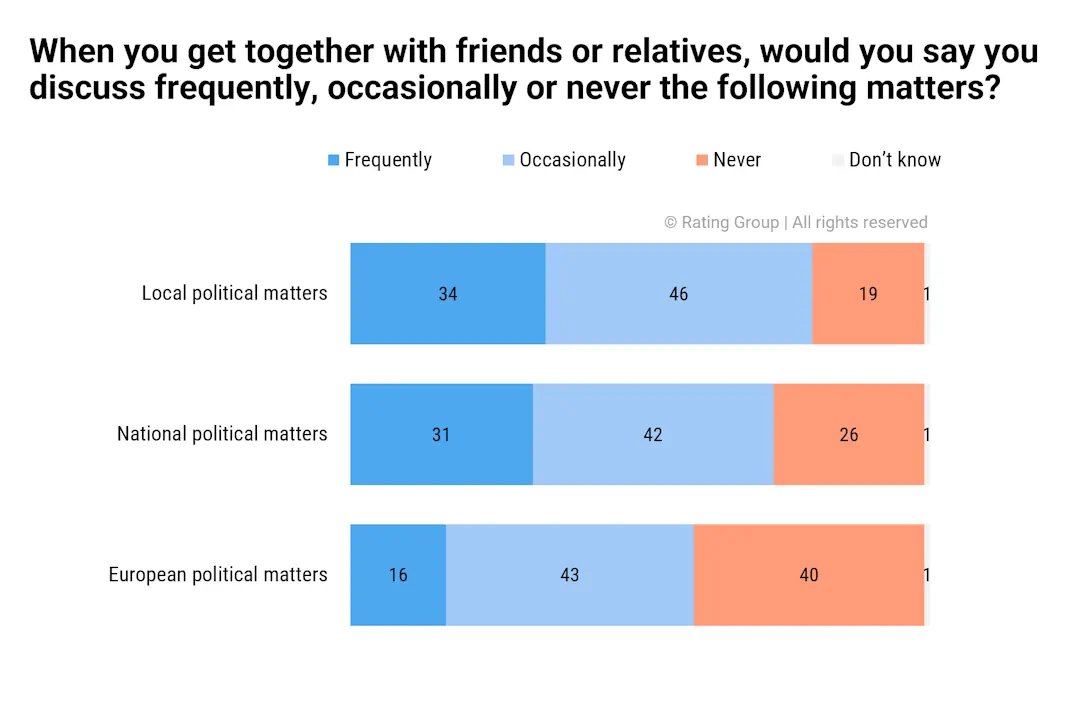
Most Ukrainians discuss local political matters (80%), national political matters in Ukraine (73%), and European political matters in general (59%) with friends or relatives. This indicates a significant level of interest in politics at different levels.
- Ukrainians’ interest in European political matters does not differ very strongly from the average across EU countries, where 70% on average discuss European politics at least occasionally.
- As in the EU on average, every seventh Ukrainian (16%) frequently discusses European political matters.
- Ukrainians discuss European politics somewhat more often than respondents in France (51%), Portugal, or Spain (56% each).
- Compared with European countries outside the EU, Ukraine’s figures are similar to those in the United Kingdom (63% discuss European politics), Albania (61%), and Turkey (59%).
Ukrainians who are interested in national politics are usually also interested in European political matters.
- For example, among respondents who frequently discuss national political matters in Ukraine, 49% also frequently discuss European political matters, while another 45% do so occasionally.
- By contrast, respondents who are not interested in Ukrainian politics are almost never interested in European political matters either (90%).
Support for EU and NATO accession
As of late June 2026, an absolute majority of Ukrainians support accession to the European Union (70%) and NATO (63%)
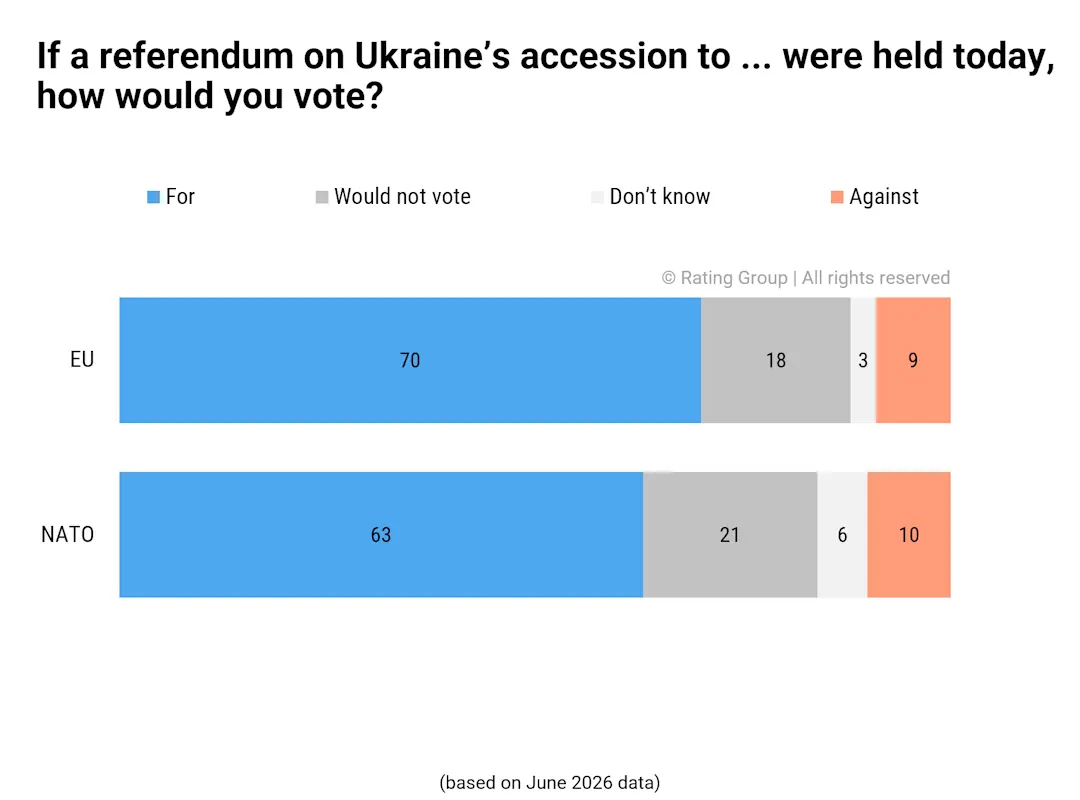
- EU accession is supported by 70% of Ukrainians.
- 9% oppose EU accession, another 18% said they would not vote in a referendum, and 3% were undecided.
- NATO accession is supported by 63% of Ukrainians.
- 10% oppose NATO accession, another one in five say they would not vote, and 6% were undecided.
How support for EU and NATO accession has changed in recent years
Overall, support for EU and NATO accession had been declining over the past three years, reaching its lowest point in April 2026. However, in June 2026, we observe a substantial increase in support.
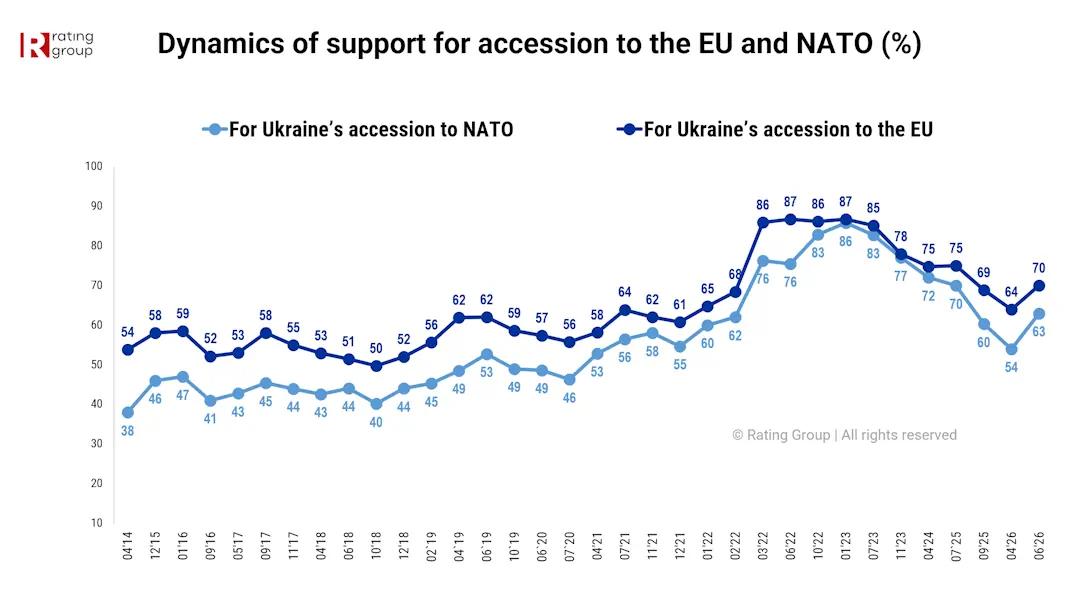
- For example, in July 2023, 85% supported Ukraine’s accession to the EU; in July 2025, 75%; and in April 2026, 64%. However, in June 2026, support increased again to 70%.
- Similarly, in July 2023, 83% supported Ukraine’s accession to NATO; in July 2025, 70%; and in April 2026, 54%. However, support for NATO accession rose sharply to 63% in June 2026.
In June 2026, the gap between support for the EU and NATO also narrowed.
- Historically, the gap between support for the EU and NATO remained at around 10 percentage points in favor of the EU.
- It narrowed to around 5 percentage points on the eve of the full-scale invasion, and then widened again to 10 percentage points in the first months of the full-scale war.
- Since late 2022, when the Armed Forces of Ukraine had already liberated a significant part of the occupied territories and more substantial military assistance began arriving from NATO allies, support for joining NATO and the EU became almost synchronized: around 85% supported accession to both alliances.
- Starting in the summer of 2023, the gap widened again and stood at around 10 percentage points as of April 2026.
- In June 2026, the gap between support for the EU and NATO narrowed to 7 percentage points.
Comment by Hlib Kuzmenko, Research Expert and Head of Communications at Rating Group:
“Between September 2025 and April 2026, support for EU and NATO accession declined to its lowest level since the beginning of the full-scale invasion. The gap between support for EU and NATO accession also increased. Speaking about the information environment in March and April, Ukrainians likely paid attention to the absence of a unified position within NATO and the EU regarding the war in Iran, critical statements by U.S. representatives about NATO’s capacity, hints at a possible withdrawal from the Alliance, and similar developments.
Put simply, Ukrainians may have developed stronger doubts about the real capacity of NATO and the broader West in the field of security.
In June 2026, the informational and emotional environment became completely different, and attitudes toward EU and NATO accession improved. First, Ukrainians now see effective strikes by the Defense Forces against Russian targets and significant successes on the front almost every day. This certainly strengthens belief in Ukraine’s overall prospects, including its geopolitical prospects. Second, the European Union officially launched accession negotiations with Ukraine and opened the first cluster of Ukraine’s accession talks. This is a significant step forward.
There are also other positive signals regarding military and economic support for Ukraine from G7 allies, NATO, and other partners.”
What is support for EU accession associated with?
Based on April 2026 data, we identified several patterns in the views that make respondents more likely to support EU accession.
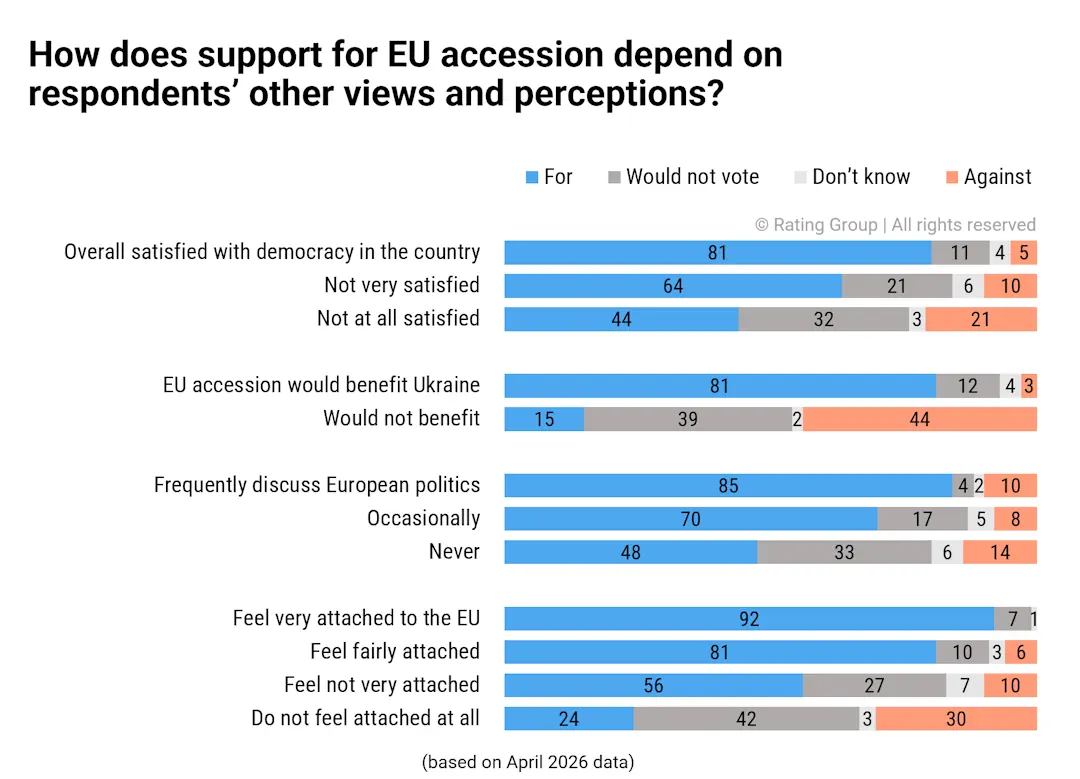
Emotional attachment to the European Union and the belief that accession would benefit the country are important foundations of support for Ukraine’s EU accession.
- Respondents who feel emotionally attached to the EU almost always support EU accession: 92% among those who feel very attached and 81% among those who feel fairly attached.
- By contrast, among respondents who do not feel attached to the EU at all, only one quarter would support Ukraine’s accession.
- The perception of benefit for the country is also an important indicator of support for accession. Among respondents who believe that Ukraine would benefit from joining the EU, 81% would vote in favor of accession in a referendum.
- Conversely, respondents who do not see benefits for Ukraine from joining the EU most often say they would vote against accession (44%) or would not vote at all (39%). Only 15% of them would support EU accession.
Respondents who are interested in European politics are more supportive of Ukraine’s European integration.
- Three quarters of respondents who frequently discuss European political matters with friends, and 70% of those who do so at least occasionally, support Ukraine’s EU accession.
- Among those who never discuss European politics, support for accession is significantly lower — 48%. Around one third (30%) would vote against accession, and 42% say they would not vote in a referendum.
Respondents who are very or fairly satisfied with the way democracy works in Ukraine mostly support EU accession (81%).
- Respondents with the most critical assessment of the state of democracy in the country — those who are not at all satisfied — support accession almost twice less often: 44% would vote in favor.
- Every fifth respondent who is dissatisfied with the way democracy works opposes EU accession. Another third say they would not take part in the vote.
Perceptions of democracy, protection of rights, and communication in the country
Most Ukrainians are dissatisfied with the way democracy works in the country (64%).
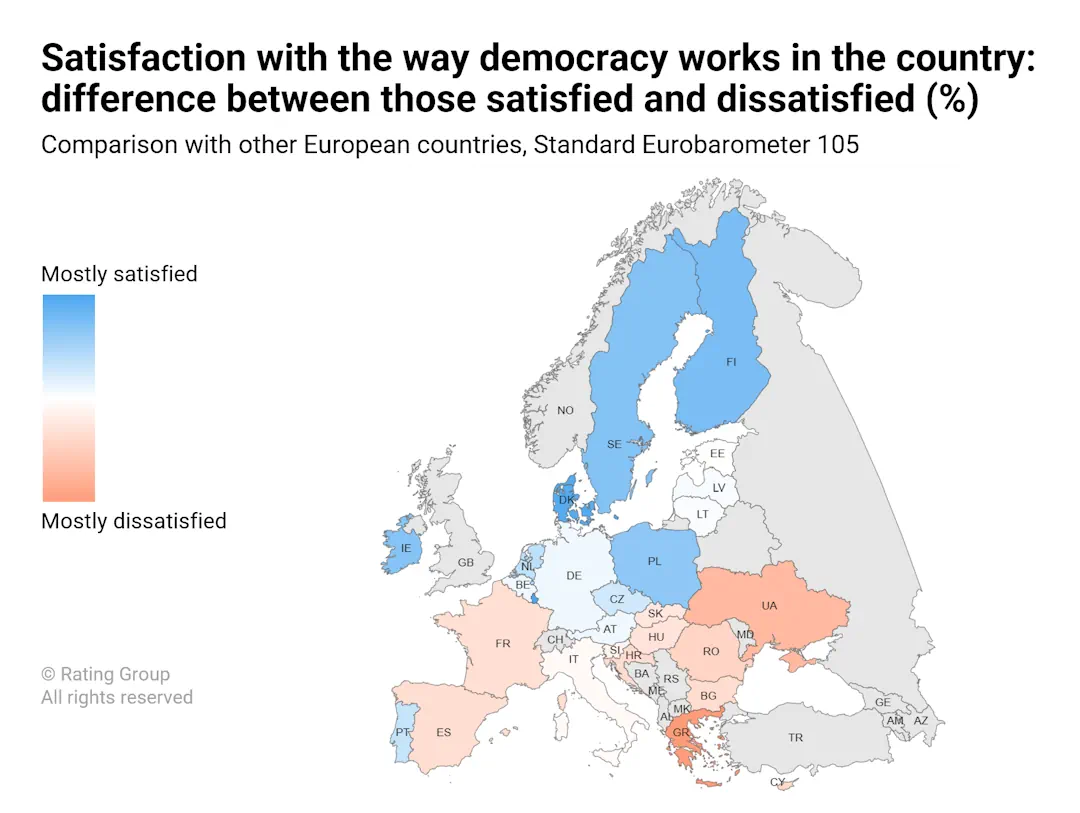
- Another third of Ukrainians (33%) say they are satisfied with the way democracy works in the country, while 3% were undecided.
- Ukrainians who oppose EU accession are much more likely to be dissatisfied with the state of democracy: 82%, compared with 57% among supporters of accession.
- Against the EU average, where 58% are satisfied and 40% are not, Ukrainians assess the functioning of democracy in their country more critically.
- A relatively similar situation can be observed in other European countries where the share of those dissatisfied with the state of democracy exceeds the share of those satisfied. This includes a number of countries in Eastern Europe (Romania, Bulgaria, Hungary) and Southern Europe (Greece, Cyprus, Croatia, Spain), as well as France.
More than half of Ukrainians (53%) disagree with the statement that core EU values, such as fundamental rights, democracy, and the rule of law, are properly protected in the country.
- At the same time, 44% still believe that these values are protected.
- On this indicator, Ukrainians are also more critical than residents of the European Union: on average, two thirds of EU respondents (66%) confirm that core EU values are protected in their country.
- There is a substantial difference in responses between supporters and opponents of EU accession. Among supporters of Ukraine’s accession to the EU, opinions are roughly divided: 50% still believe that EU values are protected in Ukraine, while 48% disagree.
- Meanwhile, among opponents of Ukraine’s accession to the EU, three quarters (75%) disagree with the statement.
Most Ukrainians are concerned about threats to freedom of expression, independence of the media, and disinformation. The figures are similar to those in EU countries.
- More than half of Ukrainians are very concerned about the independence of the media; the EU average is 56%.
- Disinformation is of great concern to 59% of Ukrainians and, on average, 69% of respondents in the EU.
- Freedom of expression is a major concern for 59% in Ukraine and, on average, 67% in the EU.
Project team
- Ihor Tyshchenko, Rating Group Founder & CEO
- Tetiana Skrypchenko, Rating Group Deputy Director
Research analysts
- Hlib Kuzmenko, “Common Contours” coordinator, Research Expert & Head of Communications, Rating Group
- Yevhen Krotevych, Head of Analytics, Rating Group
- Artem Shevchenko, Analyst, Rating Group
- Daryna Narolska, Analyst, Rating Group
- Lina Mukhina, Analyst, Rating Group
Data collection and processing
- Bohdan Suliatytskyi, Call Center Director
- Vitaliy Strelchenko, Head of CATI/CAWI Projects Department
- Dmytro Ponochovnyi, Data Processing Specialist
Rating Group is one of Ukraine's largest research institutions, operating since 2008. The company is registered in Ukraine and has extensive experience conducting sociological surveys both within Ukraine and abroad. The group includes: Rating Sociological Group, Rating Lab research laboratory, Rating Online platform, and Rating Call Center.
Methodology
- Fieldwork dates: March 11–12, 2026 — 1,000 respondents; April 15–17, 2026 — 1,000 respondents; June 23–24, 2026 — 1,200 respondents.
- Survey method: CATI (Computer-Assisted Telephone Interview) – telephone interviews using a computer
- Sampling format: random sample of mobile phone numbers (Ukrainian population aged 18 and older in all regions, except for temporarily occupied territories, as well as territories where Ukrainian mobile communication is absent at the time of the survey). The results are weighted using current data from the State Statistics Service of Ukraine.
- Representativeness: the sample is representative by age, gender, and type of settlement (error margin – no more than 3.1% for a sample of 1,000 respondents and 2.8% for a sample of 1,200 respondents with a confidence level of 0.95)
The survey data collected in Ukraine by Rating Group are compared with data from EU member states, EU candidate countries, and other European countries from Standard Eurobarometer 104 (October–November 2025), Standard Eurobarometer 105 (March–April 2026), the EP Autumn 2025 Survey (November 2025), and Special Eurobarometer 552: Justice, Rights, and Values (March–April 2024). The questionnaire mirrors the questions used in these surveys.
Note: sometimes the sums of percentages in some charts may not arithmetically equal 100% due to rounding of numbers (including decimals).
Contact form
Let's discuss your research idea
Fill in the form below, and we will contact you as soon as possible