
03.12.2025
How does punishment affect children's stress and emotional connection with their parents?

How do punishments and harsh parenting methods affect a child's stress and emotional connection with their parents? How acceptable do parents find such methods? Is violence inherited through generations? These topics are covered in the sixth article from the study "Changes in Children's Mental Health and Well-being" by Rating Group/Rating Lab.
In October 2025, Rating Group/Rating Lab surveyed more than 1,500 teenagers aged 10-18 and their parents using the unique Family 360° family research technology. In each publication, we discuss the mental health of teenagers and various aspects of their lives: gadgets and AI, emotional recognition by parents, dreams, household chores and stress, upbringing and punishment in the family, and bullying. Preliminary results of the series of studies can be found at the link.
The acceptability of harsh parenting practices
We asked parents of children aged 10-18: if a child behaves inappropriately, to what extent are certain parenting actions acceptable?
- Parents are most opposed to physical punishment (89% consider it unacceptable), ignoring (87%), and using unpleasant words in conversation (79%). There is almost complete consensus on this.
- Almost a third of parents (30%) approve of the possibility of threatening severe punishment, 55% are against it, and 16% are undecided.
- More than a third (36%) of parents consider it acceptable to take away phones and gadgets, 50% consider it unacceptable, and another 15% are undecided.
- Parents' opinions on raising their voice or shouting are more evenly divided: 35% are in favour, 42% are against, and 23% are undecided.
Are harsh disciplinary measures and violence inherited?
We asked the parents of teenagers: how were they themselves raised by their parents during their childhood? We wanted to understand whether childhood experiences influence parents' understanding of what is ‘acceptable’ in raising their own children.
The more often certain parenting practices and punishments were used on parents during their childhood, the more acceptable they consider them to be
- This is especially true for yelling and threats. Among parents who were often yelled at as children, almost half (48%) consider this an acceptable method. Meanwhile, among those who were rarely or never yelled at as children, 14% consider this method acceptable.
- Also, among those who were often threatened with severe punishment, 46% consider this acceptable.
We also asked children (aged 10-18) to describe how their parents react to their inappropriate behaviour.
- The least common practices are light physical punishment and ignoring. Five per cent and seven per cent of children, respectively, mentioned that their parents use these methods relatively often.
- One in six children relatively often encounter unpleasant words in conversation, threats of severe punishment and confiscation of gadgets.
- Raising one's voice is the most common practice on the list. About a third of children (34%) encounter it relatively often.
At the same time, there is a worrying tendency: harsh parenting practices, punishment and violence in the family are passed down through generations
As mentioned earlier, the more often parents experienced certain parenting practices in their childhood, the more acceptable they find such methods. There is a direct link between perception and actions in practice: the more acceptable the practice (from the parents' point of view), the more likely they are to apply it to their child. In other words, parents who were yelled at as children are more likely to yell at their own children. This is confirmed by the children's own responses.

51% of parents who consider shouting to be acceptable raise their voices at their children. More than a third (37%) of parents who are ‘undecided’ about the acceptability of shouting also do so. In addition, 42% of parents who consider the use of unpleasant words to be acceptable use them when talking to their own children.
How do such methods affect children?
Harsh disciplinary measures and punishment are detrimental to a child's psychological well-being
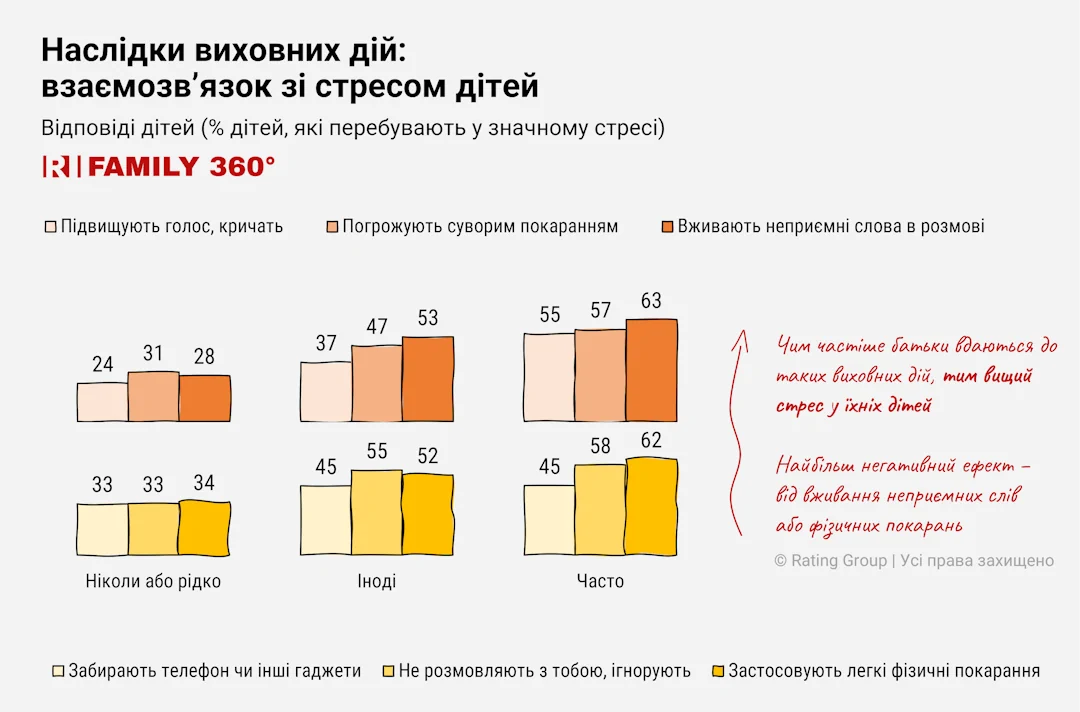
The more often harsh parenting methods are used on children, the greater their stress levels. For example, almost two-thirds of children who are physically punished (62%) or who are spoken to in an unpleasant manner (63%) have significant (conditionally ‘red’) stress levels. More than half of children who are often ignored (58%), threatened with severe punishment (57%) or frequently shouted at (55%) have the same level of stress. These children experience ‘red’ levels of stress two to three times more often than their peers who are never punished in such ways.
Harsh disciplinary measures and punishment destroy the emotional bond between the child and their parents

The more often parents use harsh parenting practices, the weaker the bond between parent and child. For example, just over half (55%) of children whose parents often shout at them feel a strong bond with their parents. In contrast, among their peers whose parents never shout at them, almost 80% feel a strong bond.
About Family 360° technology
It is not worth making conclusions about teenagers without asking their opinion. That is why the Rating Group team launched Family 360° technology for family surveys, which focuses on the child who is being surveyed, as well as their parents, family members and, in some cases, teachers, doctors, psychologists, etc. Comparing the answers of children and their parents allows us to understand the relationships and changes within the family. We have previously used this approach successfully with our partners at UNICEF, KSE, and Ty Yak? when researching mine awareness, mental health, education, and career guidance.
About the study
We first researched the topic of mental health in the parent-child context in October 2024. This year, we decided to continue, expanding the topic and using longitudinal research techniques to better understand the dynamics. In October 2025, this survey covered more than 1,500 children/adolescents aged 10-18 and their parents.
Authors of the research idea: Svitlana Roiz, child and family psychologist, mother of two; Marianna Tkalych, CEO of Rating Lab, Doctor of Psychological Sciences, mother of Masha (17 years old); and Tetiana Skrypchenko, Deputy Director of Rating Group, mother of Solomiia (8 months old).
Methodology
- Fieldwork dates: 3–7 October 2025.
- Survey method: CATI>CAWI (Computer-Assisted Telephone Interview – telephone interviews using a computer, CAWI – online survey). In the first stage (CATI), contact was made with parents who gave their consent for their children to participate in the online survey. In the second stage, children completed the survey via a personal link. After that, parents received a personal invitation to take part in an online survey for parents.
- Sample size: 2,531 respondents. Of these, 1,572 were children aged 10-18 and 959 were their parents. Almost 900 children took part in the survey again in a longitudinal format.
Contact form
Let's discuss your research idea
Fill in the form below, and we will contact you as soon as possible