
Press releases
Search press releases

On August 21–25, 2026, Rating Group conducted a survey of Ukrainian refugees in Poland about their life abroad.
Polish Language Proficiency
The survey of Ukrainian refugees living in Poland shows a fairly high level of language integration.
- 60% of respondents said they speak Polish at an intermediate or advanced level.
- A basic level – 26%, an elementary level – 12%.
- Only 2% of respondents do not know Polish at all.
Adapting to Life Abroad
57% of respondents are satisfied with their level of social adaptation, while 37% are not.
- At the same time, life abroad comes with a wide range of challenges. The most common concern among refugees is the negative influence of the media, cited by 45%.
- Mental health issues were noted by 29%, difficulty accessing quality medical care – 28%, general health problems – 24%, lack of opportunities for self-realization – 23%. Insufficient social adaptation, a shortage of free time, and housing difficulties each concern 22%, physical safety – 21%.
- A high workload and lack of money were named by 19% each, difficulty finding employment or a profession losing relevance – 17%, loss or destruction of housing due to the war – 14%, difficulty choosing a future profession – 12%.
Psychological state also remains a notable concern.
26% often or very often felt excessive anxiety or panic they could not cope with. Another 31% experienced such states occasionally, while 40% encountered them rarely or never.
Social Connections
Ukrainian refugees' own attitude toward the local population is mostly neutral (44%) or warm (50%). Refugees perceive Poles' attitude toward them more reservedly: 30% describe it as warm, 46% as neutral, and 22% as cold.
- For 45%, the closest circle of communication consists mostly of Ukrainians, while for 34% it includes both Ukrainians and local residents in roughly equal measure. Only 8% communicate mainly with Poles, and 13% said they have no circle of communication at all.
- Over the past 12 months, 31% of surveyed Ukrainian refugees experienced discrimination based on national or ethnic origin, and 22% faced prejudice for using the Ukrainian language.
- Negative attitudes because of the Russian language were reported by 6%, because of age – 5%, because of gender – 3%. At the same time, nearly half of respondents (49%) did not experience discrimination on any of the grounds listed in the survey.
Assessing Different Aspects of Living in Poland
- Ukrainian refugees rate access to quality leisure in Poland most highly: positive assessments reach 57%, negative – 10%.
- The ability to live comfortably is rated well by 41%, poorly by 14%. Access to preschool and school education is viewed positively by 39%, negatively by 5%, though 37% were unable to assess it.
- Opportunities to start a business received 29% positive and 13% negative ratings, while 32% were undecided.
- Prospects for achieving success are rated positively by 29%, negatively by 20%. 28% rate access to higher education well and 9% poorly, though 40% could not answer.
- Assessments of the protection of rights and freedoms are almost evenly split – 27% positive versus 28% negative. A similar picture emerges for jobs with adequate pay – 26% positive versus 27% negative.
- Access to quality healthcare is rated well by 26%, poorly by 32%; for housing rental, the figures are 25% and 28% respectively. Social support is rated positively by 20%, negatively by 29%, with 27% undecided.
- Buying one's own home remains the most difficult: only 16% rate its accessibility positively, while 44% rate it negatively.
Plans for Living Abroad
- 44% of respondents would like to settle abroad permanently, while 43% would not. Among those who want to live abroad, 40% choose Poland, 17% another European country, and 6% a country outside Europe. Meanwhile, 37% could not name a country.
- Respondents named obtaining Polish citizenship as the most desired form of assistance for making life in Poland easier – 35%.
- Polish language courses are needed by 17%, recognition of Ukrainian diplomas – 16%, financial support – 14%, help with social adaptation – 13%, access to healthcare – 12%, psychological support – 11%. Help with employment is needed by 9%, free education and help finding housing – 6% each.
- 34% of refugees are considering obtaining Polish citizenship, including those who have already submitted documents. 46% do not plan to, and another 20% are undecided.
Returning to Ukraine
51% of surveyed refugees in Poland intend to return to Ukraine, though most are postponing this step until the war ends.
- 8% are ready to return in the near future, 43% after the war. 26% do not plan to return, and 23% cannot give a definite answer.
- The key condition that would encourage return is security and stability in Ukraine, named by 71% of respondents.
- Economic development matters to 36%, employment prospects to 26%, the absence of internal linguistic, religious and other conflicts to 21%. The development of social infrastructure and the ability to influence social change were each named by 12%, participation in rebuilding the country and worsening living conditions abroad by 11% each.
Financial Situation and Employment
73% of Ukrainian refugees in Poland said they have a job, of whom 87% work directly in Poland.
- Over the past year, the financial situation of Ukrainian refugees improved more often than it worsened. 36% reported positive changes, 20% negative changes, while 41% felt no change.
- Respondents are somewhat more optimistic about the future: 38% expect improvement over the next year, 12% expect it to worsen, and 31% expect no change. Another 20% could not predict their financial situation.
- Among the employed, 87% work in Poland, 4% in Ukraine, and 5% in several countries.
- 81% of refugees rent housing, while only 7% own their home. For 3%, housing is provided by their employer, 2% each live with Polish families or with Ukrainian friends and acquaintances, and 1% use social housing.
Rating Group is one of Ukraine's largest research institutions, operating since 2008. The company is registered in Ukraine and has extensive experience conducting sociological surveys in Ukraine and abroad. The group includes the Rating Sociological Group, the Rating Lab research laboratory, the Rating Online platform, and the Rating CATI Center.

Rating Group conducted a survey from August 4–9, 2026, on Ukrainians' attitudes toward some world leaders and countries.
Attitudes Toward Certain Leaders
Among the world leaders presented, respondents rate French President Emmanuel Macron most positively (79%), followed by German Chancellor Friedrich Merz (64%) and Turkish President Recep Tayyip Erdoğan (61%).
- Polish PM Donald Tusk – 45% positive, 35% negative.
- UK PM Andy Burnham – 45% positive, 7% negative; 35% are unfamiliar with him.
- Hungarian PM Péter Magyar – 33% positive, 34% negative; 20% are unaware of him.
- Polish President Karol Nawrocki – 20% positive, 62% negative.
- US President Donald Trump – 16% positive, 77% negative.
- The most negative ratings go to Vladimir Putin (97% negative) and Alexander Lukashenko (90% negative).
Positive sentiment toward Macron and Erdoğan has grown since 2024. Merz is viewed more favorably than his predecessors as German chancellor. Nawrocki's ratings are markedly worse than those of his predecessor, Andrzej Duda, while Magyar significantly outperforms his predecessor, Viktor Orbán.
Perceptions of Countries' Stances Toward Ukraine
- France – 81%, including 27% "definitely friendly"; Great Britain – 80%, including 40% "definitely friendly".
- Lithuania – 77%, Germany – 77%, Moldova – 68%.
- Romania – 56%, the US – 54%, Poland – 50% (21% consider Poland's stance hostile).
- Turkey – 48% friendly, 41% neutral.
- Hungary – 23% friendly, 36% neutral, 35% hostile.
The most hostile perceptions are of Russia (97% negative), Belarus (83% negative) and China (53% consider its stance hostile).
Attitudes Toward Residents of Neighboring Countries
Most Ukrainians feel warmth or neutrality toward residents of neighboring countries; the exceptions are Russian and Belarusian citizens, toward whom attitudes have grown colder since 2022.
- Warmest reception: Moldovans – 55% warm, 39% neutral; Turks – 45% warm, 48% neutral; Bulgarians – 43% warm, 48% neutral.
- Coldest reception: Russians – 91% cold; Belarusians – 70% cold.
Since 2022, the share of Ukrainians who feel very cold toward Russians has grown from 56% to 81%.
Rating Group is one of Ukraine's largest research institutions, operating since 2008. The company is registered in Ukraine and has extensive experience conducting sociological surveys in Ukraine and abroad. The group includes the Rating Sociological Group, the Rating Lab research laboratory, the Rating Online platform, and the Rating CATI Center.

National identity of Ukrainians
According to respondents, the most important aspect of being Ukrainian is one's own self-identification (95%).
An overwhelming majority (90%) said that being a citizen of Ukraine matters to them personally. Other important markers of Ukrainian identity included:
- Sense of responsibility for the country's situation – 92%
- Respect for its laws and political system – 89%
- Engagement with Ukrainian culture – 88%
- Use of the Ukrainian language – 80%
- Long-term residence in Ukraine – 74%
- Ukrainian nationality – 69%
- Being born in Ukraine – 67%
- Christian faith – 48%, the least important marker.
Civic, local and European identity
Respondents identify most strongly as citizens of Ukraine (an average score of 9.1 out of 10 points).
Local identity follows at 8.1 points, and European identity at 5.0 points. Civic identity remains high, though it is still below its April 2022 peak of 9.7 points.
Understanding of patriotism
Respondents most often named law-abiding conduct (39%) and defending democracy, rights and freedoms (36%) as markers of patriotism.
Preserving Ukrainian culture also ranked highly (33%), while military service and use of the Ukrainian language were each named by 24%.
Historical figures
Asked to name the three greatest Ukrainians of all time, respondents most often named:
- Taras Shevchenko – over 60%
- Lesya Ukrainka – 28.4%
- Bohdan Khmelnytsky – 15.9%
- Stepan Bandera – 11%
- Volodymyr Zelensky – 10.4%
Among a list of historical figures presented for evaluation, the most positively rated were:
- Bohdan Khmelnytsky – 90% positive
- Mykhailo Hrushevsky – 84%
- Ivan Mazepa – 82%
- Stepan Bandera – 74%
Warriors across different eras
Respondents expressed strong support for:
- Soldiers of the modern Armed Forces of Ukraine – 98%
- Soviet fighters of World War II – 87%
- UPA fighters – 74%
- Soldiers of the UNR and ZUNR – 64%
82% support recognizing the OUN-UPA as fighters for Ukraine's independence, up sharply from 45% in 2019.
Historical questions and legacy
On Russian and Soviet cultural products, 45% support banning only those containing direct anti-Ukrainian propaganda, 33% favor removing them entirely, and 20% would leave the choice to each individual.
50% of respondents describe the role of the Soviet Union as a totalitarian regime that carried out repression and destroyed Ukrainian identity.
45% see both positive and negative sides to it, and 4% view it positively.
60% of respondents view the Revolution of Dignity as a fight by citizens for their rights, freedom and European choice.
25% see it as ambiguous, and 13% call it a coup that led to loss of territory and war.
65% of respondents support creating a Ukrainian National Pantheon.
8% oppose it, and 25% know nothing about it.
Vision for the future
43% believe Ukraine is moving in the wrong direction, 39% believe the direction is correct, and 18% are unsure.
Respondents named victory in the war as the main factor for preserving independence (54%). The importance placed on fighting corruption has grown, from 35% in July 2025 to 40% now.
Asked about Ukraine's post-war future, respondents envisioned:
- A self-sufficient "fortress state" – 38%
- Ukraine joining the EU and NATO – 29%
- A regional leader – 21%
- Neutrality – 7%
- Unification with Belarus and a "democratized" Russia – 1%
51% describe the current war as a liberation struggle for Ukraine's existence and independence, 35% see it as a geopolitical conflict, and 11% view it as exhausting and self-destructive.
Rating Group is one of Ukraine's largest research institutions, operating since 2008. The company is registered in Ukraine and has extensive experience conducting sociological surveys in Ukraine and abroad. The group includes the Rating Sociological Group, the Rating Lab research laboratory, the Rating Online platform, and the Rating CATI Center.

Key findings and conclusions
Communities' overall readiness for veterans' reintegration scored 3.2 out of 5 among the general population and 3.1 among veterans' family members.
The strongest areas are social support and conflict-free interaction; the weakest are accessibility, employment, and business conditions.
- Veterans receive strong support – 4.2/4.1.
- Daily interactions are generally peaceful – 4.1/3.9.
- Accessibility remains a barrier – 2.5/2.4.
- Employment opportunities are limited – 2.6/2.5.
- Business environment conditions are weak – 2.5/2.6.
Veterans and their families are most critical of local authority support (2.7), involvement in decision-making (2.7), and implementation of state veterans' policy (2.6).
Regional variation is significant: western communities score higher, while border and frontline regions score substantially lower. Urban centers offer better employment and more inclusive services, while rural communities maintain a healthier social-psychological climate. Entrepreneurs give the most critical assessments; pensioners and wage workers remain more optimistic. Veterans' family members – primarily wives – are the most vulnerable group.
Social perception of veterans
Communities generally express respect and gratitude, though indifference, contempt, and aggression also occur. Interactions are complicated by mutual misunderstanding between military and civilian populations, veterans' self-isolation, and stereotypes about instability, aggression, substance dependency, and mercenary motives.
Psychoemotional state and family reintegration
Returning veterans frequently experience emotional withdrawal, irritability, vulnerability, apathy, depression, and loss of motivation. Their families face stress from disrupted sleep and anxiety, and the possibility of PTSD, though families remain wary of psychological support.
Economic integration
Communities rate their local economies as satisfactory, yet labor shortages – particularly in skilled trades – remain acute. Business development is held back by inflation, rising utility costs, taxation, and unpredictable conditions. Although local authorities support veteran employment, barriers persist: unsuitable workplaces, veterans' health conditions, reluctance toward physically demanding roles, lower civilian wages compared with military benefits, and the need for retraining.
Infrastructure, inclusion, and access to services
Primary healthcare is generally accessible, but specialists such as rehabilitation physicians, trauma surgeons, and prosthodontists are scarce, and free imaging services involve long waits. Specialized medicine, rehabilitation, and quality psychological support exist in only half of the communities studied, and some veteran centers exist "only on paper." Despite gradual improvements, roads and public transport remain largely inaccessible for people with mobility limitations.
Veterans' policy and the role of local authorities
Local authorities try to support veterans within the limits of their resources, yet families frequently encounter formal attitudes, bureaucracy, responsibility-shifting between institutions, and a lack of individualized support. Local programs cover the main areas of support but rely solely on community budgets; the absence of state subsidies deepens the gap between wealthier and disadvantaged communities.
A proactive, cross-sectoral policy is needed: support for veterans' families, easing the financial transition, incentives for employers, state co-funding for communities, destigmatizing veterans, and involving them in community governance.
Recommendations
- Continue educational campaigns against stereotypes of "instability," and organize joint events for veterans and civilians.
- Introduce mandatory training in conflict communication, reintegration ethics, and de-escalation for transport workers, administrative centers, government agencies, and retail staff.
- Strengthen coordination between social services and police in working with veterans' families, and provide crisis and family psychotherapy.
- Expand psychological support for veterans' families, including burnout prevention and respite services.
- Recruit specialists for rural and remote communities through targeted housing and municipal supplements.
- Guarantee adequate funding for veteran hubs and resilience centers staffed by qualified professionals.
- Conduct community accessibility audits, purchase low-floor transit vehicles, and adapt key routes for people with mobility and visual impairments.
- Introduce 6–12 months of compensation for veterans moving into lower-paid civilian jobs.
- Actively inform businesses about compensation for workplace adaptation, and provide tax incentives for creating inclusive environments.
- Update retraining programs and increase funding for technology-focused and low-physical-demand professions.
- Ensure state co-financing for local veteran programs and a uniform basket of services across all communities.
- Establish unified support algorithms at administrative centers with minimal bureaucracy.
Rating Group is one of Ukraine's largest research institutions, operating since 2008. The company is registered in Ukraine and has extensive experience conducting sociological surveys in Ukraine and abroad. The group includes the Rating Sociological Group, the Rating Lab research laboratory, the Rating Online platform, and the Rating CATI Center.
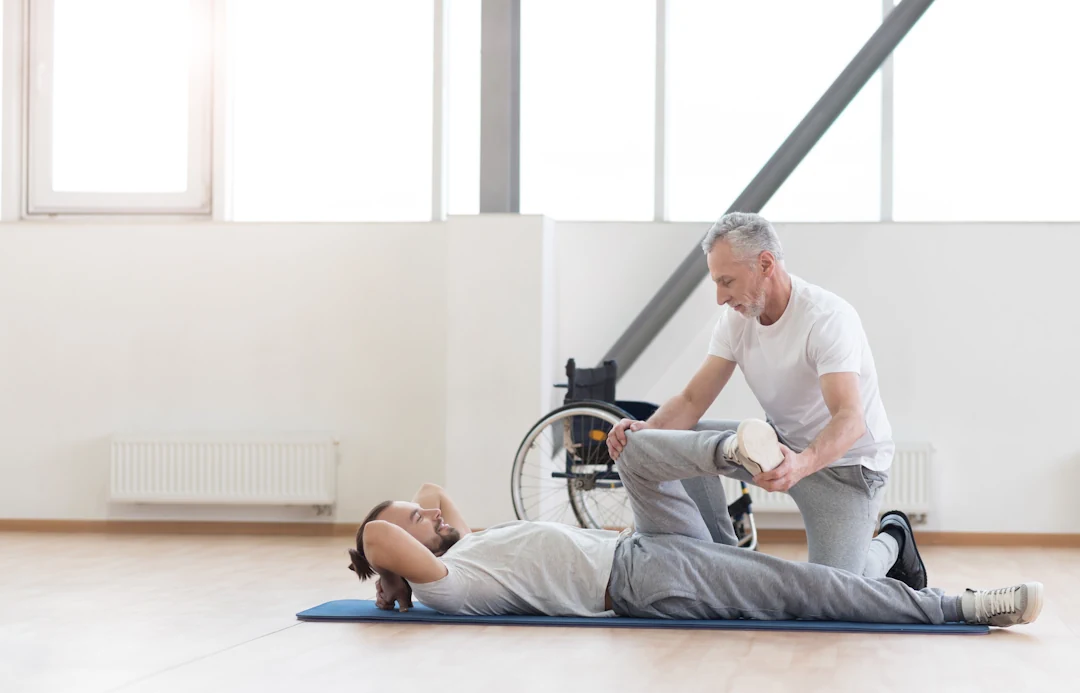
Health Tracker survey is an updated monitoring of the health needs of the adult population of Ukraine. The study continues the cooperation between Rating Group and the World Health Organization (WHO), launched in 2022. The second round of Health Tracker was conducted in March–April 2026.
Since 2022, Rating Group and WHO have regularly studied how the full-scale war affects Ukrainians’ access to health-care services and medicines, as well as population health. Health Tracker builds on the previous monitoring project, “Assessment of the Health Needs of the Adult Population of Ukraine”: it is a serial quantitative study with a modular questionnaire that makes it possible to track changes in the health sector during the protracted war. WHO conducts the analysis based on survey data collected by Rating Group.
The second round shows that access to essential health services in Ukraine remains broadly functional. Almost all respondents have access to a family doctor (96%), most have a signed declaration with a family doctor (92%), and most of those who sought primary health care received the services they needed either fully or partially. At the same time, mental health, the affordability of medicines and treatment, and disparities affecting internally displaced persons (IDPs) and residents of the most affected oblasts remain among the most prominent challenges.
Mental health and the impact of the war
- Three quarters of respondents (76%) reported mental health difficulties during the previous 12 months. The most common were anxiety, constant worry or difficulty relaxing (67%), low mood, trouble sleeping, poor appetite or difficulty concentrating (65%), and high levels of stress (58%).
- Among respondents who experienced mental health difficulties, a majority (70%) reported significant stress or other mental health problems during the previous two months. More than half (52%) said these difficulties interfered with their normal activities at home or work, or with interacting with other people.
- IDPs were more likely to report mental health difficulties than people residing in their home communities (80% vs 75%). IDPs also more often reported stress (64% vs 57%), low mood (70% vs 65%) and anxiety (73% vs 66%).
- In the most affected oblasts, 80% of respondents also reported mental health difficulties. Significant psychological distress during the previous two months was reported by 76%, compared with 67% in other regions.
- Among those who sought help, most received the support they needed: 87% from family doctors, 91% from mental health specialists and 83% from non-medical specialists.
Family doctors and primary health care
- Almost all respondents have access to a family doctor (96%). In-person access was reported by 88%, access by phone by 81%, via online messaging tools by 34% and via online calls by 24%.
- Most respondents have a signed declaration with a family doctor (92%), while 73% visited a family doctor during the previous 12 months.
- Nearly one in four IDPs (24%) changed their family doctor during the previous year, compared with 13% of people residing in their home communities. IDPs were also more likely to report having no access to a family doctor (8% vs 3%) and not having a signed declaration (9% vs 4%).
- Among those who needed primary health-care services and sought care, 74% received all the services they needed and a further 23% received them partially.
- The most common problems in accessing primary health care were the cost of medicines (48%), the cost of treatment (28%), transport costs (22%) and the time needed to access services (20%).
Specialized care, diabetes and rehabilitation
Beyond primary care, gaps in the completeness and continuity of care become more visible, particularly for some vulnerable groups.
- More than one third of respondents (37%) reported needing specialized health-care services. Among them, 84% sought such care, 66% received all the services they needed, 28% received them partially and 6% were unable to receive them.
- Health-care services for diabetes were needed by 9% of respondents. Among those who sought such care, 70% received all the services they needed, 23% received them partially and 4% were unable to receive them.
- IDPs were substantially less likely to receive all the diabetes-related services they needed: 48% compared with 73% among people residing in their home communities. At the same time, 42% of IDPs received services only partially, compared with 21% among non-displaced respondents.
- Rehabilitation services were needed by 13% of respondents. Among those who sought rehabilitation care, 61% received all the services they needed, 28% received them partially and 11% were unable to receive them.
- Among those who sought rehabilitation services, 70% faced access problems. The most common were the cost of medicines (41%), the cost of treatment (37%), transport costs (27%) and the time needed to access services (27%).
Medicines and the Affordable Medicines Program
Access to medicines remains one of the most sensitive aspects of health care: affordability is the main barrier, while security-related constraints add further pressure in the most affected oblasts.
- More than two thirds of respondents (69%) needed medicines. Among them, 89% encountered problems obtaining medicines and 11% were unable to obtain the medicines they needed.
- The most common problem was an increase in medicine prices (81%). Respondents also reported not having enough money to buy medicines (36%), medicines not being available at the pharmacy (24%) and having no pharmacy nearby (20%).
- In the most affected oblasts, security-related constraints on obtaining medicines were reported much more often than in other regions (23% vs 5%). Financial difficulties in affording medicines were also more common there (42% vs 34%).
- Most respondents who needed medicines were aware of the Affordable Medicines Program (68%). Among those aware of the programme, 28% received medicines under it, 7% tried but were unable to do so, while 60% had no need to use it.
- Among those who could not receive medicines under the programme, the most common reason was that the medicine they needed was not yet covered by the programme (43%).
Expenditures and postponed health care
Financial and everyday barriers continue to affect whether people seek health care in a timely manner.
- More than one quarter of respondents (27%) postponed health care.
- Among those who postponed care, respondents most often said they knew how to treat the condition from previous experience (83%) or expected it to resolve on its own (69%). Nearly two in five (39%) cited the high cost of services, medicines or transport, while 37% mentioned long queues in hospitals.
- One third of households (33%) had expenses related to health-care services during the previous month.
- Among households with an income, 34% reported that health-care and medicine expenditures accounted for less than 10% of household income, 26% said they accounted for 10–25%, and 14% reported spending 26–50%.
Impact of winter conditions
A separate thematic block in the second round examined how winter conditions affected everyday life, health and access to health care.
- More than four in five households (82%) reported that winter conditions affected their daily routines.
- The most common difficulties were disruptions to electricity supply (87%), increased household expenses for heating, electricity or fuel (77%) and difficulty keeping the home warm (52%).
- More than one third of respondents (35%) reported that winter conditions led to health problems. The most common were respiratory or cold-related illnesses (92%), worsening of chronic diseases (55%) and mental stress or anxiety related to winter conditions (51%).
- One in ten respondents (10%) reported being unable to access health care because of winter conditions.
Rating Group is one of Ukraine’s largest research institutions and has been operating since 2008. The company is registered in Ukraine and has extensive experience conducting sociological surveys in Ukraine and abroad. The group includes Sociological Group Rating, the Rating Lab research laboratory, the Rating Online platform and Rating CATI Center.

The Sociological Group "Rating" (Rating Group) conducted a representative survey of Ukraine's population on sociopolitical issues on August 5–6, 2026.
Trust in politicians, officials, and public figures
- Over the past month, trust levels have remained stable for Valerii Zaluzhnyi (68% trust, 21% distrust), Kyrylo Budanov (62% trust, 21% distrust), and Volodymyr Zelensky (59% trust, 38% distrust).
- As of early August, 58% trust Mykhailo Fedorov and 17% distrust him. "In recent weeks there have been shifts in trust levels: by mid-July, 35% trusted him."
- 56% trust the newly appointed Commander-in-Chief of the Armed Forces of Ukraine, Mykhailo Drapatyi, while 12% distrust him. 23% had not heard of him, and 9% answered "difficult to say."
- For Serhii Koretskyi, the newly appointed Prime Minister: 70% had not heard of him, 8% chose "difficult to answer," 10% trust him, and 12% distrust him.
Electoral attitudes
The survey included a hypothetical question about the first round of a presidential election.
- Leaders: Volodymyr Zelensky (25.2%), Valerii Zaluzhnyi (16.7%), Mykhailo Fedorov (12.5%)
- Next: Kyrylo Budanov (7.9%), Petro Poroshenko (5.6%)
- Other candidates: Dmytro Razumkov (2.8%), Yulia Tymoshenko (2.4%), Andrii Biletsky (2.2%), Serhii Prytula (1.7%), Yurii Boyko (1.7%)
- 3.9% would vote for another candidate, 5.5% would not take part, and 11.9% answered "difficult to say."
Rating Group is one of Ukraine's largest research institutions, operating since 2008. The company is registered in Ukraine and has extensive experience conducting sociological surveys in Ukraine and abroad. The group includes the Rating Sociological Group, the Rating Lab research laboratory, the Rating Online platform, and the Rating CATI Center.

The Sociological Group "Rating" (Rating Group) conducted a representative survey of Ukraine's population on July 20–21, 2026, on current sociopolitical issues:
- trust in officials and public and political figures;
- current personnel matters (Mykhailo Fedorov, Oleksandr Syrskyi);
- electoral attitudes.
Note: the survey was completed before media reports appeared about Oleksandr Syrskyi's resignation as Commander-in-Chief of the Armed Forces of Ukraine.
Trust in politicians, officials, and public figures
We asked respondents to rate their trust in specific officials, political figures, and public figures.
The highest trust levels go to Valerii Zaluzhnyi (70%), Mykhailo Fedorov (65%), Kyrylo Budanov (62%), and Volodymyr Zelensky (59%).
- 54% of Ukrainians expressed trust in Oleksandr Usyk, compared with 23% for Oleksandr Syrskyi and 21% for Petro Poroshenko.
- Over the past week, trust in Mykhailo Fedorov rose from 35% to 65%, while trust in Oleksandr Syrskyi fell from 39% to 23%.
Personnel matters: Mykhailo Fedorov and Oleksandr Syrskyi
72% of Ukrainians did not support Mykhailo Fedorov's dismissal as Minister of Defense, while 5% supported it.
Another 17% said they were indifferent, and 6% chose "difficult to answer."
Oleksandr Syrskyi's resignation as Commander-in-Chief of the Armed Forces of Ukraine was supported by more than half of respondents (55%), while 15% opposed the dismissal.
Another 19% said they were indifferent to the issue, and the remaining 11% chose "difficult to answer."
Electoral attitudes
We asked respondents whom they would vote for in the first round of a hypothetical presidential election in Ukraine.
- The top three by electoral support are Volodymyr Zelensky (22.3%), Valerii Zaluzhnyi (14.9%), and Mykhailo Fedorov (13.4%).
- Next come Kyrylo Budanov (7.2%), Oleksandr Usyk (5.9%), Petro Poroshenko (4.6%), Ihor Terekhov (4.3%), Dmytro Razumkov (3.7%), and Andrii Biletsky (2.3%).
- Yulia Tymoshenko – 1.7%, Serhii Prytula – 0.8%, Vitali Klitschko – 0.3%.
- 4% of respondents would vote for another candidate, 2.6% would not take part in the vote, and the remaining 11.9% answered "difficult to say."
Rating Group is one of Ukraine's largest research institutions, operating since 2008. The company is registered in Ukraine and has extensive experience conducting sociological surveys in Ukraine and abroad. The group includes the Rating Sociological Group, the Rating Lab research laboratory, the Rating Online platform, and the Rating CATI Center.

"Women in Business: Economics and Entrepreneurship Trends in Ukraine" is a joint analytical study by the visual communications agency Top Lead and Rating Group (the Sociological Group "Rating"), in partnership with the Ministry of Economy of Ukraine and YouControl.
Rating Group acted as General Partner and funded the survey that formed the basis of the study. In March 2026, we learned the opinions, plans, and outlook of 602 women entrepreneurs and 300 potential women entrepreneurs in Ukraine.
Below we present the main insights from the survey. The study's full report is available in the attached files, as well as on the platform from Top Lead.
When republishing (reprinting) these materials, a link to the Rating Group and Top Lead websites is required.
Business is freedom
For women, business is freedom — the ability to be independent, realize their own ideas, and have more control over their lives.
- Most respondents describe their own business as an opportunity: 67% among active entrepreneurs and 70% among potential ones. 18% of active entrepreneurs and one in four potential entrepreneurs call their own business a necessary step.
- Respondents most often see business as being about having more freedom rather than about earning money. This gap is especially visible among active entrepreneurs, where 48% pointed to freedom and 36% to the ability to earn more.
- For women, business is tied not only to basic financial security but also to higher-level needs. Respondents most often say business improves self-realization and personal development (88% among active, 95% among potential), self-respect (87% and 93%), and recognition and respect from others (78% and 79%).
- Even with equal income from business and paid employment, the vast majority of women (about 80% among both active and potential entrepreneurs) would choose their own business. Active entrepreneurs are even more convinced this is the right choice: more than half of them (54%) would definitely choose their own business, compared with 41% among potential entrepreneurs.
Values of active and potential entrepreneurs
- Active and potential entrepreneurs generally share similar value profiles: both groups are dominated by creativity and a focus on self-realization.
- At the same time, active entrepreneurs are less likely to see traditionalism (in the sense of modesty and restraint) as characteristic of themselves. Asked about the statement "It is important to this person to be modest and restrained; she tries not to draw attention to herself," one in five potential entrepreneurs (21%) said this describes her fairly or fully, compared with 12% among active entrepreneurs.
Resources and barriers at the start
- Active entrepreneurs named their own funds and savings as the main resource for starting out. Potential entrepreneurs, by contrast, are far more likely than active ones to expect to rely on grants and outside financing.
- Among active entrepreneurs, the top barrier is a lack of business knowledge and experience (34%). A shortage of funds was named by 29%, fear of risk by 25%, and uncertainty about demand by 20%.
- Among potential entrepreneurs, the hardest barrier at the start is a shortage of funds (56%). Also frequently mentioned are a lack of business knowledge and experience (36%), fear of risk and failure (35%), and uncertainty about demand (26%).
- 21% of active entrepreneurs said they faced no significant barriers at the start. Among potential entrepreneurs, only 3% said the same.
- To overcome barriers, active entrepreneurs primarily cite personal motivation (58%) and support from family and friends (42%); roughly one in four or five also mention a willingness to take risks and having a team or partners.
Demand for knowledge and support
Potential entrepreneurs need basic knowledge to get started, while active ones need tools for growth, scaling, and promoting their business.
- Active entrepreneurs focus relatively more on marketing and promotion (44%) and scaling the business (33%).
- Potential entrepreneurs are relatively more likely to want to strengthen their knowledge in financial planning and accounting (41%), sales (38%), legal issues and taxes (35%), and finding suppliers or partners (20%).
- Financing is a major challenge for both groups: 60% of active entrepreneurs and 66% of potential entrepreneurs lack the funding to carry out their plans.
Business conditions, the war, and everyday difficulties
Active entrepreneurs assess the state of business more optimistically than potential entrepreneurs do, but they also often mention difficulties such as uncertainty and psychological exhaustion.
- Active entrepreneurs rate the state of their own business far more positively than potential entrepreneurs rate the state of business in Ukraine overall. Among active entrepreneurs, 54% believe their business is thriving, 25% call it stable, and 22% say it is declining.
- Among potential entrepreneurs, more than half — 65% — believe business in Ukraine is declining, 16% call it stable, and 19% say it is thriving.
- The main external obstacles to business are falling consumer purchasing power, energy supply problems, a high tax burden, and rising prices for materials and components.
- On a personal level, active entrepreneurs' biggest difficulties are uncertainty about the future (65%), fatigue and burnout (42%), fear of losing income (35%), and a lack of time for themselves (24%).
Bias, sexism, and balancing business and family
47% of active entrepreneurs have faced gender-based bias or sexism in business.
50% had no such experience.
- Bias most often occurred in dealings with existing clients (32%), within the team (21%), and in negotiations with potential clients or during tenders (21%).
- Potential entrepreneurs are somewhat more optimistic about being able to combine business and personal life: 44% consider it easy, compared with 39% among active entrepreneurs.
- Among active entrepreneurs, 21% rate combining business and personal life as moderately difficult, and 41% as difficult.
Plans for the future
- Among active entrepreneurs, the most common plan for the next three years is to maintain the current level of activity, named by 37%.
- About a third have plans for growth: 29% plan to open a new line of business or launch new products or services, and 28% plan to scale their business.
- Among potential entrepreneurs, 44% are only considering starting their own business at some point in the distant future, and 32% have an idea but no specific timeline.
- A smaller share have taken more practical steps: 7% plan to launch within the next year, 4% are actively preparing to launch soon, and 2% have already begun preparatory steps.
Advice from active entrepreneurs
We asked entrepreneurs to give advice to women who don't yet have their own business but want to start one.
Fortune favors the bold.
Entrepreneurs most often said it's worth being bold: "Believe in yourself," "Commit to your idea," "Don't give up after the first setbacks," "Don't be afraid," "Start and just do it."
But it's also worth approaching it thoroughly.
At the same time, active entrepreneurs advise preparing well and thinking things through: "Be ready for difficulties," "Calculate the risks," "Have a clear plan and a financial cushion," "Keep learning."
Rating Group is one of Ukraine's largest research institutions, operating since 2008. The company is registered in Ukraine and has extensive experience conducting sociological surveys in Ukraine and abroad. The group includes the Rating Sociological Group, the Rating Lab research laboratory, the Rating Online platform, and the Rating Call Center.

For 46% of homeless people, the main reason for losing their housing was military action or occupation.
This is according to a study conducted by the Sociological Group "Rating" (Rating Group) in partnership with the charitable foundation Depaul Ukraine and the Ptoukha Institute for Demography and Social Studies of the National Academy of Sciences of Ukraine, with financial support from CAFOD.
Research stages
The study included four stages:
- Assessing the scale of homelessness — a survey of 1,090 homeless people (Kyiv, Odesa, Kharkiv, Lviv)
- A survey of homeless people — 260 respondents (Kyiv, Odesa, Kharkiv, Lviv)
- Expert interviews — 10 expert interviews
- A general representative survey of Ukraine's population on attitudes toward homelessness
Key findings
- IDPs and veterans — new risk groups: Among homeless people, 40% are internally displaced persons, and the number of veterans seeking help keeps rising. Experts note that veterans struggle to reintegrate into civilian life and end up on the street.
- Homeless people are often outwardly indistinguishable from the rest of the population: Although 70% of Ukrainians associate homelessness with addiction, the survey shows that 63% of homeless people have never had an alcohol dependency, and 92% have never had a drug dependency. Addiction is often not the cause but the result of living on the street.
- Readiness for change: 86% of homeless people say they want help returning to a stable life. 58% are willing to meet strict conditions (paying rent, employment, oversight by social services) to receive social housing.
- Public demand: 89% of the population consider homeless people full members of society, and 68% have a positive attitude toward opening a shelter near their home. Although 84% of citizens provided some help to homeless people over the past year, the public places the main responsibility for solving the problem on local authorities (39%) and central government (38%).
- A hidden scale of the crisis: 76% of Ukrainians say the homelessness situation has worsened as a result of the full-scale war. Official statistics may lag behind reality: the state records only 12,500 people, while the number of people visiting homeless assistance centers reaches 57,000–121,000. Experts estimate that the total number of homeless people, including those who don't turn to any service, may exceed one million.
Rating Group is one of Ukraine's largest research institutions, operating since 2008. The company is registered in Ukraine and has extensive experience conducting sociological surveys in Ukraine and abroad. The group includes the Rating Sociological Group, the Rating Lab research laboratory, the Rating Online platform, and the Rating Call Center.

How do parents and caregivers of children under 6 perceive kindergartens, and what do they expect from them?
This is addressed in the results of the study "Attitudes and Engagement of Parents and Caregivers with Preschool Education and Child Development in Ukraine," which Rating Group conducted in February 2026 at the request of UNICEF Ukraine, in partnership with Ukraine's Ministry of Education and Science (MES).
Preschool attendance
More than half of children under 6 attend a kindergarten.
- 55% of parents and caregivers of children under 6 said their child currently attends a kindergarten. 36% said their child does not attend, and another 2% said their child is enrolled but does not currently attend.
- The highest share of attendance was recorded in the West — 66%, and the lowest in the East — 37%.
- In regional centers, 60% of children attend kindergarten; in other cities, 57%; in villages, 47%.
- Among those whose children are enrolled in or attend kindergarten, 59% did not wait in a queue at all. 15% waited less than a month, 6% waited 1–2 months, 4% waited 3–5 months, 5% waited 6 to 12 months, and another 9% waited more than a year.
- 37% of parents and caregivers used the electronic queue when enrolling their child in kindergarten, and 62% did not.
- The electronic queue was used most often in regional centers — 59%. In other cities this figure is 31%, and in villages, 16%.
Why parents enroll children in kindergarten
Kindergarten is seen primarily as a setting for socialization and early development.
- The main reasons for enrolling a child in kindergarten are the opportunity for the child to interact with peers (named by 77% of parents and caregivers whose children are enrolled in or attend kindergarten) and supporting the child's early development (49%).
- One in four respondents whose child is enrolled in or attends kindergarten mentions preparing the child for school structure and routine (29%), the child being in a safe, developmental environment while parents are at work (28%), and kindergarten allowing parents or caregivers to keep working or return to work (28%).
- 22% mention introducing the child to academic basics, and 21% mention developing independence, confidence, and personal growth.
Why some children don't attend kindergarten
- Among respondents whose children don't attend kindergarten, 46% say this is because the child hasn't yet reached the appropriate age.
- 21% said they can't attend kindergarten because of the security situation. 10% cited the lack of a kindergarten in their settlement, and 8% cited the lack of a bomb shelter.
- Other reasons were mentioned less often: distrust in the child's safety with other people (6%), no group available for the relevant age category (6%), transport difficulties (5%), and insufficient funds to cover kindergarten-related costs (4%).
Experience attending kindergarten
Most parents and caregivers notice positive changes after their child starts attending kindergarten.
- 76% of respondents said that after their child started attending kindergarten, they noticed mostly positive changes in their child.
- 16% mention both positive and negative changes. Only 2% noted mostly negative changes, and 4% noticed no changes.
- The highest satisfaction ratings go to basic areas of care and interaction: care for children, interaction with parents, the composition of caregivers and staff, and the development of communication skills.
- Somewhat lower ratings go to the development of reading and math skills, food, the facility's financial transparency and accountability, and its material and technical equipment.
Which skills parents consider most important
We asked parents to choose up to three skills they consider most important for their child's development.
Parents most often consider communication and the ability to express one's personality the main skills for a child's development.
- Parents and caregivers most often named interacting with other children (40%), the ability to express and stand up for one's own opinion (36%), and interacting with adults (32%).
- One in four respondents (26%) named responsibility and the ability to make choices.
- Almost one in five named self-care, safe behavior, sensory development, and a healthy lifestyle.
- Academic and digital skills were mentioned far less often: math was named by 5%, digital literacy by 4%, civic awareness by 2%, and environmental awareness by 1%.
What services parents expect from kindergartens
Among parents, we see significant demand for modern, engaging resources for child development.
- The most common wish is for kindergartens to have modern and engaging playgrounds with a variety of equipment — 59%.
- Other frequently mentioned material needs include updated classroom technology, sensory rooms or spaces for relaxation and stimulation, and interactive floors or tables with learning technology (each around 40%).
- Also frequently mentioned are opportunities and activities such as speech therapy (45%), a swimming pool, and foreign language classes (44%). About a third also mentioned excursions and trips, music and theater programs, and STEM activities.
Rating Group is one of Ukraine's largest research institutions, operating since 2008. The company is registered in Ukraine and has extensive experience conducting sociological surveys in Ukraine and abroad. The group includes the Rating Sociological Group, the Rating Lab research laboratory, the Rating Online platform, and the Rating Call Center.

IRI Survey Shows Ukrainians Remain Optimistic About Ukraine’s Future. Results Also Show Overwhelming Support for Ukraine’s Accession to European Union Membership.
Kyiv, Ukraine – A nationwide poll conducted by the International Republican Institute’s (IRI) Center for Insights in Survey Research (CISR) shows that 78 percent of Ukrainians see their country’s future as promising and 85 percent believe their country will win the war against Russia.
“Even after four years of war, the Ukrainian people remain steadfast in the face of Russia’s unjust invasion,” said Stephen Nix, Senior Director for Europe and Eurasia at IRI.
When asked about accession to European Union (EU) Membership, 79 percent of Ukrainians stated their support for it.
“It is clear that Ukrainians desire a European-oriented future for their country,” stated Nix.
.webp)
This is the first summary report of the “Common Contours” research project by Rating Group, which includes surveys of Ukrainian population between March and June 2026. Key topics of this issue:
- How interested are Ukrainians in European politics compared to citizens of other European countries?
- How many Ukrainians would vote for joining the EU and NATO?
- Who is most supportive of the idea of joining the EU?
- How do Ukrainians assess the state of democracy in the country?
The full report also includes data from previous releases of “Common Contours” between March and June 2026.
"Common Contours" is a survey about Ukraine in a European context, where we reflect questions and compare data from our own surveys of Ukrainians with data from other surveys in EU countries, candidate countries, and other European countries. In this issue, we compare our own research data with Eurobarometer data – a series of official EU surveys from the European Commission and the European Parliament. Eurobarometer data belongs directly to the EU, and we thank them for open access to it.
How interested are Ukrainians in local, national, and European politics?
(based on April 2026 data)
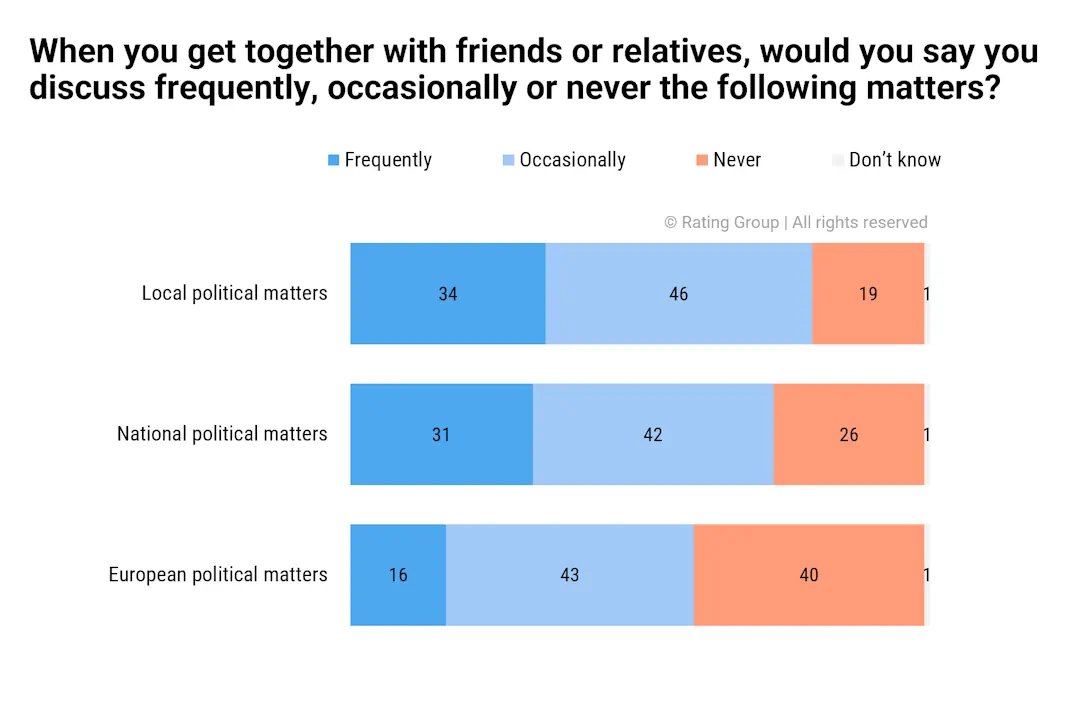
Most Ukrainians discuss local political matters (80%), national political matters in Ukraine (73%), and European political matters in general (59%) with friends or relatives. This indicates a significant level of interest in politics at different levels.
- Ukrainians’ interest in European political matters does not differ very strongly from the average across EU countries, where 70% on average discuss European politics at least occasionally.
- As in the EU on average, every seventh Ukrainian (16%) frequently discusses European political matters.
- Ukrainians discuss European politics somewhat more often than respondents in France (51%), Portugal, or Spain (56% each).
- Compared with European countries outside the EU, Ukraine’s figures are similar to those in the United Kingdom (63% discuss European politics), Albania (61%), and Turkey (59%).
Ukrainians who are interested in national politics are usually also interested in European political matters.
- For example, among respondents who frequently discuss national political matters in Ukraine, 49% also frequently discuss European political matters, while another 45% do so occasionally.
- By contrast, respondents who are not interested in Ukrainian politics are almost never interested in European political matters either (90%).
Support for EU and NATO accession
As of late June 2026, an absolute majority of Ukrainians support accession to the European Union (70%) and NATO (63%)
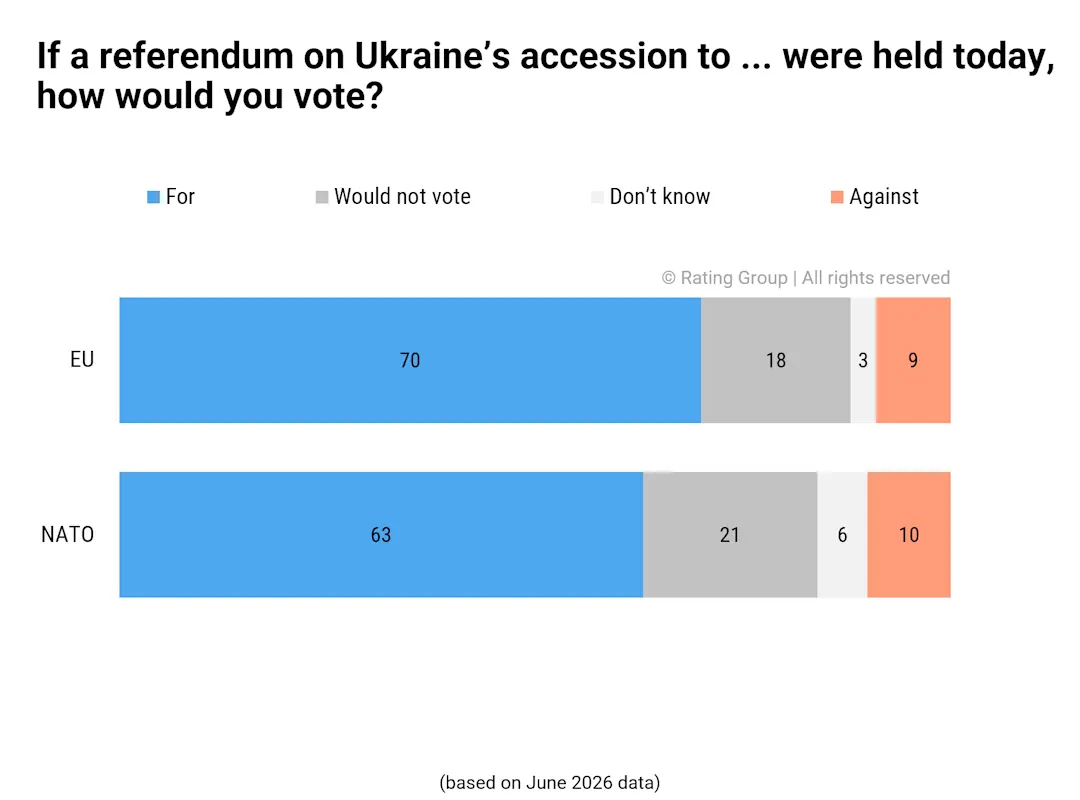
- EU accession is supported by 70% of Ukrainians.
- 9% oppose EU accession, another 18% said they would not vote in a referendum, and 3% were undecided.
- NATO accession is supported by 63% of Ukrainians.
- 10% oppose NATO accession, another one in five say they would not vote, and 6% were undecided.
How support for EU and NATO accession has changed in recent years
Overall, support for EU and NATO accession had been declining over the past three years, reaching its lowest point in April 2026. However, in June 2026, we observe a substantial increase in support.
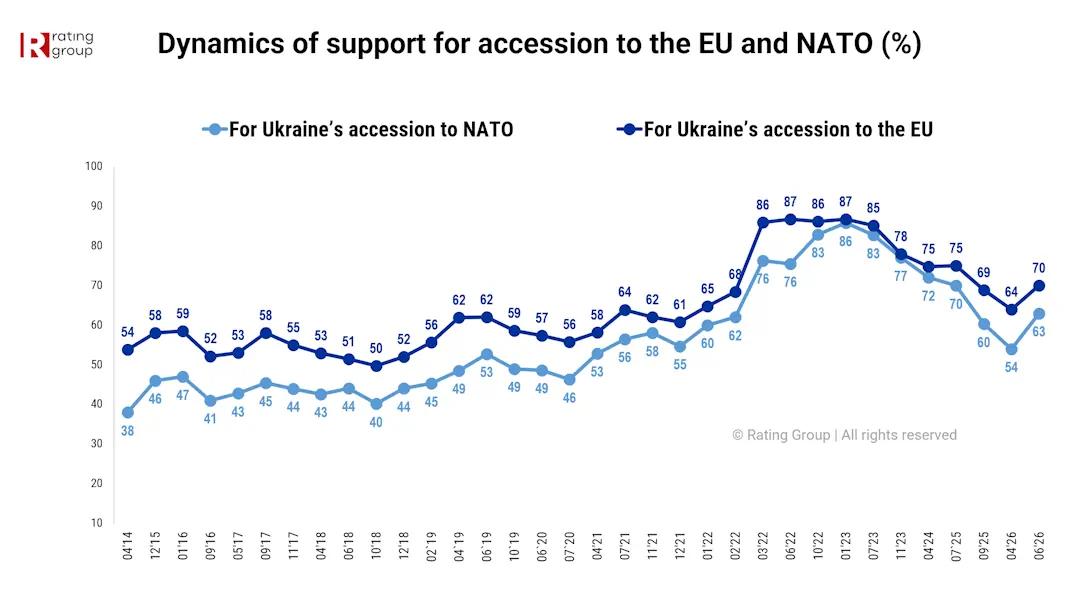
- For example, in July 2023, 85% supported Ukraine’s accession to the EU; in July 2025, 75%; and in April 2026, 64%. However, in June 2026, support increased again to 70%.
- Similarly, in July 2023, 83% supported Ukraine’s accession to NATO; in July 2025, 70%; and in April 2026, 54%. However, support for NATO accession rose sharply to 63% in June 2026.
In June 2026, the gap between support for the EU and NATO also narrowed.
- Historically, the gap between support for the EU and NATO remained at around 10 percentage points in favor of the EU.
- It narrowed to around 5 percentage points on the eve of the full-scale invasion, and then widened again to 10 percentage points in the first months of the full-scale war.
- Since late 2022, when the Armed Forces of Ukraine had already liberated a significant part of the occupied territories and more substantial military assistance began arriving from NATO allies, support for joining NATO and the EU became almost synchronized: around 85% supported accession to both alliances.
- Starting in the summer of 2023, the gap widened again and stood at around 10 percentage points as of April 2026.
- In June 2026, the gap between support for the EU and NATO narrowed to 7 percentage points.
Comment by Hlib Kuzmenko, Research Expert and Head of Communications at Rating Group:
“Between September 2025 and April 2026, support for EU and NATO accession declined to its lowest level since the beginning of the full-scale invasion. The gap between support for EU and NATO accession also increased. Speaking about the information environment in March and April, Ukrainians likely paid attention to the absence of a unified position within NATO and the EU regarding the war in Iran, critical statements by U.S. representatives about NATO’s capacity, hints at a possible withdrawal from the Alliance, and similar developments.
Put simply, Ukrainians may have developed stronger doubts about the real capacity of NATO and the broader West in the field of security.
In June 2026, the informational and emotional environment became completely different, and attitudes toward EU and NATO accession improved. First, Ukrainians now see effective strikes by the Defense Forces against Russian targets and significant successes on the front almost every day. This certainly strengthens belief in Ukraine’s overall prospects, including its geopolitical prospects. Second, the European Union officially launched accession negotiations with Ukraine and opened the first cluster of Ukraine’s accession talks. This is a significant step forward.
There are also other positive signals regarding military and economic support for Ukraine from G7 allies, NATO, and other partners.”
What is support for EU accession associated with?
Based on April 2026 data, we identified several patterns in the views that make respondents more likely to support EU accession.
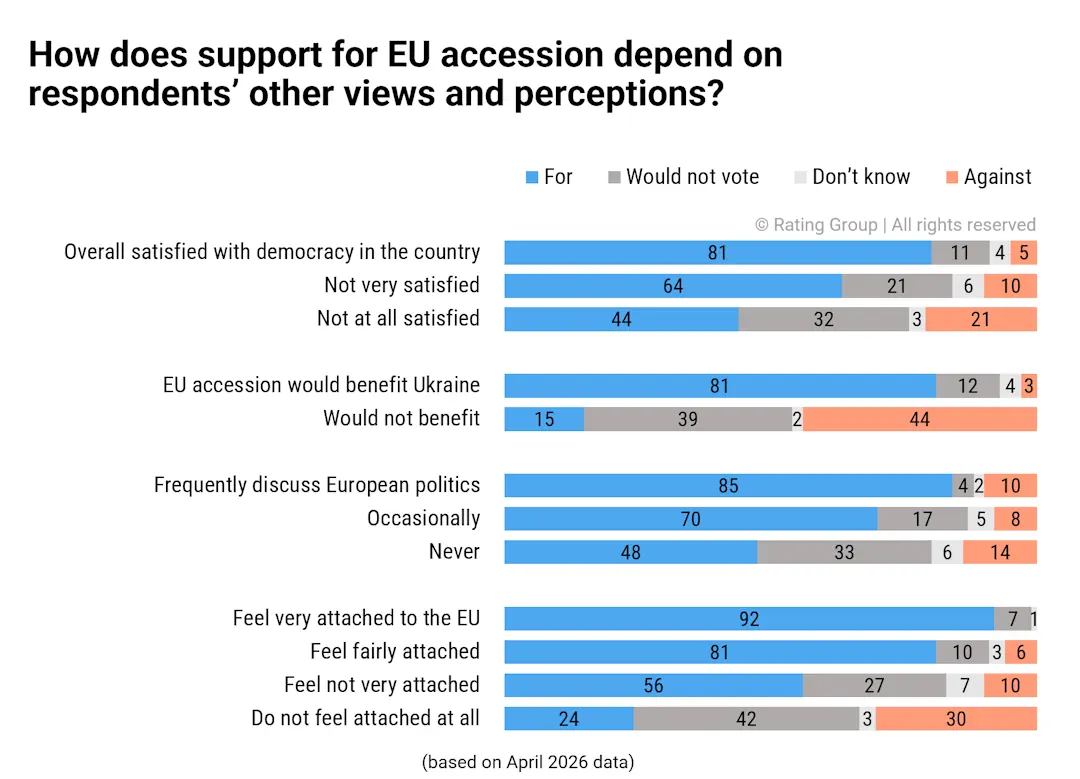
Emotional attachment to the European Union and the belief that accession would benefit the country are important foundations of support for Ukraine’s EU accession.
- Respondents who feel emotionally attached to the EU almost always support EU accession: 92% among those who feel very attached and 81% among those who feel fairly attached.
- By contrast, among respondents who do not feel attached to the EU at all, only one quarter would support Ukraine’s accession.
- The perception of benefit for the country is also an important indicator of support for accession. Among respondents who believe that Ukraine would benefit from joining the EU, 81% would vote in favor of accession in a referendum.
- Conversely, respondents who do not see benefits for Ukraine from joining the EU most often say they would vote against accession (44%) or would not vote at all (39%). Only 15% of them would support EU accession.
Respondents who are interested in European politics are more supportive of Ukraine’s European integration.
- Three quarters of respondents who frequently discuss European political matters with friends, and 70% of those who do so at least occasionally, support Ukraine’s EU accession.
- Among those who never discuss European politics, support for accession is significantly lower — 48%. Around one third (30%) would vote against accession, and 42% say they would not vote in a referendum.
Respondents who are very or fairly satisfied with the way democracy works in Ukraine mostly support EU accession (81%).
- Respondents with the most critical assessment of the state of democracy in the country — those who are not at all satisfied — support accession almost twice less often: 44% would vote in favor.
- Every fifth respondent who is dissatisfied with the way democracy works opposes EU accession. Another third say they would not take part in the vote.
Perceptions of democracy, protection of rights, and communication in the country
Most Ukrainians are dissatisfied with the way democracy works in the country (64%).
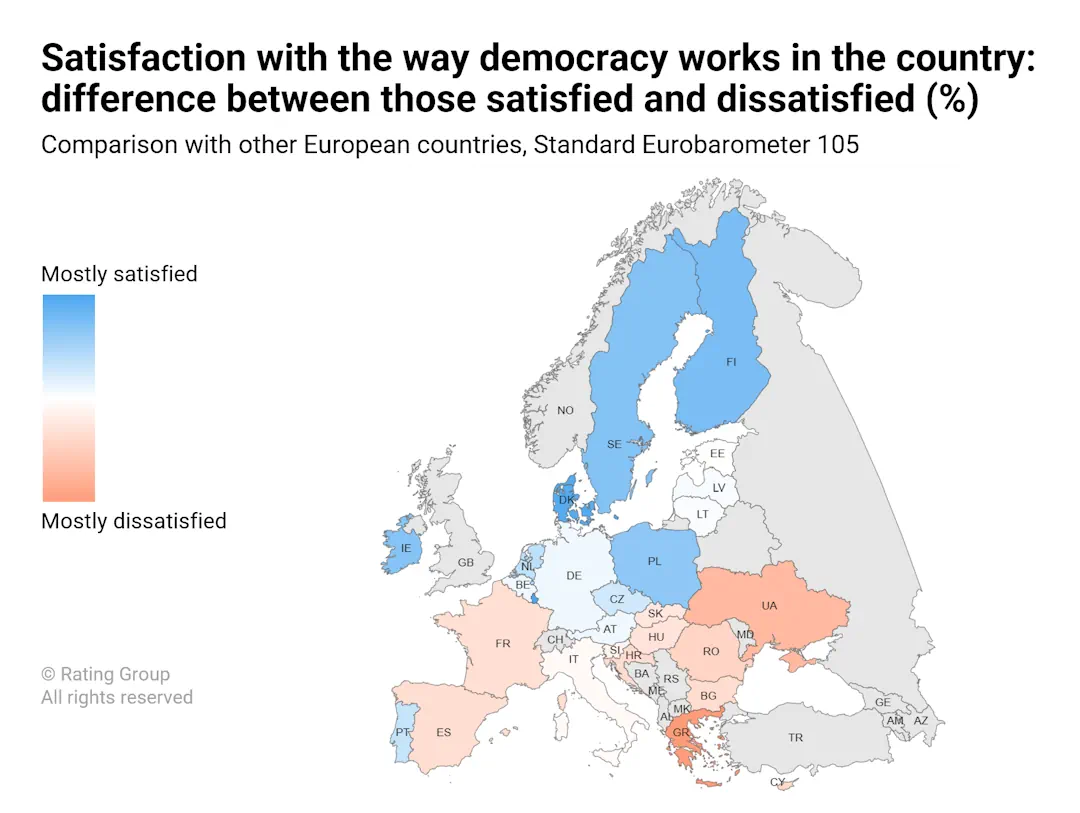
- Another third of Ukrainians (33%) say they are satisfied with the way democracy works in the country, while 3% were undecided.
- Ukrainians who oppose EU accession are much more likely to be dissatisfied with the state of democracy: 82%, compared with 57% among supporters of accession.
- Against the EU average, where 58% are satisfied and 40% are not, Ukrainians assess the functioning of democracy in their country more critically.
- A relatively similar situation can be observed in other European countries where the share of those dissatisfied with the state of democracy exceeds the share of those satisfied. This includes a number of countries in Eastern Europe (Romania, Bulgaria, Hungary) and Southern Europe (Greece, Cyprus, Croatia, Spain), as well as France.
More than half of Ukrainians (53%) disagree with the statement that core EU values, such as fundamental rights, democracy, and the rule of law, are properly protected in the country.
- At the same time, 44% still believe that these values are protected.
- On this indicator, Ukrainians are also more critical than residents of the European Union: on average, two thirds of EU respondents (66%) confirm that core EU values are protected in their country.
- There is a substantial difference in responses between supporters and opponents of EU accession. Among supporters of Ukraine’s accession to the EU, opinions are roughly divided: 50% still believe that EU values are protected in Ukraine, while 48% disagree.
- Meanwhile, among opponents of Ukraine’s accession to the EU, three quarters (75%) disagree with the statement.
Most Ukrainians are concerned about threats to freedom of expression, independence of the media, and disinformation. The figures are similar to those in EU countries.
- More than half of Ukrainians are very concerned about the independence of the media; the EU average is 56%.
- Disinformation is of great concern to 59% of Ukrainians and, on average, 69% of respondents in the EU.
- Freedom of expression is a major concern for 59% in Ukraine and, on average, 67% in the EU.
Project team
- Ihor Tyshchenko, Rating Group Founder & CEO
- Tetiana Skrypchenko, Rating Group Deputy Director
Research analysts
- Hlib Kuzmenko, “Common Contours” coordinator, Research Expert & Head of Communications, Rating Group
- Yevhen Krotevych, Head of Analytics, Rating Group
- Artem Shevchenko, Analyst, Rating Group
- Daryna Narolska, Analyst, Rating Group
- Lina Mukhina, Analyst, Rating Group
Data collection and processing
- Bohdan Suliatytskyi, Call Center Director
- Vitaliy Strelchenko, Head of CATI/CAWI Projects Department
- Dmytro Ponochovnyi, Data Processing Specialist
Rating Group is one of Ukraine's largest research institutions, operating since 2008. The company is registered in Ukraine and has extensive experience conducting sociological surveys both within Ukraine and abroad. The group includes: Rating Sociological Group, Rating Lab research laboratory, Rating Online platform, and Rating Call Center.

Ukrainian society combines a sense of closeness to the country with a closeness to the wider, European space, shows issue #6 of the “Common Contours” study by the Rating Group
"Common Contours" is a survey about Ukraine in a European context, where we reflect questions and compare data from our own surveys of Ukrainians with data from other surveys in EU countries, candidate countries, and other European countries. In this issue, we compare our own research data with Eurobarometer data – a series of official EU surveys from the European Commission and the European Parliament. Eurobarometer data belongs directly to the EU, and we thank them for open access to it.
Emotional connection with the country and city / village
- 93% of respondents feel an emotional connection with Ukraine.
- However, the intensity of the connection of Ukrainians with the country is higher than the average in EU countries: if in Ukraine 69% have a pronouncedly strong emotional connection with the country, such sentiment is shared by 52% on the EU countries.
- 84% of Ukrainians feel close to the city / village.
- A similar sentiment towards their native settlement is shared by respondents in the countries of Northern Europe (83-84%), Estonia (84%), and France (85%).
Emotional connection with the EU & Europe
Although Ukraine is not yet a member of the EU, most citizens feel an emotional closeness to the EU and Europe in general. The estimates are comparable to the estimates in the EU member states
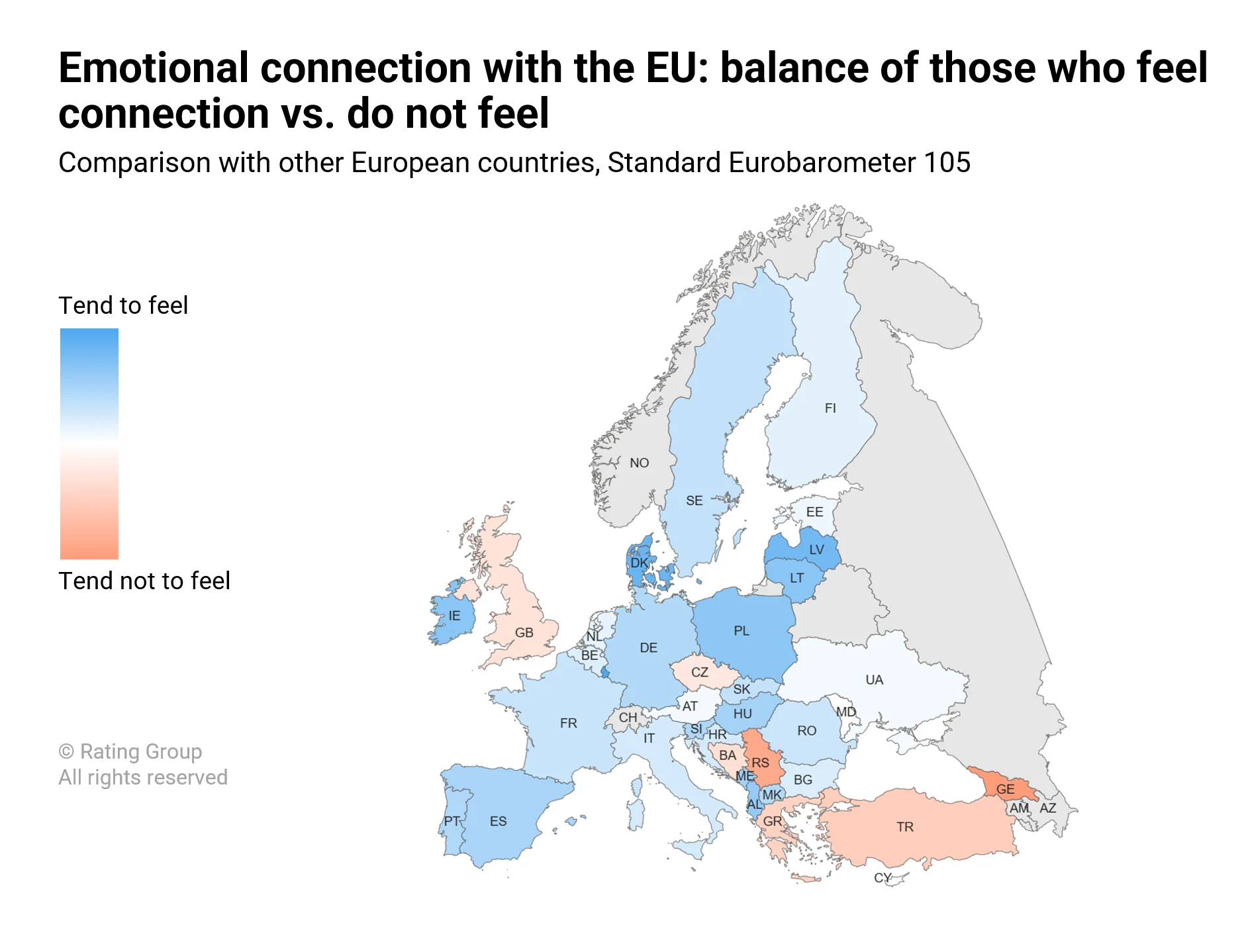
- More than half of Ukrainians feel emotional connection with the EU (51%) and Europe in general (56%).
- For comparison: on average in the European Union countries, 62% feel an emotional connection with the EU.
- The level of emotional connection with the EU in Ukraine is similar to the estiamtes in Cyprus (52%), Austria (54%), Estonia (54%), Finland (56%), the Netherlands (56%) and is somewhat higher than in the Czech Republic (44%) and Greece (38%).
- Older respondents, respondents with higher income and education levels, residents of Kyiv, and western regions feel relatively stronger connection EU.
- Logically, among supporters of joining the EU, the majority feel an emotional connection with the European Union (67%).
Ukraine belongs to the candidate countries with the strongest emotional attachment to the EU
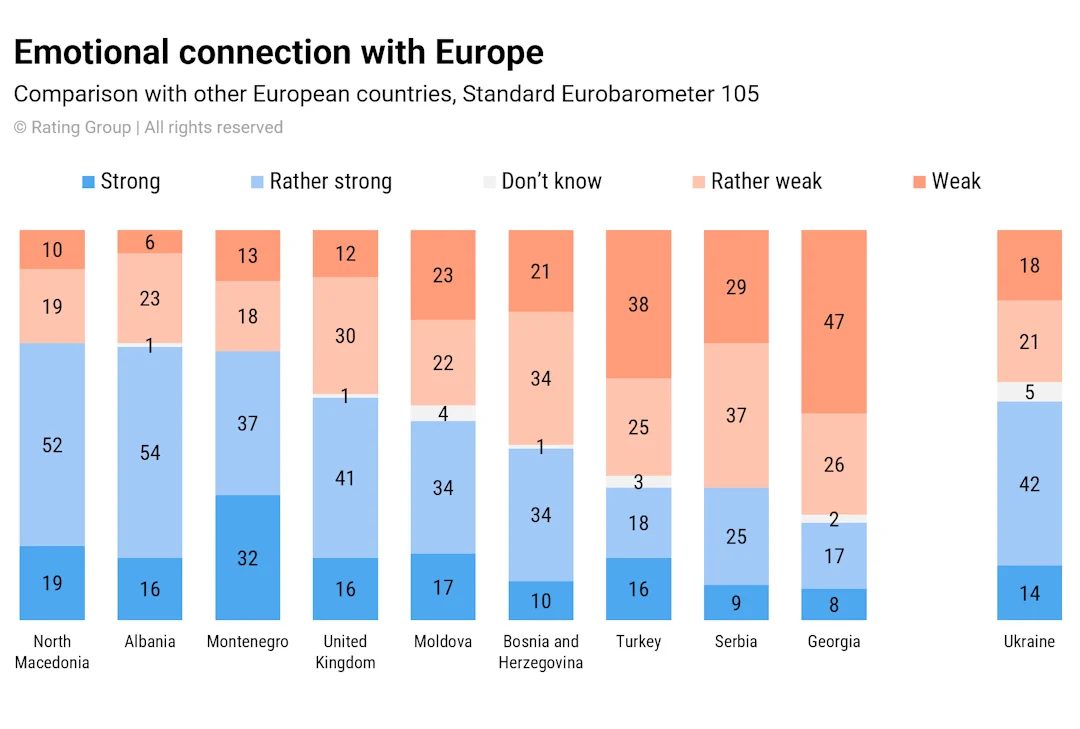
- Among the candidate countries, the highest level of emotional connection with the EU is felt by residents of Albania (70%), Montenegro (68%), North Macedonia (55%), Ukraine (51%), and slightly less by residents of Moldova (49%).
- To compare, 42% in the United Kingdom and Bosnia and Herzegovina, 1/3 in Turkey, only 25% in Serbia, and 20% in Georgia feel emotional attachment to the EU.
Rating Group is one of Ukraine's largest research institutions, operating since 2008. The company is registered in Ukraine and has extensive experience conducting sociological surveys both within Ukraine and abroad. The group includes: Rating Sociological Group, Rating Lab research laboratory, Rating Online platform, and Rating Call Center.

What are the educational needs of Ukrainian veterans? What motivates them to pursue education after their service, and what education formats interest them most?
Find out in the results of a survey conducted by the Rating Group and the Ukrainian Veterans Fund of the Ministry of Veterans Affairs in December 2025.
Education needs
- A quarter of veterans indicated a need for education after discharge from service.
- However, the majority reported that there was no such need.
Motivation and decision to pursue education
- Among respondents who reported a need for education, the most frequently cited purpose of pursuing education after service was self-development and personal growth – 60%.
- One-third of respondents – 33% – mentioned a change of occupation compared to their activities before military service. Increasing competitiveness in the labour market was selected by 22% of respondents. Rapid entry into the labour market and meeting new people/socialisation were each mentioned by 17%.
- More than half of respondents who had a need for education – 57% – did not participate in educational programmes for veterans. A total of 28% completed an educational programme, while another 15% reported that they had started but did not complete their studies.
- Among those who had a need for education and used educational opportunities, 65% chose formal education – higher education, professional pre-higher or vocational education and training. Professional training and retraining courses were completed by 42% of respondents. Non-formal education – trainings, seminars, consultations and online courses – was used by 27%. Grants and financial support for education were mentioned by 19%.
- Respondents who had a need for education but did not participate in training most often cited lack of time as the main reason – 32%. Lack of funds was mentioned by 26%, while bureaucratic barriers and health problems were each selected by 21%. Lack of information about educational opportunities was reported by 18%. An educational environment not adapted for people with disabilities and the fact that the need had already been fulfilled were each mentioned by 9%.
Perception of education opportunities
- When speaking about factors that make educational opportunities more appealing, 28% of veterans mentioned support with subsequent employment. Affordable cost or free education, as well as the opportunity to combine education with work, were each selected by 25%.
- The opportunity to study online was mentioned by 19%. Receiving a certificate was selected by 14%, while a practical learning format – projects, case studies and internships – and a flexible asynchronous schedule were each mentioned by 11%. Mentoring support was reported by 8%, and the reputation of the organisation or instructors by 7%. At the same time, 27% did not select any of the listed factors.
- Support with subsequent employment as a factor making educational opportunities more appealing was mentioned more often by respondents from frontline territories, younger respondents aged 21–35, women veterans and low-income respondents. Affordable education was more often mentioned by respondents from central regions, younger respondents, women veterans, and respondents with medium or sufficient income levels. The opportunity to combine education with work was mentioned somewhat more often by respondents from western and central regions, women veterans, respondents with medium or sufficient income levels, and people with higher education.
Education formats
- Formal education was selected as the preferred education format by 34% of respondents. Professional training and retraining courses were selected by 27%, while non-formal education was chosen by 23%. The option “none” was selected by 18%.
- Formal education is more appealing to residents of frontline territories and younger respondents aged 21-35. Professional training courses were more often selected by veterans from western and central regions, women veterans and respondents without disabilities.
- Non-formal courses were mentioned somewhat more often by veterans from central regions and by low- and medium-income respondents.
- As for the optimal duration of educational programmes, respondents’ opinions were divided as follows: 20% consider 3-6 months to be optimal, and the same share – 20% – selected programmes lasting more than one year. A duration of 1-3 months was mentioned by 18%, while 6-12 months was selected by 15%. Programmes lasting less than one month were chosen by 4%. A total of 23% were undecided.
Perception of education providers
- According to respondents, the preferred providers of educational services are state educational institutions – 45%.
- Private educational companies and resources, as well as educational programmes offered by civil society organisations and donors, were each selected by 18% of respondents. Educational programmes offered by businesses were chosen by 15%. A total of 19% of surveyed veterans were undecided on this issue.
- State educational institutions were more often selected by respondents from frontline regions, younger respondents aged 21-35, women veterans, low-income respondents and people with higher education.
- Educational programmes offered by civil society organisations are more appealing to veterans from central regions and older respondents aged 46 and above.
- Private educational companies and resources are relatively more appealing to respondents from frontline regions, younger respondents, women veterans and higher-income respondents.
Themes of interest
- Among educational opportunities by area of interest, surveyed veterans most often mentioned information technology and digital professions – 17% – and construction, architecture and design – also 17%. Engineering, manufacturing and industry were selected by 16%. Military affairs, security and the defence industry were mentioned by 14%.
- Transport, logistics and aviation/maritime affairs were selected by 13%; law, public administration and policy by 12%; and economics, finance and entrepreneurship by 11%.
- Education, culture and humanities were chosen by 10%; medicine, pharmaceuticals and social services by 9%; the agricultural sector and food industry by 8%; and services, hospitality and restaurant business and tourism, as well as communications and media, by 6% each. The option “none of the above” was selected by 16%.
- The breakdowns by age and gender show notable differences. Information technology and digital professions; military affairs, security and the defence industry; and economics, finance, entrepreneurship and business administration were more often selected by younger respondents aged 21-35. Transport, logistics and aviation/maritime affairs were more often chosen by older respondents aged 46 and above. Construction, architecture and design were selected more often by men veterans, while military affairs, security and the defence industry; law, public administration and policy; education, culture and humanities; and especially medicine, pharmaceuticals and social services were more often selected by women veterans.
Rating Group is one of Ukraine's largest research institutions, operating since 2008. The company is registered in Ukraine and has extensive experience conducting sociological surveys both within Ukraine and abroad. The group includes: Rating Sociological Group, Rating Lab research laboratory, Rating Online platform, and Rating Call Center.

4-12 травня 2026 року Rating Group (Соціологічна група "Рейтинг") опитала 1100 мешканців Одеської області щодо оцінки релігійної ситуації в Україні. Нижче - ключові знахідки дослідження.
Ставлення до різних конфесій
- Недовіра до людей інших релігійних конфесій є меншою (31%) порівняно з недовірою до людей інших політичних поглядів (36%) або іншої національності (59%).
- Серед лідерів релігійних конфесій найбільшу довіру опитані висловлюють до митрополита Епіфанія, Предстоятеля Православної Церкви України (41%), найменшу - Патріарха Російської Православної Церкви Кирила (6%).
- На думку опитаних, відносини між вірянами різних церков і релігій є більш дружніми або спокійними у місцевості, де вони проживають (78%), ніж загалом в Україні (47%).
Релігійна приналежність
- 32% мешканців Одеської області називають себе православними, проте не відносять себе до жодної конфесії, 17% відносять себе до Православної Церкви України (митрополит Епіфаній), 16% - до невіруючих, атеїстів, 15% - до віруючих, що не відносять себе до жодної конфесії, 11% - до вірян Української Православної Церкви (митрополит Онуфрій). 50% православних зазначили вплив на визначення своєї конфесії сімейними традиціями та вихованням, 37% - усвідомленим вибором у дорослому віці, 25% - культурною та національною ідентичністю.
- Серед тих, хто не відносить себе до жодної православної конфесії, 35% називають вважають релігію особистою справою, 22% ніколи не замислювалися над питанням визначення конфесії, 16% не довіряють церковним інституціям загалом, ще 16% зазначають суперечності та конфлікти між православними конфесіями.
- 91% опитаних святкують Різдво, з них 32% - 25 грудня, інші 32% - 7 січня, 27% двічі – 25 грудня і 7 січня.
Релігійні вірування та практики
Більшість респондентів в Одеській області (74%) вірять у Бога, а ще 14% не вірять в Бога, але вірять у вищі сили
- Ще 11% не вірять в існування Бога та вищих сил.
- За словами 54% опитаних, їхні релігійні погляди і конфесійна приналежність не змінились з початку повномасштабного вторгнення, у 15% посилилися, у 7% послабилися. 23% не були релігійними і не стали на цей момент.
- Серед релігійних практик мешканці Одеської області найчастіше носять релігійні символи (41%), моляться вдома (33%), читають або слухають релігійні тексти (14%), відвідують богослужіння – 10%. Спілкуються з духовними наставниками 8%, дотримуються посту – 6%, займаються духовними практиками – 5%.
- У виборі церкви опитані частіше керуються територіальною близькістю (40%), особистістю священника (32%), атмосферою (23%), належністю до конфесії (18%), мовою богослужіння (17%).
Оцінка релігійної ситуації в Україні
- Більшість мешканців Одеської області (65%) оцінюють ступінь свободи віросповідання в Україні як високий, 31% - як низький. Абсолютна більшість (89%) не зазначали утисків через релігійні переконання ані щодо себе, ані щодо своїх близьких.
- 55% респондентів вважають, що богослужіння має вестись українською мовою, 39% - мовою, традиційною для конфесії.
- Більше половини (55%) вважають, що краще, коли люди в суспільстві мають різні вірування, 39% - якщо вірування є однаковими.
- 60% вважають, що Церква в Україні має бути відокремлена від держави, натомість 35% не погоджуються з цим.
- 78% опитаних погоджуються із тим, що держава має регулювати релігійні організації, якщо вони порушують законодавство або загрожують суверенітету України.
Створення ПЦУ
- 55% респондентів позитивно оцінюють створення Єдиної Помісної Церкви – Православної Церкви України, більше третини байдуже ставляться до цієї події.
- 50% мешканців Одеської області підтримують ідею об’єднання православних церков – Православної Церкви України та Української Православної Церкви в єдину Православну Церкву України
- Ідею об’єднання усіх православних церков, зокрема Православної Церкви України, Української Православної Церкви і Української Греко-католицької Церкви в єдину Православну Церкву України підтримують 39% респондентів.
Питання зв'язку релігійних організацій в Україні з російською церквою
- 73% опитаних підтримують ідею розриву зв’язків Української Православної Церкви з Російською Православною Церквою через російську агресію проти України.
- 56% підтримують закон, який забороняє діяльність релігійних організацій, пов’язаних з державою-агресором росією.
- 48% підтримують ідею заборонити діяльність Української Православної Церкви під керівництвом митрополита Онуфрія через зв’язки з Російською Православною Церквою. Також 55% опитаних підтримують введення санкцій щодо митрополита Онуфрія через його зв’язки з Російською Православною Церквою.
Національна приналежність
- 86% опитаних мешканців Одеської області вважають себе українцями за національністю, тільки 4% - росіянами.
- Ще 3% вказали приналежність до болгар, а 1% - до гагаузів.
Rating Group — одна з найбільших дослідницьких інституцій України, яка на ринку з 2008 року. Компанія зареєстрована в Україні та має значний досвід проведення соціологічних опитувань в Україні та за кордоном. До групи входять: Соціологічна група Рейтинг, дослідницька лабораторія Rating Lab, платформа Rating Online та Rating Call Center.

Як українці оцінюють релігійну ситуацію в Україні? 4-9 травня 2026 року Rating Group (Соціологічна група "Рейтинг") опитала 2000 українців щодо релігійної ситуації в Україні. Нижче - ключові знахідки дослідження.
Ставлення до різних конфесій
- Недовіра до людей інших релігійних конфесій є невисокою (31%) порівняно з недовірою до людей інших політичних поглядів (60%) або іншої національності (38%).
- Серед лідерів релігійних конфесій найбільшу довіру українців має митрополит Епіфаній, Предстоятель Православної Церкви України (47%), найменшу - Патріарх Російської Православної Церкви Кирило (3%), рівень недовіри до якого різко зріс у порівнянні з даними 2018 р.
- На думку опитаних, відносини між вірянами різних церков і релігій є більш дружніми або спокійними у місцевості, де вони проживають (74%), ніж загалом в Україні (48%).
Релігійна приналежність
- 26% українців відносять себе до православних, без визначення конкретної конфесії, 22% - до Православної Церкви України (митрополит Епіфаній), 16% - до віруючих, що не належать до жодної конфесії.
- 46% православних зазначили вплив на визначення своєї конфесії сімейними традиціями та вихованням, 37% - усвідомленим вибором у дорослому віці, 28% - культурною та національною ідентичністю.
- 38% опитаних не відносять себе до жодної православної конфесії через думку про те, що релігія – це особиста справа, 27% ніколи не замислювалися над питанням визначення конфесії, 19% не довіряють церковним інституціям загалом, 16% - через суперечності та конфлікти між православними конфесіями.
- 90% українців святкують Різдво, з них 51% - 25 грудня, 18% - 7 січня, 21% двічі – 25 грудня і 7 січня.
Релігійні вірування та практики
Абсолютна більшість респондентів загалом вірить в існування Бога (78%). Ще 12% не вірять у Бога, але вірять в існування вищих сил
- Більше половини респондентів (56%) вважають, що Бог існує, і не сумніваються в цьому, 22% вірять в існування Бога, однак іноді сумніваються, 12% не вірять в Бога, але вірять у вищі сили, 8% не вірять в існування Бога та вищих сил.
- У 56% опитаних не змінились релігійні погляди і конфесійна приналежність з початку повномасштабного вторгнення, у 18% посилилися, у 6% послабилися, 19% не були релігійними і не стали зараз.
- Серед релігійних практик найчастіше українці згадують носіння релігійних символів (42%), молитви вдома (36%), читання або слухання релігійних текстів (18%), відвідування богослужіння у церквах (13%). Спілкуються з духовними наставниками та дотримуються посту по 9%, займаються духовними практиками та медитаціями – 7% опитаних.
- У виборі церкви опитані частіше керуються територіальною близькістю (36%), особистістю священниками (30%), атмосферою (23%), мовою богослужіння (22%), належністю до конфесії (20%).
Релігійна ситуація в Україні, свобода віросповідання
- 68% українців оцінюють ступінь свободи віросповідання в Україні як високий, 27% - як низький. Абсолютна більшість опитаних (88%) не зазнавали утисків через релігійні переконання ані щодо себе, ані щодо своїх близьких.
- На думку 70% респондентів, основною мовою богослужіння в Україні має бути українська, 24% - мова, традиційна для конфесії.
- 50% респондентів вважають, що краще, коли люди в суспільстві мають різні вірування, 42% - якщо вірування є однаковими.
- 50% опитаних вважають, що Церква в Україні має бути відокремлена від держави, тоді як 45% підтримують протилежне твердження.
- Переважна більшість опитаних (79%) погоджується із твердженням, що держава має регулювати релігійні організації, якщо вони є загрозою для України.
Створення ПЦУ
- 60% респондентів позитивно оцінюють створення єдиної Помісної Церкви, близько третини висловлюють байдужість до цієї події.
- 54% респондентів підтримують ідею об’єднання православних церков – Православної Церкви України та Української Православної Церкви в єдину Православну Церкву України, 45% - ідею об’єднання усіх православних церков, зокрема Православної Церкви України, Української Православної Церкви і Української Греко-католицької Церкви в єдину Православну Церкву України.
Питання зв'язку релігійних організацій в Україні з російською церквою
- 80% опитаних підтримують ідею розриву зв’язків Української православної церкви з Російською православною церквою через російську агресію проти України.
- 62% опитаних підтримують закон, який забороняє діяльність релігійних організацій, пов’язаних з державою-агресором росією.
- 57% підтримують ідею заборонити діяльність Української Православної Церкви під керівництвом митрополита Онуфрія через зв’язки з Російською Православною Церквою. Також 67% опитаних підтримують введення санкцій щодо митрополита Онуфрія через його зв’язки з Російською православною церквою.
Rating Group — одна з найбільших дослідницьких інституцій України, яка на ринку з 2008 року. Компанія зареєстрована в Україні та має значний досвід проведення соціологічних опитувань в Україні та за кордоном. До групи входять: Соціологічна група Рейтинг, дослідницька лабораторія Rating Lab, платформа Rating Online та Rating Call Center.

До Дня Києва 2026 Соціологічна група "Рейтинг" (Rating Group) опитала 1200 мешканців Києва та дізналася думку громади про:
- сприйняття загальної ситуацію в Україні та місті
- відзначення Дня Києва
- діяльність місцевої влади
Ситуація в Україні та Києві зокрема
- 46% опитаних киян кажуть, що справи в Україні загалом йдуть у неправильному напрямку, тоді як 32% - що в правильному. 21% не змогли дати однозначну відповідь на це питання.
- З кінця 2025 року в киян з'явилося дещо більше оптимізму: у листопаді про те, що справи в Україні рухаються в правильному напрямку, казали 24%, нині - третина.
- 82% киян вважають Київ у цілому комфортним для життя. Порівняно з результатами опитування, проведеного у серпні 2021 р., дещо зросла частка киян, які вважають столицю комфортною для проживання (з 75% до 82%).
- Серед наявних можливостей у Києві найкраще опитані оцінюють можливості знайти роботу в місті (7,8 балів), відпочивати та проводити дозвілля (7,5) і досягти успіху (7,0).
- Інші можливості оцінені гірше, зокрема заняття підприємництвом (5,6), проживання у безпеці (4,4).
День Києва
Абсолютна більшість мешканців столиці (87%) пишається тим, що проживає у Києві
- Серед основних причин гордості за Київ респонденти найчастіше називають її історію, культурну спадщину (62%), парки, зелені зони (56%), культурне життя (46%) та можливості для самореалізації (41%).
- Половина опитаних киян планують відзначати День Києва (50%), водночас 47% респондентів не мають таких намірів.
- Найбільш популярними форматами святкування Дня Києва є прогулянки містом, парками чи історичними місцями (56%) та зустрічі із родиною або друзями (53%).
Діяльність влади
- 33% опитаних зазначають, що за час перебування Віталія Кличка на посаді мера ситуація у місті покращилась, 35% - що вона не змінилась, 25% зазначають про погіршення.
- 54% опитаних вважають, що основну відповідальність за забезпечення енергостійкості та захист критичної інфраструктури столиці України від обстрілів несе центральна влада, 32% - місцева влада.
- Половина опитаних вважають успішними зусилля мера представляти інтереси Києва та залучати міжнародну допомогу для ліквідації наслідків обстрілів. 35% мають протилежну думку.
Пріоритети для міської влади й окремі ініціативи
- Серед найбільш пріоритетних сфер для міської влади кияни насамперед зазначають безпеку в місті (49%), допомогу армії (33%) й облаштування бомбосховищ і укриттів (33%).
- Також як пріоритетні сфери часто називають прозорість роботи влади і боротьбу з корупцією (26%), роботу медичних закладів (20%), благоустрій дворів і прибудинкових територій (20%), якість комунальних послуг (19%).
- Майже 80% опитаних підтримують ініціативу облаштувати безбар’єрний громадський простір із фонтаном на місці колишнього пам’ятника Леніну на Бессарабській площі на кошти меценатів.
Rating Group — одна з найбільших дослідницьких інституцій України, яка на ринку з 2008 року. Компанія зареєстрована в Україні та має значний досвід проведення соціологічних опитувань в Україні та за кордоном. До групи входять: Соціологічна група Рейтинг, дослідницька лабораторія Rating Lab, платформа Rating Online та Rating Call Center.

Ukraine in Europe's Security Architecture - a new special study from the Rating Group team (Sociological Group "Rating"). In spring 2026, we found out what Ukrainians think about the following questions:
- What is Ukraine's status among other European countries?
- Who are the AFU currently defending: only the people of Ukraine, or also other European nations?
- Would Ukrainians support the AFU's participation in defending several other European countries if Russia attacked them?
We compare the results for some questions over time with our 2022 studies.
Ukraine's Status Among European Countries
We asked respondents to assess where they would place Ukraine when compared to other European countries: among leaders, middle-performers, or outsiders.
A relative majority of Ukrainians (40%) believe that Ukraine is a leading country when compared to other European countries.

- A third classify it as a middle-performer, and another 21% as an outsider.
- Since 2022, the proportion of Ukrainians who classify Ukraine as a "middle-performer" among European countries has decreased (from 42% in March 2022 to 33% in April 2026).
- Conversely, there's an increase in views in which Ukraine is either a leader (from 34% in March 2022 to 40% in April 2026) or, conversely, an outsider (from 16% to 21%).
- For context, it's worth noting that the perception of Ukraine as a leading state strengthened from the first months of the full-scale invasion and the first significant successes of the AFU at the front. For example, in January 2022, only 8% called Ukraine a leader, while half (49%) considered it an outsider. However, in March 2022, a third of citizens began to consider Ukraine a leader, and only 16% an outsider.
Who are the AFU defending?
An absolute majority of Ukrainians see Ukraine as an integral part of Europe's security architecture: they believe that in the war, the AFU are defending not only the Ukrainian people but also Europe as a whole.
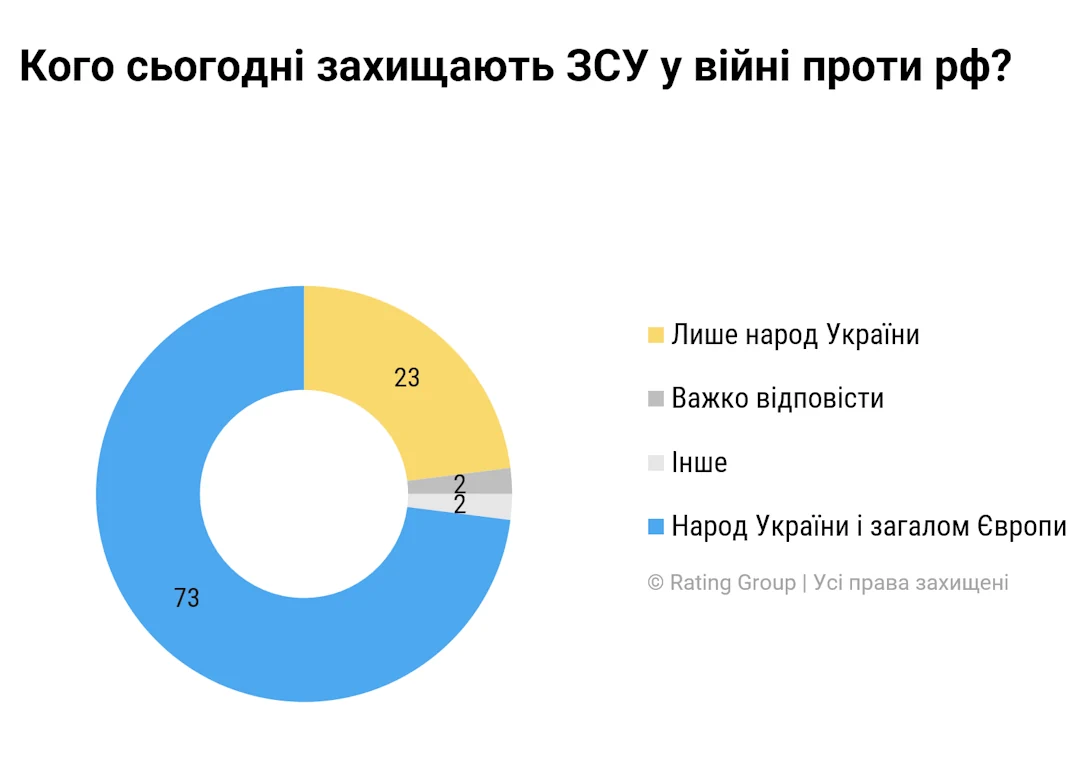
- Just like four years ago, approximately three-quarters of Ukrainians (73%) believe that in the war, the AFU are defending both the people of Ukraine and other European nations..
- 23% say that the AFU are defending only the people of Ukraine.
- Citizens who would vote for Ukraine's accession to the EU even more frequently believe that the AFU are defending both the people of Ukraine and other European nations (84%). Only 15% among supporters of EU accession believe that in the war, the AFU are defending only the people of Ukraine.
- Among opponents of EU accession, there are significantly fewer respondents who believe that the AFU are defending both the people of Ukraine and Europe as a whole (57%).
Do Ukrainians support the participation of the Armed Forces of Ukraine in defending other European countries if Russia attacks them?
We asked respondents to imagine that Russia invades certain European countries and to answer whether they would support the participation of Ukrainian troops in defending such countries: Moldova, Poland, the Baltic states (Lithuania, Latvia, Estonia), and Finland.
The absolute majority of Ukrainians would support the participation of Ukrainian troops in defending the Baltic states (Lithuania, Latvia, Estonia), Moldova, Finland, and Poland in the event of a Russian attack.
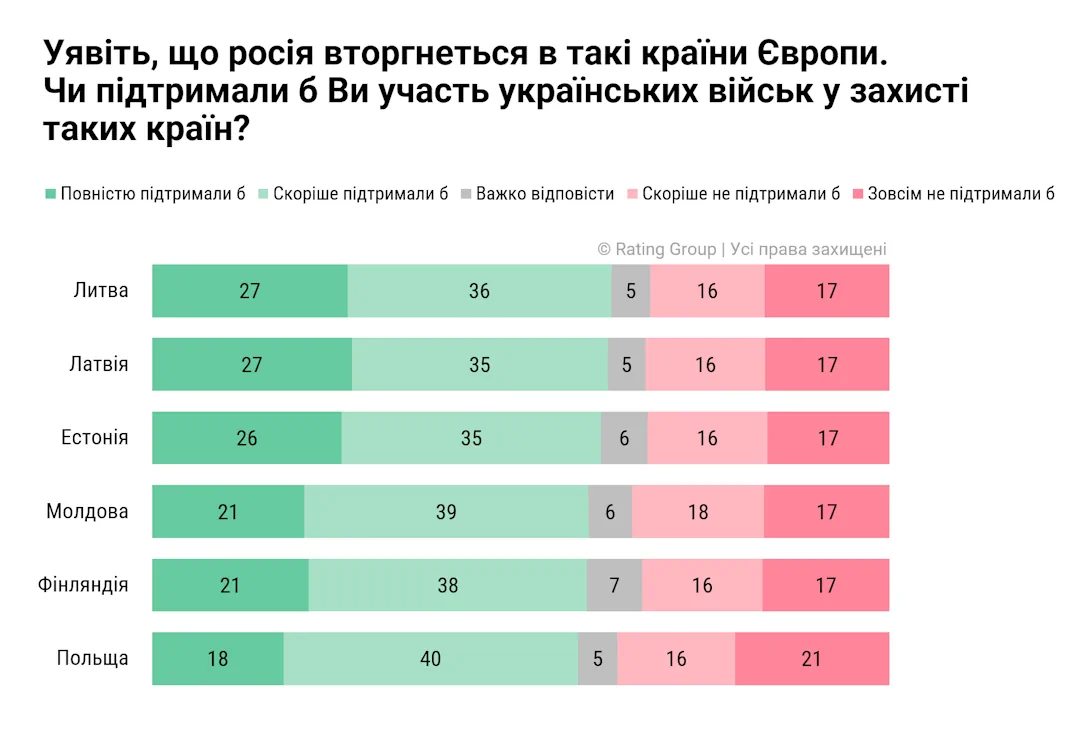
More than half of Ukrainians would support the participation of the Armed Forces of Ukraine in defending all allied countries on the list if Russia attacked them:
- Lithuania: 63% – would support, 33% – would not support
- Latvia: 62% – would support, 33% – would not support
- Estonia: 61% – would support, 33% – would not support
- Moldova: 60% – would support, 35% – would not support
- Finland: 59% – would support, 33% – would not support
- Poland: 58% – would support, 37% – would not support
The stronger Ukrainians' emotional connection to the EU, the more they support the AFU's assistance to other countries in the event of a Russian attack.
Let's take support for Estonia as an example.
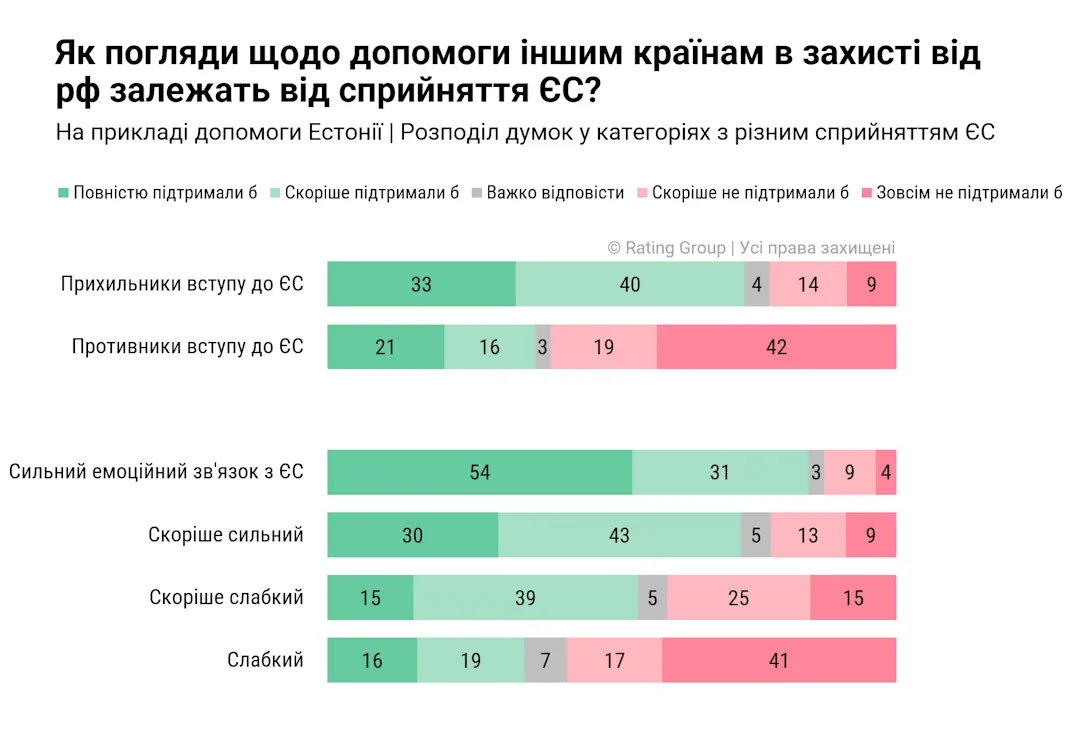
- Among Ukrainians who would vote in a referendum for EU membership, 73% of citizens would support AFU assistance to Estonia.
- Among opponents of EU membership, only 37% would support it, while the absolute majority (61%) would be against it.
- Among Ukrainians with a strong emotional connection to the EU, 85% would support armed assistance to Estonia.
- In comparison, among those who weakly associate themselves with the EU, only a third (35%) would support such a decision, while 58% would be against it.
Rating Group is one of Ukraine's largest research institutions, operating in the market since 2008. The company is registered in Ukraine and has significant experience conducting sociological surveys in Ukraine and abroad. The group includes: Sociological Group Rating, Rating Lab research laboratory, Rating Online platform, and Rating Call Center.
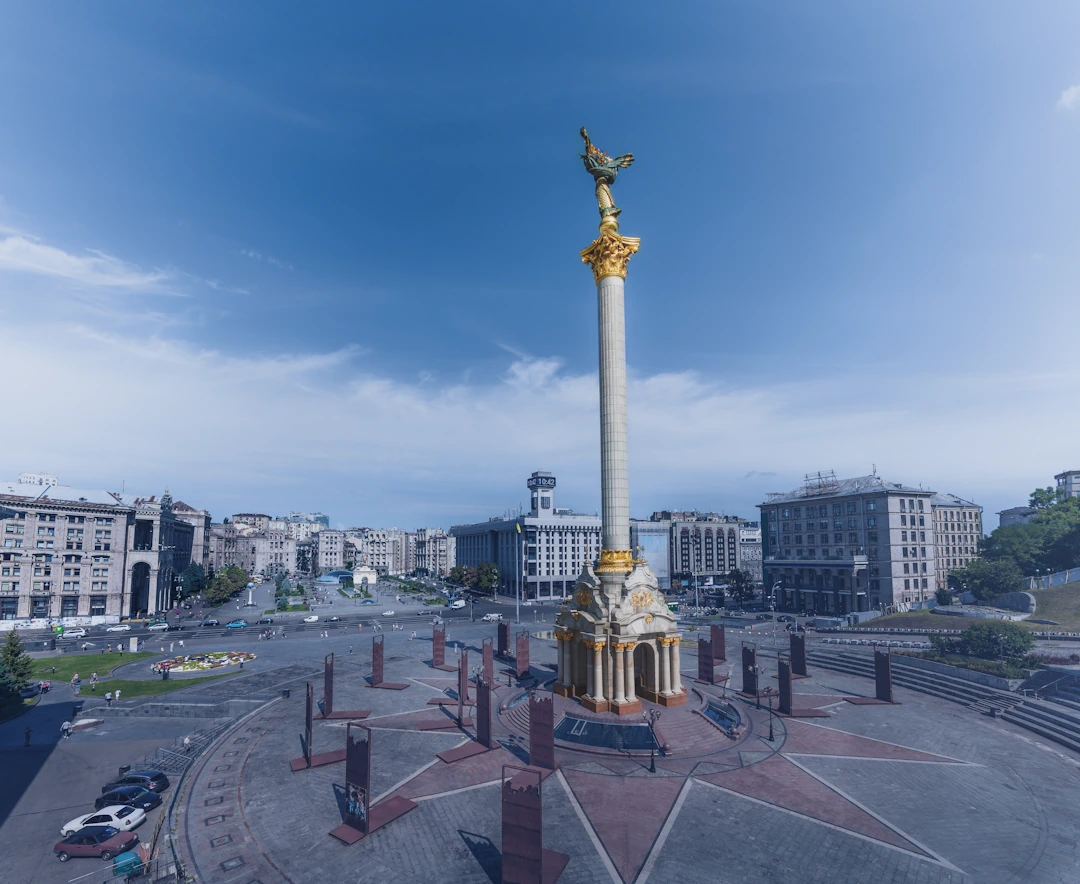
"Rating" Sociological Group presents the fifth issue of its special research project "Common Contours". This time, we investigated which social issues concerning the country's future most concern Ukrainians during the full-scale war, and compared these sentiments with data from EU countries.
"Common Contours" is a survey about Ukraine in a European context, where we reflect questions and compare data from our own surveys of Ukrainians with data from other surveys in EU countries, candidate countries, and other European countries. In this issue, we compare our own research data with Eurobarometer data – a series of official EU surveys from the European Commission and the European Parliament. Eurobarometer data belongs directly to the EU, and we thank them for open access to it.
Note: This study examined a specific list of social issues from the Eurobarometer survey, which was researched in EU countries. This is not an exhaustive list of issues that may concern Ukrainians, especially during the full-scale war. The research results should be interpreted as relative indicators of priorities and differences in perception between Ukrainians and other European countries.
General Findings
Amidst the war, Ukrainians are particularly concerned that children will grow up in poverty
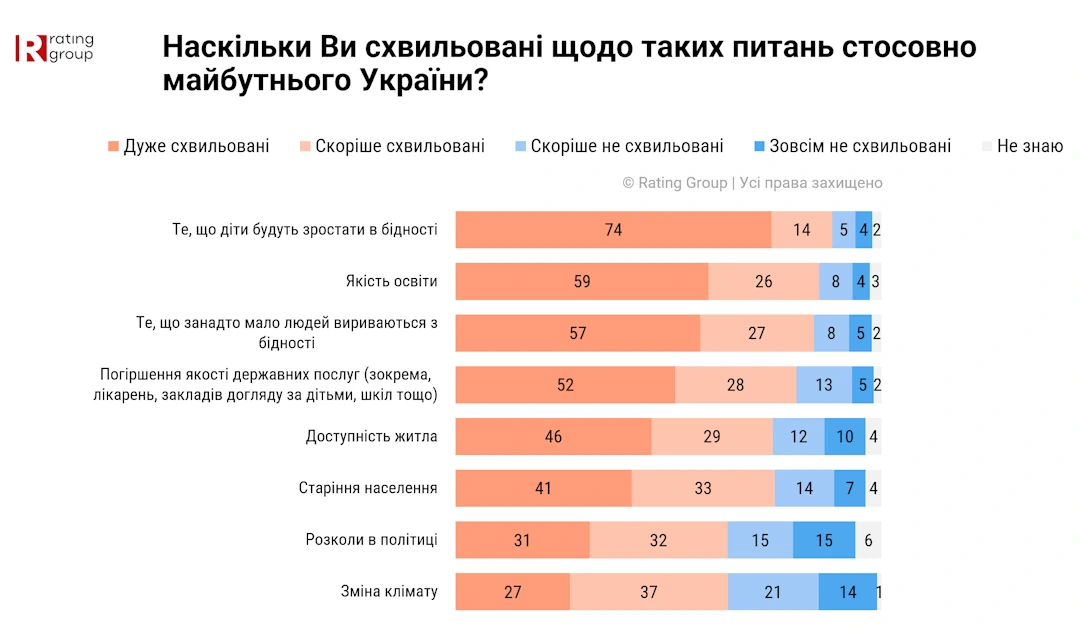
All topics examined in the study concern the majority of Ukrainians to some extent. However, the level of concern varies significantly.
- Amidst the war, Ukrainians are most acutely aware of issues related to the future of children and their risk of growing up in poverty (88% are concerned, including 74% who are very concerned),
- The top three concerns also include the quality of education (85% overall and 59% very concerned) and poverty (84% overall and 57% very concerned).
- Climate and political divisions also significantly concern Ukrainians, but amidst the war, they are relatively less pressing than socio-economic and humanitarian issues.
- At a general level, the responses of Ukrainians are quite similar to the average indicators in EU countries. In some cases, the differences lie not so much in the overall percentage of people concerned about a particular issue, but in the intensity of this concern.
- Ukrainians are significantly more concerned about poverty, the quality of education, and population aging than the average EU citizen.
- In contrast, Ukrainians are somewhat less concerned about political divisions and climate change than the average in the EU.
Below, we will look at several topics in more detail.
The future of children is Ukrainians' most pressing concern regarding the country's future.
- 74% of Ukrainians are very concerned that children might grow up in poverty; overall, 88% are concerned.
- This is the highest concern level among all topics in the release.
- In Ukraine, this issue is significantly more acute than the EU average: 40% there are very concerned (compared to 74% in Ukraine).
Education is one of the key concerns in the context of the country's future.
- 59% of Ukrainians are very concerned about the quality of education; overall, 85% are concerned.
- This is the second most pressing issue after the risk of children growing up in poverty.
- The overall percentage of concern is close to the EU figure (85% in Ukraine, 81% on average in the EU), but again, there is a significant difference in the proportion of those who are very concerned: 59% in Ukraine and 39% in the EU.
Population aging: Amid war, migration, and human capital loss, concerns about the demographic situation are even more acute.
- 41% of Ukrainians are very concerned about population aging; overall, 74% are concerned.
- This topic concerns younger people relatively less than older citizens. While about two-thirds of young men and women express concern, 81% of men aged 51+ are concerned about population aging, and 87% of older women are concerned.
- Given the war, migration, human capital loss, and other challenges, concerns about population aging are significantly stronger in Ukraine than in the EU. While 26% in the EU are very concerned, this figure is 41% in Ukraine.
Ukrainians are often concerned about climate change, but urgent socio-economic and humanitarian challenges relatively shift this issue down in priority.

- 27% of Ukrainians are very concerned about climate change; overall, 64% are concerned.
- In Ukraine, women are relatively more concerned about climate change. Young men aged 18-35 showed the least concern about climate change (45% are concerned, 55% are not), whereas 68% of women in this age group are concerned.
- In many EU countries, the climate topic holds a more prominent place on the public agenda. On average, 78% of respondents in EU countries stated they are concerned about climate change.
Rating Group is one of Ukraine's largest research institutions, operating since 2008. The company is registered in Ukraine and has extensive experience conducting sociological surveys both within Ukraine and abroad. The group includes: Rating Sociological Group, Rating Lab research laboratory, Rating Online platform, and Rating Call Center.
Ahead of World Vyshyvanka Day 2026, we recall the results of sociological research on the affirmation of Ukrainian national and civic identity, conducted by the Sociological Group "Rating" (Rating Group) in September 2025 in cooperation with the Ministry of Youth and Sports of Ukraine.
Vyshyvanka remains an important cultural symbol for Ukrainians: 67% of Ukrainians own one.
- Residents of the West, women, and youth aged 14–19 are relatively more likely to report owning a vyshyvanka.
- Among those who own a vyshyvanka, 24% wear it often, 46% - sometimes. A third, however, rarely wear a vyshyvanka at all.
- We also asked Ukrainians to choose from a list of holidays that they have come to appreciate more over the past year / since the full-scale invasion. Vyshyvanka Day is among the top 5 such holidays – 17% mentioned it.
Rating Group is one of Ukraine's largest research institutions, operating in the market since 2008. The company is registered in Ukraine and has significant experience conducting sociological surveys both in Ukraine and abroad. The group includes: Sociological Group Rating, research laboratory Rating Lab, platform Rating Online, and Rating Call Center.