News and Press releases

Thank you! Your submission has been received!
Oops! Something went wrong while submitting the form.
News
Expert of Rating Group Roman Borysov and Professor Nataliia Chernysh — on their joint study of Ukrainians’ resilience
All
All
2025
23.09.2025

The sociological company Rating Group has released a study titled “Problems of Social Cohesion in Ukraine.” This is a joint academic project with Nataliia Chernysh, Doctor of Sociology and Professor at the Department of Sociology of Ivan Franko National University of Lviv.

The research team examined how resilient and cohesive Ukrainians are, the extent to which we trust one another, and whether we are willing to help others.

"We wanted to determine the actual state of national resilience in Ukrainian society and to measure it through the language of numbers. In the summer of 2025, the National Resilience Index stood at 3.6 out of 5. Its slight decline is due to the prolonged war as well as the drop in trust in government. At the same time, we record a strengthening of social bonds and their growing role. This is crucial for withstanding Russian aggression, maintaining hope for ultimate victory, and ensuring post-war renewal,” said Nataliia Chernysh, Doctor of Sociology and Professor.

As noted by Roman Borysov, Head of the Analytics Division at the Department of Strategic Research of Rating Group:

"Since the beginning of the full-scale invasion, civic identity has taken the leading position, clearly surpassing regional identity, for example. It has become a key factor of unity, and the duration of its effect has already exceeded the typical span of the ‘rally ’round the flag’ phenomenon. As for the markers of societal resilience, these are primarily trust within society and direct manifestations of social capital: the experience of helping others, volunteering, mutual support, and participation in civic organizations."

Roman Borysov also emphasizes the importance of synergy between the research agency and the academic community:

"This project is a great example of fruitful collaboration between Rating Group as a research agency and scholars from the academic world. It is a particular pleasure to work with the giants of Ukrainian science, especially Nataliia Yosypivna Chernysh, who stood at the origins of modern Ukrainian sociology. Her profound knowledge, insight, and genuine enthusiasm are truly inspiring, encouraging us to rethink our approaches and to open up new perspectives for the development of sociology."

Learn more about Ukrainians’ cohesion and societal trust in the press release of the study.
Press
Problems of social cohesion in Ukraine
All
All
2025
22.09.2025

"Проблеми соціальної згуртованості в Україні" - нове наукове дослідження Соціологічної групи Рейтинг (Rating Group) у співпраці з Наталією Черниш, доктором соціологічних наук, професором кафедри соціології Львівського національного університету ім. Івана Франка.

‍У фокусі дослідження - самоідентифікація українців, довіра одне до одного, рівень соціальної стійкості, готовність допомагати іншим й інші індикатори соціальної згуртованості.

Самоідентифікація

  • Абсолютна більшість українців (94%) відчувають себе громадянами України.
  • За час повномасштабної війни самоідентифікація українців ще більше змістилася у бік країни загалом: люди асоціюють себе скоріше з Україною загалом, ніж зі своїм регіоном (77%).
  • Більше половини (52%) вважають себе європейцями та лише 8% вважають себе радянською людиною.

Цінності

Коли респондентів попросили обрати до трьох найважливіших цінностей з переліку, найчастіше позначали перемогу України (62%), родину та близьких (53%), власне здоров’я (34%), незалежність української держави (26%), відновлення України (20%). Це екзистенційні цінності, цінності виживання. Ці результати співзвучні з нещодавнім дослідженням Rating Group про цінності українців.

Довіра в суспільстві

  • Загальний Індекс довіри в суспільстві має середній рівень (3,0). Шкала: від 1 (мінімум довіри) до 5 (максимум).
  • Найвища довіра - до близького кола (3.9), тобто рідних, друзів, мешканців міста/села. Менше довіряють суспільному колу (2.9), тобто інституціям, організаціям, владі, мешканцям України тощо, а також колу "інших людей" (2.4), тобто незнайомим людям у випадкових ситуаціях, людям інших політичних поглядів або національності.
  • ‍Понад третина респондентів довіряє мешканцям України (36%, ще 42% вагаються), дещо менше - мешканцям міста/села (30%, ще 42% вагаються).
  • Серед інституцій українці висловлюють найвищу довіру до волонтерських організацій (63%). Менше довіряють громадським організаціям (30%, ще 37% вагаються), місцевій (25%, ще 27% вагаються) і центральній (24%, ще 26% вагаються) владі.

Соціальний капітал і громадське життя

  • В умовах повномасштабної війни в українському суспільстві виріс соціальний капітал: 86% українців надавали допомогу людям, які опинились у складній ситуації під час війни, зокрема 27% переважно допомагали людям за межами родинного кола.
  • Половина респондентів налагодила і зберегла зв’язки, що виникли через об’єднання з іншими людьми для взаємопідтримки. У деяких випадках ці взаємозв’язки ставали інституціоналізованими: близько 10% респондентів є членами громадської організації, а 43% мають таких людей серед найближчого оточення (родичі, друзі).
  • Серед типів громадської активності українці надають перевагу допомозі іншим. Респонденти активно допомагають ЗСУ – 70% постійно або час від часу допомагають фінансово, 44% - нефінансово (сітки, свічки, ремонт авто тощо). Також відносно поширеною є допомога біженцям, переселенцям, людям з інвалідністю (49%).
  • Інші види активності не є такими поширеними: 23% беруть участь у громадських слуханнях та підписанні петицій, 20% - вирішенні спільних проблем в житті територіальної громади, 13% - у громадських акціях і мітингах.
  • Більш активними є мешканці Заходу і Центру, а також більш забезпечені опитані.

Соціальна стійкість

  • Українське суспільство зберігає стійкість. Індекс стійкості складає 3.6 (вище середнього рівня) за шкалою від 1 (мінімум) до 5 (максимум).
  • Абсолютна більшість оптимістично оцінює як майбутнє України (76%), так і власне (72%).
  • Більше 70% вважають, що можуть самостійно впоратися з проблемами, які в них виникають.
  • Окрім того, високим є відчуття єдності з іншими українцями, його висловлюють майже дві третини респондентів. З місцевою громадою себе ідентифікують 53%.
  • Дещо нижчими є оцінка рівня солідарності та взаємодопомоги (48%), справедливості (45%) у суспільстві та впевненість в тому, що держава у кризовій ситуації ухвалить правильне рішення (44%).

Rating Group — одна з найбільших дослідницьких інституцій України, яка на ринку з 2008 року. Компанія  зареєстрована в Україні та має значний досвід проведення соціологічних опитувань в Україні та за кордоном. До групи входять: Соціологічна група Рейтинг, дослідницька лабораторія Rating Lab, платформа Rating Online та Rating Call Center.

News
State Emergency Service and Stalker 2 release video on mine safety based on Rating Group/UNICEF insights
All
All
2025
12.09.2025
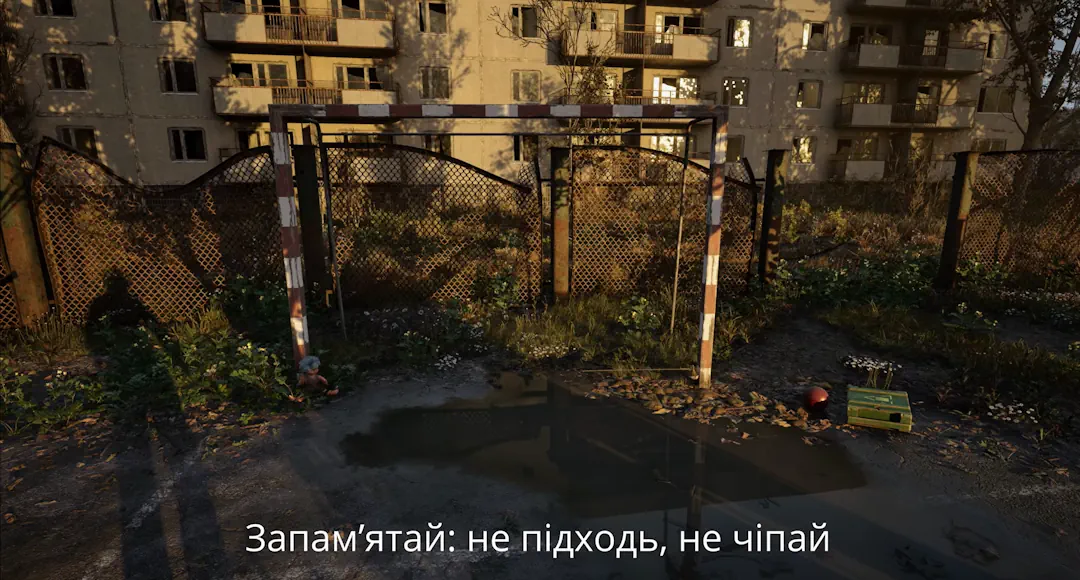
Screenshot from the video by the State Emergency Service of Ukraine

Rating Group insights become the base for effective mine safety advertising!

The State Emergency Service of Ukraine and GSC Game World (creators of the Stalker series) have released a video in which the main character of Stalker 2, Skif, demonstrates the basics of mine safety. According to the State Emergency Service, the video takes into account the results of a study on mine safety among Ukrainian teenagers conducted by the Rating Group and UNICEF (2024). The research part was carried out by Rating Lab: the team developed an original mine safety test and surveyed more than 25,000 Ukrainian teenagers and their parents.

"Being brave, stalker, means being cautious" (from the video)

According to the study, boys aged 14-15 and 16-17 are the most at risk when it comes to explosive objects. Among other things, this is due to the typical hobbies of teenage boys: computer games and related media content, which somewhat distances them from the idea of real risks. The State Emergency Service and the creators of Stalker 2 took this data into account and were able to effectively convey information on how to protect the lives and health of children and others.

More resources:

News
“Nothing about 'peace at any cost,'” - Rating Group CEO on Ukrainians' attitudes at the "New Country" panel discussion
All
All
2025
10.09.2025
From left to right: Ihor Liski, Oleksandr Kornienko, Olha Stefanishina, Oleksiy Antypovych. Photo: Zoryana Stelmakh

September 9, 2025 CEO of Rating Group Oleksiy Antypovych participated in the panel discussion “New Country” (organized by LB.ua and EFI Group) on key social, political and economic challenges for Ukraine.
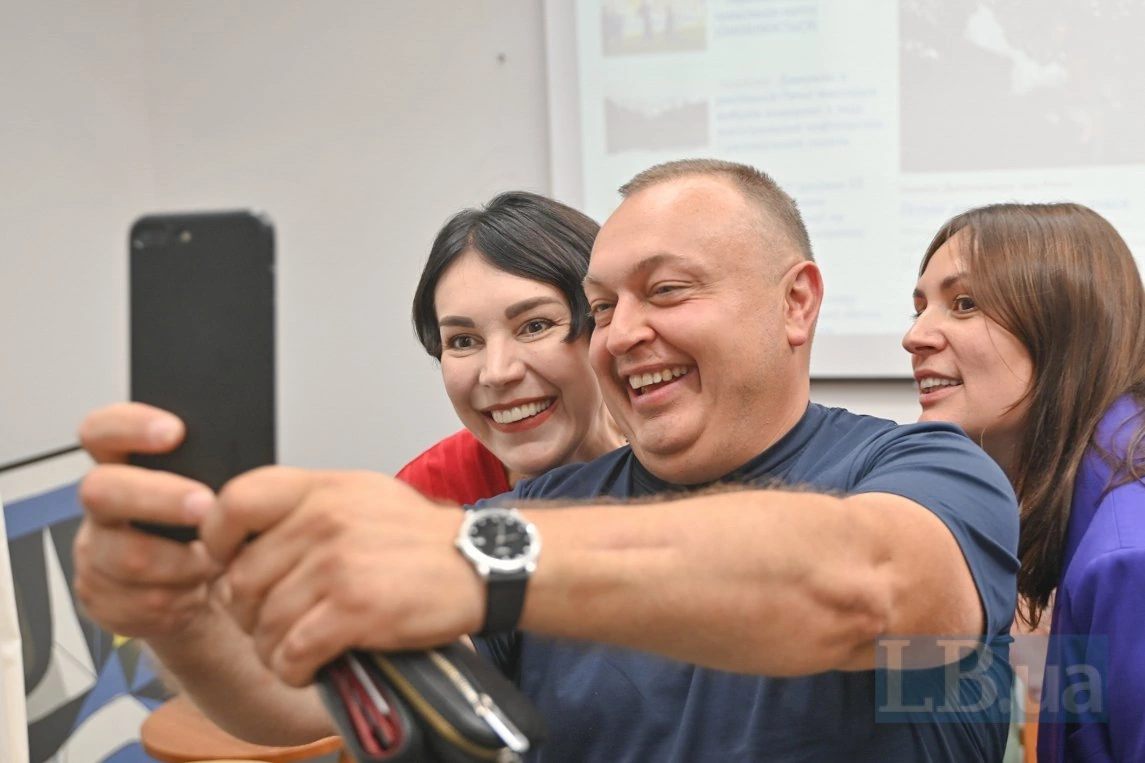
From left to right: Editor-in-Chief of LB.ua Sonya Koshkina, CEO of Rating Group Oleksiy Antypovych, Ambassador of Ukraine to Canada Yulia Kovaliv. Photo: Zoryana Stelmakh

The speakers of the event were also the Chairman of the Supervisory Board of the investment company EFI Group Igor Liski, the First Deputy Chairman of the Verkhovna Rada of Ukraine, Oleksandr Kornienko, the Ambassador of Ukraine to the USA Olga Stefanishina and the representative of the Ministry of Ukraine Ilya Pavlenko.
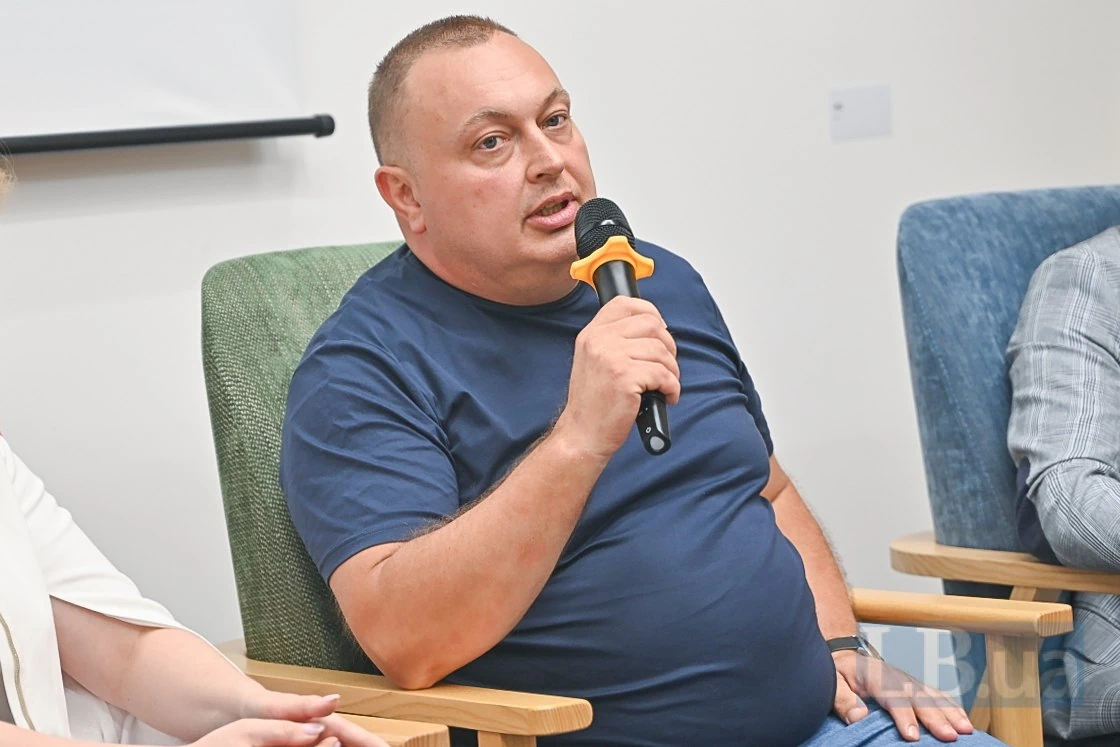
Oleksiy Antypovych. Photo: Zoryana Stelmakh

Oleksiy Antypovych commented on the public sentiment towards the end of the war. A recent survey by Rating Group shows that Ukrainians support the general idea of a diplomatic settlement, but a prerequisite for peace is reliable security guarantees from partners. 82% consider negotiations a realistic way to end the war (62% for finding a compromise with the involvement of other countries, 20% — for direct negotiations with the Russian Federation). At the same time, 75% believe that Ukraine should agree to a ceasefire only under the condition of international security guarantees.

“The most important thing about those figures is that there is nothing about peace at any cost,” - Oleksiy Antypovych, CEO of Rating Group

More materials:

News
Rating Group CEO Oleksiy Antipovich on security guarantees for Ukraine on ProUA
All
All
2025
08.09.2025

On Friday, September 5, 2025, on ProUA broadcast (presenter - Andriy Kulikov) Rating Group CEO Oleksiy Antypovych commented on the August survey of social and political attitudes of Ukrainians conducted by the Rating Sociological Group.

“Ukrainians see the financing and armament of the Armed Forces of Ukraine as the main guarantee from partners. That is, we take responsibility for our safety first and foremost,” - Oleksiy Antypovych, CEO of the Rating Group

According to the study, 52% of Ukrainians identified the financing of the army and the supply of weapons from partners as a key guarantee. Among other key guarantees, Ukrainians cite the commitment of the Allies to enter the war in the event of a repeat attack (48%) and international patrolling of air and sea space (44%).

See more:

News
Rating Group, Lviv Media Forum, and IMS present "Media Audience Segments in Ukraine" study
All
All
2025
01.09.2025
Image: Kyivinform Press Centre

The Rating Group, Lviv Media Forum and International Media Support (IMS) presented the results of a new study "Media Audience Segments in Ukraine". The event took place on August 29, 2025 at the Kyivinform Press Centre.

Speakers:

  • Oleksiy Antypovych, CEO of the Rating Group
  • Zurab Alasania - Media Advisor IMS (International Media Support)
  • Olha Bilousenko - Head of the Research Department of the NGO "Lviv Media Forum"

The study showed how Ukrainians are divided according to their media consumption, which media they trust the most, and how they counteract disinformation:

"We thank International Media Support and the Lviv Media Forum for this study... Together we devoted a month to developing the methodology and approached the issue of disinformation very professionally... 59% of Ukrainians belong to the more vulnerable audience. But the most interesting thing turned out to be not this: all categories of consumers (both traditional media, online, "omnivorous", and those who generally avoid information) are vulnerable to disinformation", - Oleksiy Antypovych, Rating Group CEO

Resources:

Press
Ukrainians, trust in media, and disinformation
All
All
2025
01.09.2025

On April 1-23, 2025, the Rating Group conducted a study of media consumption of Ukrainians commissioned by the NGO "Lviv Media Forum" and International Media Support. The survey topics are information behavior, media consumption, trust in the media, the fight against disinformation and vulnerability to it.

Sources of information

  • Telegram is the main means of obtaining information about current events for Ukrainians. Telegram channels are read constantly or often (4-5 days a week) by more than half of respondents (52%).
  • In second place is YouTube (32% watch constantly or often), in third place is Facebook (28%).
  • The "United News" telethon and Viber chats are watched constantly or often by 25%.
  • Regular reading of printed media is a rare practice: 84% never use newspapers and magazines to obtain information.
  • The majority of Ukrainians also never receive information from the radio (75%), regional media (69%), regional online media (67%), international online media (66%).

Trust in the media

  • Ukrainians have little trust in the media in general. But Telegram channels (29%) and Youtube channels (24%) are relatively more trusted.
  • International and Ukrainian online media are rather trusted or trusted by 16%.
  • Ukrainians distrust the United telethon the most (39% do not trust or rather do not trust, 24% are hesitant, 19% find it difficult to answer).

How Ukrainians fight disinformation

  • Almost 40% of respondents never check the reliability of information, 18% always do it.
  • Young people (18-29 years old), respondents with higher education, as well as military personnel and veterans check the reliability more often.
  • 35% believe that it is easy or rather easy for them to distinguish true information from false information in the media, 28% — that it is difficult or rather difficult for them to do so.
  • The most common practices for checking reliability are using one's own intuition and experience (34%) and comparing with several authoritative sources (25%).

Vulnerability to disinformation

59% of Ukrainians are vulnerable to disinformation, as shown by the results of the information test (see methodology). How they differ:

  • They are significantly less likely to support Ukraine's accession to the EU and NATO, as well as the actions of the current government.
  • They are less likely to watch socio-political news and trust the media less.
  • They rate their own ability to distinguish true information from false information as highly as invulnerable citizens.
  • When checking information, they rely somewhat more on their own experience and intuition and less likely to compare information from different sources.
  • Relatively more often these are Russian-speaking or bilingual respondents, residents of frontline territories, as well as representatives of less well-off and less educated categories.
Press
Sociopolitical views of Ukrainians (August 2025)
All
All
2025
31.08.2025

A study by the Rating Group on August 21-23, 2025 shows that Ukrainians want peace and are mostly ready to talk about certain concessions, but only on condition of reliable security guarantees from partners.

Vision of the end of the war

  • 59% of respondents support stopping the fighting on the battlefield and the searching for a compromise, 20% support fighting until the return of Donbas and Crimea, 13% - until the demarcation line/borders as of February 23, 2022 are restored.
  • 82% consider negotiations to be a realistic way to end the war (62% are in favor of finding a compromise with the involvement of other countries, 20% - in direct negotiations with the russian federation).
  • 75% believe that Ukraine should agree to a ceasefire only on condition of international security guarantees.
  • Among the key security guarantees, Ukrainians name: funding for the army and weapons supplies from partners (52%), an obligation of allies to enter the war in the event of a second attack (48%), and international patrolling of air and sea space (44%).
  • When asked “What is most important now?”, 58% chose receiving guarantees of funding for the Ukrainian army from Western partners in the future and the supply of weapons in sufficient quantities, while 31% chose the return of territories.
  • Most often, respondents believe that we are fighting with russia for the future of our children (60%) and freedom (44%).

Trust in politicians

The level of trust in Valery Zaluzhny is 74%, Volodymyr Zelensky is trusted by 68%, and Kyrylo Budanov has 59% trust rate.

Electoral attitudes

  • If presidential elections were to take place, Volodymyr Zelensky (35% of all respondents) and Valery Zaluzhny (25%) would receive the most support.
  • In case of the parliamentary elections, the hypothetical Zaluzhny Party would lead (24%) and the hypothetical Zelenskyy Bloc would come in second place (20%). They would be followed by the European Solidarity (7%), and two hypothetical parties - the Budanov Party (6%) and the Azov Party (6%).
Press
What do Ukrainians want and how to achieve it? Independence Day 2025 study
All
All
2025
26.08.2025

The goals of Ukrainians

Ukrainians want peace, but not at the expense of freedom.

  • Right now, the most important things for us are basic values, values of survival: family safety (73%), living in peace (62%), freedom (56%) and national security (55%).
  • It is also important for Ukrainians to live in comfort (25%), have inner harmony (22%) and self-respect (16%).
  • Common goals unite Ukrainians at home and in Europe. However, Ukrainians who have been forced to leave the country place more emphasis on comfort and less on national security.

How do Ukrainians' goals differ?

  • Older people often emphasise the importance of national security, while young people talk more about a comfortable life, love and happiness.
  • Those who want to stay in Ukraine often talk about the importance of living in peace, national security and wisdom, while those who want to move abroad talk about a comfortable life and happiness.
  • For Ukrainians who support Ukraine's accession to the EU, family security, national security and freedom are more important. For those who oppose accession, true friendship, salvation of the soul and wisdom are more important.
  • Ukrainians who do not regret the collapse of the USSR more often mention national security and freedom. Those who regret it value wisdom, happiness and equality more.

What will help achieve the main goals?

Responsibility and independence are two strong traits that are key to all five main goals. But there are other important tools for achieving them.

  • According to Ukrainians, freedom requires independence, responsibility, courage, honesty and intelligence.
  • Family security can be achieved through responsibility and a willingness to help.
  • If we want to live in peace, we need responsibility and independence.
  • National security can be achieved through responsibility, independence, courage, and a willingness to help.
  • At the same time, a comfortable life requires skills and intelligence.

How to achieve other goals?

  • To achieve happiness, you need love, independence and cheerfulness. And for inner harmony – intelligence, honesty and love.
  • Love that stands the test of time is achieved through love, honesty and responsibility. And friendship – through honesty and willingness to help.
  • Salvation of the soul can be achieved through love and forgiveness.
  • Self-respect, like equality, is built on honesty, independence, and responsibility.
  • A bright, fulfilling life requires cheerfulness, independence, and broad-mindedness.
  • A sense of achievement is attained through intellect and ability, and  social recognition through responsibility.
Press
National Survey of Ukraine (International Republican Institute, July 2025)
All
All
2025
25.08.2025

The International Republican Institute’s (IRI) Center for Insights in Survey Research (CISR) published the results of the national survey of Ukraine, which covered key socio-political topics. The data was collected by the Rating Group team on July 22-27, 2025.

Key findings

  • The majority of Ukrainians support joining the European Union (75%) and NATO (70%).
  • Ukrainians believe, the most aid in context of resistance to Russia was provided by the US (59%), Germany (48%), and the UK (38%).
  • The Armed Forces of Ukraine have the highest approval level (94%) amongst the state institutions. Most Ukrainians also approve the activites of President Zelensky (65%), the Commander-in-Chief of the Armed Forces Oleksandr Syrskyi (55%), and the Minister of Foreign Affairs Andrii Sybiha (52%).
“Ukrainians overwhelmingly desire a Western-oriented future. Ukrainians view themselves as a European people and firmly believe their future lies in Europe."

“Ukrainians are incredibly thankful for the assistance provided by the United States and its allies and partners since the outset of the war.”

- Stephen Nix, Senior Director for Europe and Eurasia at IRI, as cited by IRI website
Press
How do Ukrainians at home and in Europe view unity and independence? Survey for Independence Day 2025
All
All
2025
21.08.2025

Researchers from the Rating Group conducted a national survey ahead of Independence Day 2025! What do Ukrainians associate with independence and unity? And what, on the contrary, divides us?

The survey was conducted using a special methodology on the Rating Online platform. This allows us to compare the responses of Ukrainians at home with the opinions of Ukrainians who have moved to Europe since 2022.

What unites and divides Ukrainians

  • The victories of the Armed Forces of Ukraine are a key factor in unity today (55%). Ukrainians rally around their defenders and the preservation of the state.
  • In second place is mutual assistance (more than a third of respondents).
  • The reconstruction of the country also has significant potential for unity. It was identified by about a third of Ukrainians abroad and at home.
  • Mutual accusations (57%), political conflicts (52%), and the economic crisis (37%) are most likely to divide society.
  • Ukrainians in Europe place relatively more emphasis on mutual accusations (68%) and language issues (34%) as factors of division.

Events and symbols of independence

  • Along with the 1991 declaration (51%), Ukrainians mention the resistance of 2022 (51%), the events of the Anti-Terrorist Operation/Joint Forces Operation (42%), and the Revolution of Dignity (47%) as the most important events in the formation of the modern nation. This is a common thread: from the proclamation to the establishment of independence.
  • Ukrainians in Europe are relatively more likely to mention obtaining EU candidate status as a significant event (22% compared to 15% in Ukraine).
  • Independence Day is most often associated with the slogan “Glory to Ukraine! Glory to the heroes!” both at home and among Ukrainians abroad. The ideas of freedom, resilience, unity, and dignity are also frequently mentioned.

EU and NATO membership

  • The majority of Ukrainians support EU (75%) and NATO (71%) membership.
  • Among Ukrainians who have been forced to leave the country since 2022 and are now in Europe, this support is even stronger (83% and 78%).

Rating Group is one of Ukraine's largest research institutions, operating since 2008. The company is registered in Ukraine and has extensive experience in conducting sociological surveys in Ukraine and abroad. The group includes: Sociological Group Rating, Rating Lab research laboratory, Rating Online platform, and Rating Call Center.

News
UNICEF and the Rating Group released a large-scale study of the mental health of Ukrainians as part of the "How are you?" program
All
All
2025
20.08.2025

Rating Group and UNICEF Ukraine have published the results of a joint large-scale study on the mental health of Ukrainians. "Mind frames" is a unique project within the framework of the All-Ukrainian mental health program "How are you?" (an initiative of First Lady Olena Zelenska).

The research part was carried out by the Research Laboratory Rating Lab. The team developed a special methodology and surveyed five target audiences at once: parents of children aged 0-9; children aged 10-17 and their parents; young people aged 18-25 and other adults. The special methodology allows you to compare the answers of parents and their children.
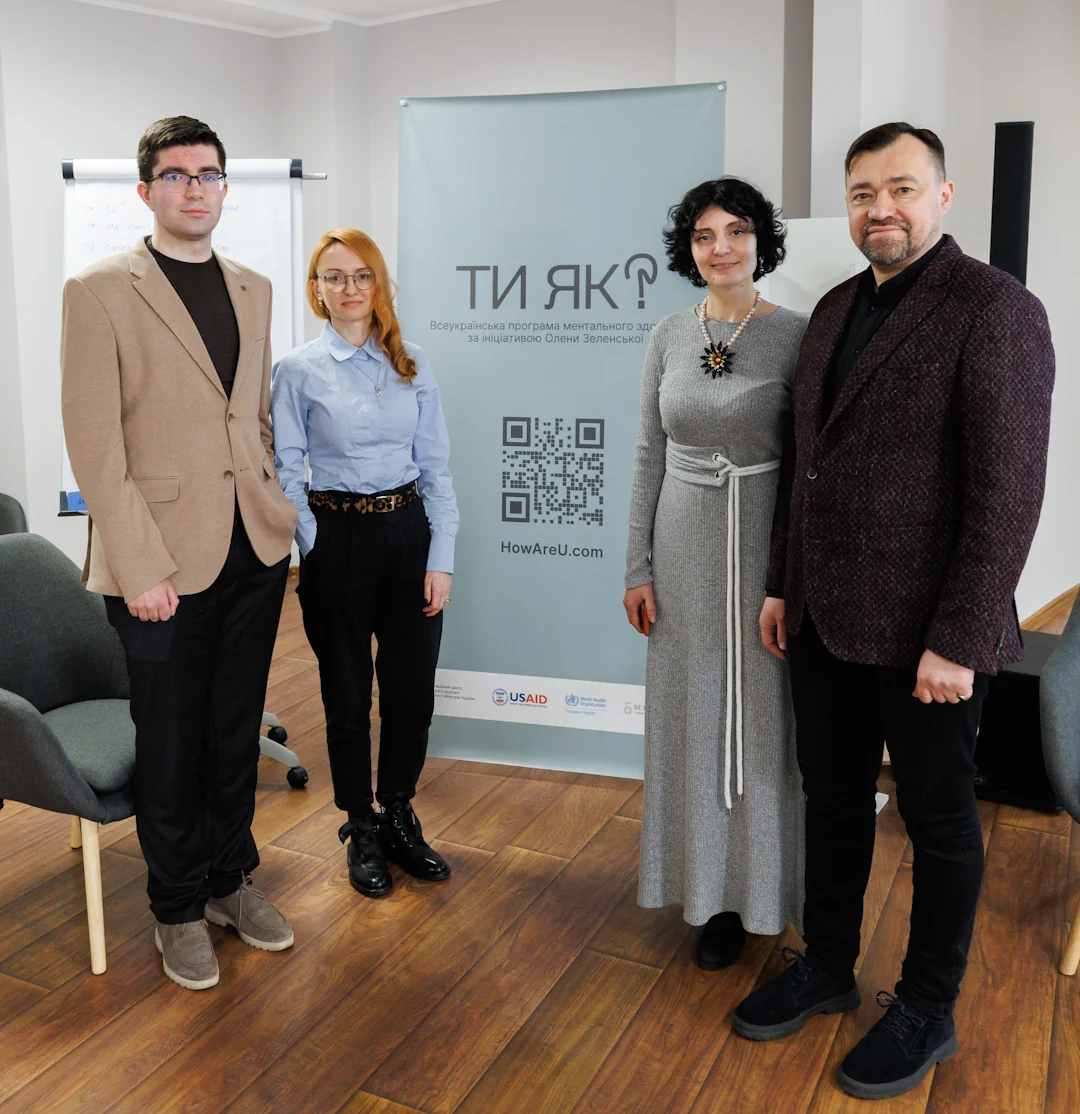
Rating Lab at the internal presentation of the study in March 2025, from left to right: Yevhen Krotevych (expert), Marianna Tkalych (founder and CEO of Rating Lab), Svitlana Royz (child and family psychologist, expert), Igor Tyshchenko (founder and CEO of Rating Group, Rating Lab)

According to the results, about half of Ukrainians have high or elevated levels of stress. The study also demonstrates how important strong relationships between parents and children, caring, and shared hobbies are for mental health. These are essential factors in adapting to stress, especially in wartime.

"Mental health is the foundation of every child's well-being. This research reveals not only the importance of loving and engaging caregivers but how parenthood can improve adults' resilience, helping the family to better cope with the stress of living through wartime. There is an urgent need to support families through access to quality social services and resources for their mental well-being, regardless of their life circumstances, and wherever they live," - Shameza Abdulla, UNICEF Representative (a.i.) to Ukraine (as cited on the UNICEF website)
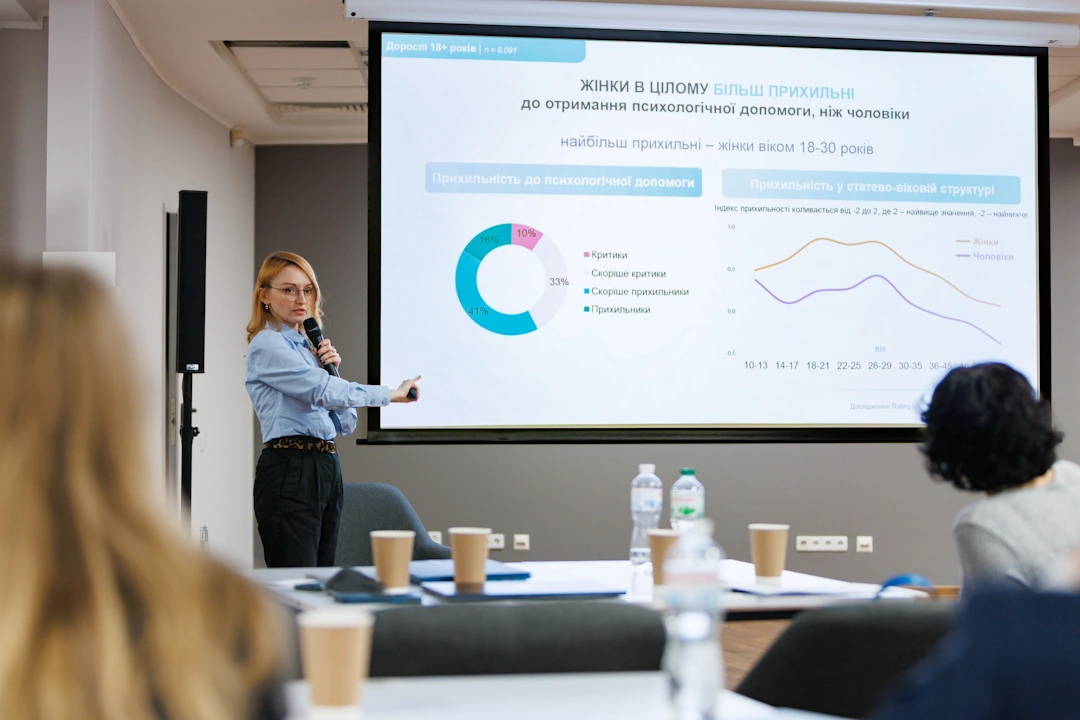
Marianna Tkalich, Founder and CEO of Rating Lab at an internal presentation of the research in March 2025

"Mind Frames" also became one of the largest projects of Rating Group/Rating Lab.

"Mind Frames" is a unique study and one of the largest projects of Rating Group and Rating Lab. A large team of analysts and experts, a large complex sample (almost 12 thousand people, but special attention to parents and their children aged 10-17). And, of course, a large set of topics: resilience, stress, triggers and reactions to them, hobbies, psychological help. We are very grateful to our partners with UNICEF Ukraine and the "How are you?" program. It is important that the idea of ​​supporting mental health is promoted at such a high level. In turn, Rating Lab is always ready to provide valid and reliable data," - Marianna Tkalich, founder and CEO of Rating Lab, Doctor of Psychological Sciences

Press
Mind frames: Ukrainians' perception of mental health and psychological support through the lens of resilience
All
All
2025
20.08.2025

Mind frames: Ukrainians' perceptions of mental health and psychological support through the lens of resilience

Rating Group and UNICEF Ukraine have published the results of a joint large-scale study on the mental health of Ukrainians. ‘Mind frames’ is a unique project within the framework of the All-Ukrainian mental health programme ‘How are you?’ (an initiative of First Lady Olena Zelenska).

Rating Lab carried out the research part — they developed a special methodology, surveyed about 12,000 Ukrainians and found out the following:

  • how psychologically resilient Ukrainians are;
  • what helps them adapt to stress;
  • how Ukrainians feel about psychological support.

The study focused on five target audiences: parents of children aged 0-9; children aged 10-17 and their parents; young people aged 18-25 and other adults aged 25+. A special methodology and survey method allows for a direct comparison of the responses of parents and their children.

Stress and its triggers

  • Almost half of Ukrainians (47%) have high or elevated stress levels. At the same time, 73% of Ukrainians are generally resilient to stress. This helps them adapt to constantly stressful living conditions.
  • The main triggers of stress in adults aged 18+ are financial difficulties, sirens and loud noises, news and arguments with loved ones (29%). Young people aged 18-25 also often mention feelings of being ignored, ridiculed and bullied.
  • For children aged 10-17, the main triggers are exams, tests and quizzes, arguments with parents/loved ones, being ignored and avoided (28%), ridicule and bullying (28%), sirens and loud/sharp noises.

Adaptability to stress

Adaptability is an experimental indicator of the interaction between stress and resilience. It shows how effectively a person responds to stressful conditions and situations.

  • Less than half of Ukrainians (45%) are adapted to stress, i.e. they have both low stress and high resilience.
  • Another 35% are partially adapted, and 20% are not adapted.

Parents, children, family

  • 52% of those who have a partner, children and live together (i.e. their own family) are adapted, among them are the fewest maladapted (18%). Among those who do not have children and a partner, on the contrary, only 39% are adapted and 23% are maladapted.
  • Parents' perceptions of their children's emotions differ significantly from the children's self-reflection: children experience joy much more often than their parents say.
  • Communication within the family is very important. The more often children aged 10-17 communicate with their parents, the more adapted they are to stress. Parents help their children a lot when, during a stressful event, they talk to them about their feelings, share their experiences, explain what is happening, and hug them.
  • Having a shared hobby helps both children and parents adapt. 57% of children have a shared hobby with their parents. This has an even stronger effect on parents: 64% of parents who share a hobby with their children are adaptable to stress.

What hobbies help you be more resilient?

  • Having a hobby is an important factor in adapting to stress. They allow you to ‘reboot’ and develop resilience mechanisms in response to the challenges of life in times of war.
  • In all age groups, those who do not have a hobby are less adapted to stress.
  • The most resourceful activities are those that involve physical activity.
  • The least resourceful hobbies are those related to devices and gadgets (computers, phones). It is in these activities that we often see the lowest resilience.

Attitude towards psychological assistance

  • More than half of Ukrainians have a positive attitude towards psychological assistance (57%), while the remaining 47% are critical.
  • The most positive attitude is among women aged 18-29.

The study was conducted in collaboration with the Oleksandr Yaremenko Ukrainian Institute for Social Research and the Institute for Behavioural Research at American University Kyiv.

Press
Does gender of the child matter to Ukrainians?
All
All
2025
17.08.2025

As part of a global study by Gallup International, Rating Group asked Ukrainians: "Suppose you could have only one child. Would you prefer that it be a boy or a girl or is gender irrelevant?"

Key findings:

  • For the absolute majority of Ukrainians (70%), the gender of the child is irrelevant. This follows the global trend - an average of 64% of respondents in the world have the same opinion.
  • 14% of Ukrainians would like the child to be a girl, 13% would like a boy.
  • India, the Philippines, Ecuador are the countries where boys are the most preferred.
  • South Korea, Japan, Spain lean towards girls.

The End of Year Survey (EoY) is an annual global survey by Gallup International which studies opinions of people in different countries. It includes the topics of the future, happiness, and economic expectations. In 2024, 35 882 respondents were surveyed in 35 countries. This is the second time the Rating Group conducted the EoY survey in Ukraine.

Press
Who are we and how do we view Ukraine?
All
All
2025
13.08.2025

On July 20–22, 2025, Rating Group conducted a survey on national identity, perceptions of the state, and resilience of Ukrainians.

Self-identification

  • The absolute majority of Ukrainians (94%) feel like citizens of Ukraine.
  • During the full-scale war, the self-identification of Ukrainians shifted even more towards the country as a whole: people associate themselves more with Ukraine as a whole than with their region (77%).
  • More than half (52%) consider themselves Europeans and only 8% consider themselves Soviet.

Independence and the future of Ukraine

  • 95% of Ukrainians would vote “for” independence if such a choice was to be made today. In 2012, only 62% would vote this way.
  • Victory in the war remains a key condition for maintaining independence (57%). This is followed by the fight against corruption (35%) and the unity of society (30%).
  • Skepticism about restoring friendly relations with the Russians is increasing: 61% consider this impossible (versus 42% at the beginning of the full-scale invasion).
Press
Ukrainians on European future: recovery, environment, energy
All
All
2025
29.07.2025

In September 2024, Rating Group asked Ukrainians about European integration and related issues: post-war reconstruction, environment, and energy. The data was collected for a study by DiXi Group and the Resource and Analytical Center "Society and Environment".

What our partners learned from the data collected by Rating Group:

  • There is a significant demand among Ukrainians for information about the EU accession, especially about the impact of reforms on citizens and the potential benefits.
  • Respondents consider safety, availability of shelters (58%), as well as energy efficiency and environmental friendliness (55%) to be the most important principles for rebuilding cities and housing.
  • Despite the war, Ukrainians note the importance of environmental protection (96%). Restoring nature (forests, reserves) is an extremely important direction of post-war reconstruction (98%).
  • Most Ukrainians also believe that they can personally play a role in protecting the environment (75%). Ukrainians are also willing to participate in specific environmental initiatives: planting plants, helping animals, spreading information about environmental problems, and cleaning up in green areas.
  • Less than 6% of Ukrainians participate in state energy efficiency programs. This indicates that the coverage of such programs probably needs to be expanded.

See the full study report in the attached file and on the DiXi Group website.

The study was conducted with the financial support of the European Union within the framework of the project “Integrating Sustainable Development in Ukraine in Accordance with the European Green Deal” and the Center for Liberal Modernity (Zentrum Liberale Moderne) within the framework of the project “Ukraine in Europe – German-Ukrainian Parliamentary Dialogue, Strengthening Competence on Ukraine in Germany and Promoting Ukraine’s European Integration”. The project was implemented by a consortium of public organizations: “DIXI GROUP” (coordinator), Resource and Analytical Center “Society and Environment”, Association “Energy Efficient Cities of Ukraine”, “Ukrainian Leadership Academy”, “Women's Energy Club of Ukraine”, “DZYGA”, “PLATO”.

Press
How united are Ukrainians?
All
All
2025
24.07.2025

The Civil Network OPORA has presented the results of a study on the social unity of Ukrainians during wartime. To conduct the research, Rating Group surveyed over 2,000 respondents in Ukraine and approximately 400 Ukrainians abroad in April 2025.

What OPORA learned from Rating Group's data:

  • The vast majority of Ukrainians (84% inside the country and 78% abroad) are proud to be citizens of Ukraine.
  • Around 87% of respondents in Ukraine and 76% abroad feel emotionally attached to Ukraine.
  • 75% of Ukrainians within the country and 71% abroad believe that people in Ukraine have a lot in common.
  • 81% of respondents in Ukraine and 77% outside of it feel trusted by those around them.
  • On the other hand, only 21% in Ukraine and 18% abroad say they trust most people.

The full research report is available in the attached file and on the Civil Network OPORA’s website.

Press
Parenting: plans and needs of Ukrainians
All
All
2025
23.07.2025

Data from Rating Group forms the basis of a new UNICEF study on parenthood! In May 2025, we surveyed Ukrainians who are planning to have children, pregnant women, and parents of children aged 0–6. The survey was conducted in collaboration with Advanter Group and with the support of the Center for Social Change and Behavioral Economics.

According to our partners at UNICEF, the survey results revealed the following:

  • 21% of respondents plan to have a child in the near future, while another 26% are postponing this decision until the end of the war.
  • 89% of Ukrainian parents understand the importance of emotional connection with their child for their psychological well-being.
  • At the same time, 67% of parents do not have access to basic resources to support them in raising their children. Only 20% have attended a specialized parenting course at least once.
  • 86% of respondents believe it is necessary to launch a national program to support parenthood.

See also the original press release on the UNICEF website

Press
Sociopolitical views of Ukrainians
All
All
2025
09.07.2025

On July 4-5, 2025, Rating Group asked Ukrainians about the U.S. support for Ukraine, efforts to achieve peace, and trust in Ukrainian politicians and military-political leadership.

Support from the U.S.

  • Ukrainians expect that the U.S. will not stop supplying weapons.
  • At the same time, only 11% of respondents expect that the U.S. will supply Ukraine with weapons in full, while only 8% do not expect any U.S. military assistance.
  • At the same time, a quarter expect that the assistance will be minimal, and the majority (53%) expect partial, that is, it will be maintained.

Efforts to achieve peace

  • The assessment of the Ukrainian negotiating team's efforts to achieve peace has decreased: in June, 48% of respondents believed that it was "doing everything possible," whereas 36% shared this opinion in July.
  • In contrast, the majority (60%) believe that President Zelenskyy is doing everything possible to achieve peace.

Trust in politicians, officials

  • Valeriy Zaluzhny (73%), Volodymyr Zelenskyy (67%) and Kyrylo Budanov (56%) are trusted the most.
  • Oleksandr Syrskyi is trusted less (41%). Denys Shmyhal is trusted by a quarter of respondents.
Press
Index of the future: Professional expectations and development of adolescents in Ukraine
All
All
2025
01.07.2025

Rating Group surveyed over 5,000 teenagers and their parents for the study ‘Index of the Future: Professional Expectations and Development of Teenagers in Ukraine’! This is a project of our partners KSE Institute and UNICEF, which was carried out on the initiative of the Olena Zelenska Foundation in cooperation with the humanitarian organisation People in Need and with the financial support of the Czech people.

Rating Group collected data using the unique Family 360° family survey technology. The focus here is on the child, who takes the survey themselves, as well as their parents, family members, and in some cases teachers, doctors, psychologists, etc. Comparing the answers of children and their parents allows us to understand the relationships and changes within the family.

Below are some of the findings that our partners have discovered thanks to this data.

Vision of the future

  • 82% of teenagers see their future as promising.
  • The majority (60%) also consider Ukraine's future to be promising.
  • At the same time, one in four children see their future abroad. Children whose parents would also like them to emigrate, as well as children who see Ukraine's future as hopeless (in general or rather), are more likely to want to live abroad.

Career guidance

  • 8/10 teenagers have already thought about their future career. Girls (85%) think about this slightly more often than boys (74%).
  • At the same time, only 30% were able to name a specific profession or type of employment they would like to pursue in the future.
  • The most common career guidance activities are talking to parents (74%), searching the Internet for information about professions (56%) and educational institutions (44%), searching for grants and other opportunities (23%), and taking tests (17%).
  • Teenagers whose parents discuss the future with them are more likely to think about their future profession (83% compared to 60% whose parents do not discuss these issues with them).